🤝 Top Collaborators

🤓 Latest Submissions
Legacy Code Whisperer
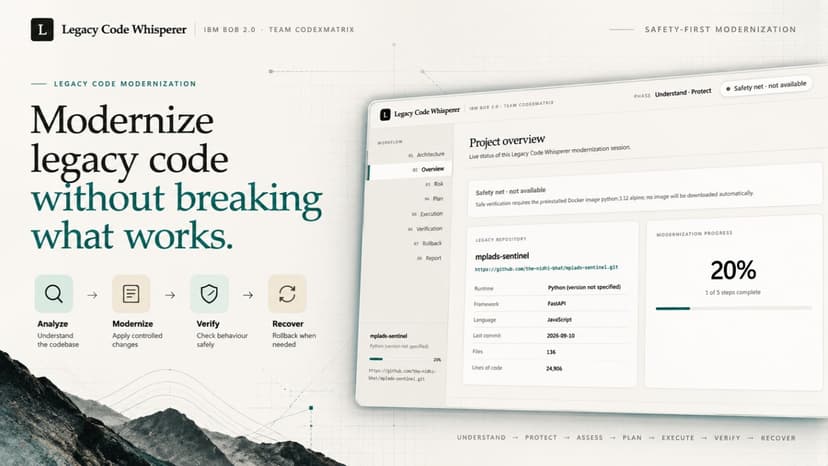
Legacy software is difficult to modernize safely because developers must understand unfamiliar code, identify risks, make changes, and prove that existing behavior has not been broken. A failed modernization can introduce regressions that are difficult to detect or recover from. Legacy Code Whisperer is a safety-first modernization workflow designed to make legacy code changes more controlled, verifiable, and recoverable. Instead of treating modernization as simply “change the old code,” the project guides the process through a structured lifecycle: Understand → Protect → Assess → Plan → Execute → Verify → Rollback → Recover → Report. Users provide a public GitHub repository URL. The application analyzes the repository and helps establish a baseline before changes are made. Modernization actions are constrained by an allowlisted execution model, while protected files and potentially sensitive data are guarded against unsafe modification. After a modernization step, verification checks whether the resulting project still satisfies its expected behavior. The workflow also treats failure recovery as a first-class part of modernization. A canonical checkpoint system records the state needed for safe recovery, while rollback can restore the repository when verification detects a regression. Recovery is then verified rather than merely assumed to have succeeded. The project was demonstrated against Get24, a 2013 Node.js/Express multiplayer browser application. The baseline validation achieved 18/18 passing checks. A controlled regression reduced validation to 16/18, after which a revert-based rollback was performed and recovery validation returned the project to 18/18. The target users are developers, engineering teams, and maintainers working with legacy or unfamiliar repositories who need more confidence when making modernization changes. What makes Legacy Code Whisperer different is that it connects modernization with verification and recovery in one workflow. Rather than assuming every automated change is successful, it explicitly plans for failure, validates outcomes, protects sensitive or important files, and provides evidence for what happened at each stage. The result is a practical modernization workflow focused not only on making changes, but on proving, recovering, and reporting them safely.
27 Sep 2026
