🤓 Latest Submissions
Z-Gate
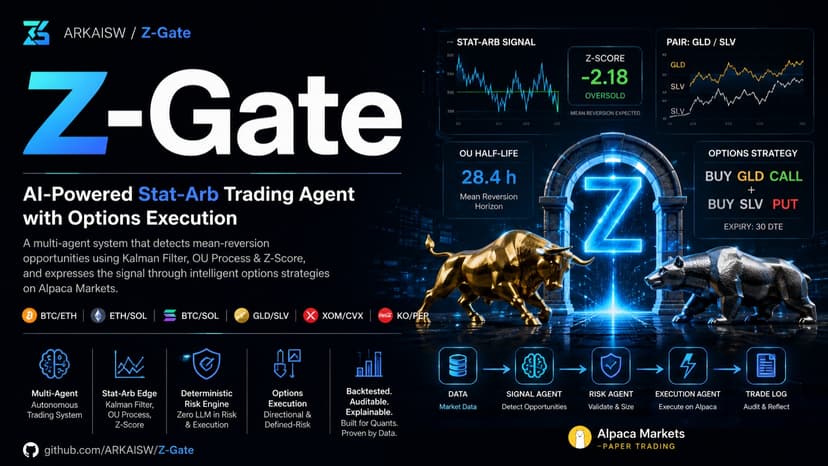
Z-Gate is an institutional-grade, hybrid multi-agent statistical arbitrage trading system engineered for Alpaca Paper Trading. It runs two concurrent market-neutral strategies across 12 cointegrated pairs: directional equity options during market hours and 24/7 cryptocurrency spot. 1. Mathematical Alpha & Dynamic Hedging Traditional pairs trading suffers from static OLS lookahead bias and microstructure noise. Z-Gate implements a recursive State-Space Kalman Filter to estimate continuous time-varying hedge ratios (beta). Spreads are modeled via an Ornstein-Uhlenbeck (OU) mean-reverting stochastic process (dS_t = kappa*(mu - S_t)dt + sigma*dW_t). Trades enter only on genuine statistical dislocations (|Z| >= 1.50-1.75 sigma) with verified Engle-Granger cointegration (p <= 0.05). 2. Dynamic Options Half-Life Expiration Snapping A core innovation of Module A is linking target option contract expiration (DTE) directly to the calibrated OU mean-reversion half-life (tau = ln(2)/kappa). Contracts are snapped to DTE = clamp(tau * 2.5, 7, 30), ensuring directional ATM calls/puts have sufficient runway for spread convergence without suffering from terminal theta decay. 3. Deterministic Safety Boundary & Zero-LLM Execution While LLM agents (Featherless / Groq) provide advisory sentiment nudges and nightly trade reviews, the Risk Agent and Execution Agent are 100% deterministic Python. A 9-rule gate enforces fractional Kelly sizing (1.5% max risk at stop-loss), cointegration thresholds, and circuit breakers with zero LLM hallucination risk. 4. Verified Performance & Cloud Deployment Historical multi-year backtesting across 4 years of daily equity bars and 7 months of hourly crypto bars yielded +80.72% net return, a 3.52 profit factor, 2.06:1 win/loss ratio, and <6.0% max drawdown with 107/107 passing unit tests. Z-Gate is fully containerized and live 24/7 on cloud infrastructure with real-time web telemetry.
4 Sep 2026

RegimeWatch
RegimeWatch detects cointegration breakdown in equity pairs before it happens — using live web signals instead of lagging price data. Most pairs trading systems raise the alarm after the Z-score explodes. RegimeWatch catches the degradation earlier by scraping daily regulatory news volume per company via Bright Data's SERP API, constructing a Regulatory Attention Index (RAI) for each asset, and testing whether asymmetric regulatory attention between pair legs Granger-causes increases in OU half-life — the statistical signature of a weakening cointegration relationship. The result is a structured Pair Health Object per pair, updated dynamically, carrying a risk flag (NORMAL / WATCH / ELEVATED / SUSPEND) that a live market-neutral strategy can consume directly. Built on rolling Johansen estimation, OLS hedge ratios, and concurrent Bright Data SERP queries across 10 sector pairs spanning financials, energy, pharma, and payments.
31 May 2026
AlphaAudit
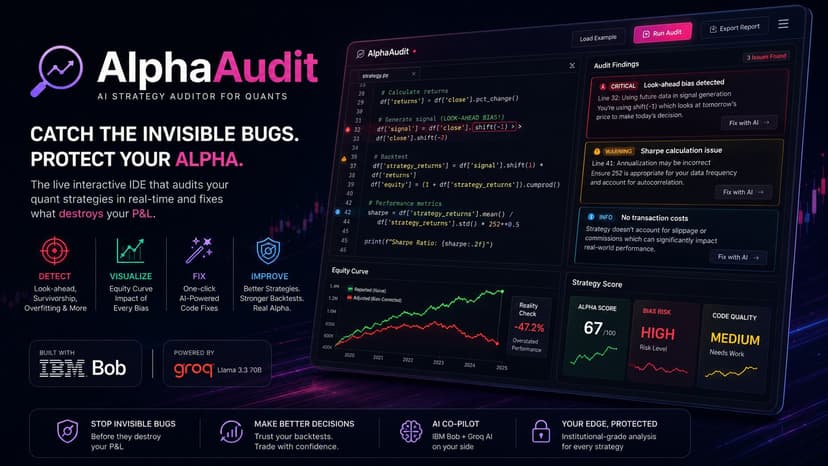
AlphaAudit is a live interactive strategy IDE built for quantitative traders and researchers who are tired of discovering their backtest was a lie. Quant strategies are uniquely dangerous code. They don't throw errors when they're wrong — they just lose money. Look-ahead bias, survivorship bias, overfitting, incorrect Sharpe calculations — these bugs are invisible to standard code review but catastrophic in live trading. Senior quants catch them. Everyone else doesn't. AlphaAudit changes that. Paste your Python backtesting strategy into the editor, hit Run Audit, and within seconds IBM Bob — acting as a senior quant reviewer — identifies every statistical and logical flaw in your code, explains why each one is dangerous in plain English, and suggests a one-click fix. The equity curve visualizer makes the impact tangible: two diverging lines showing your reported backtest performance versus the adjusted reality after bias correction. The gap between those lines is the cost of your mistakes. Built during the IBM Bob Hackathon in May 2026, AlphaAudit demonstrates what happens when AI understands both code and domain. Bob doesn't just read syntax — it understands that a negative shift means look-ahead bias, that a static ticker list means survivorship bias, that seven optimized parameters with no out-of-sample test means overfitting. This is the tool every quant researcher wishes existed during code review. Now it does.
17 May 2026

Autopsy
AUTOPSY is a real-time market stress intelligence system designed to answer a critical financial question: "Which historical crisis does the current market structure most resemble, and what happened next?" Instead of relying on standard price prediction models, AUTOPSY acts as a structural stress detector. It actively fetches live macroeconomic and financial data to compute 40 specialized market indicators across five core dimensions: Liquidity, Volatility, Correlation, Credit, and Positioning. These indicators are mathematically normalized into a high-dimensional "structural fingerprint." AUTOPSY then compares the live market fingerprint against pre-crisis signatures from 10 major historical dislocations—ranging from the 1998 LTCM collapse to the 2008 Global Financial Crisis and the 2023 SVB Banking Crisis. By utilizing cosine similarity and 2D embeddings, the system identifies precisely where the current market sits relative to historical danger zones. Finally, an integrated Large Language Model acts as a quantitative risk officer. It analyzes the raw mathematical similarities, pinpoints exact structural divergences, and automatically generates an institutional-grade risk briefing, empowering analysts to detect systemic vulnerability long before price-level panic makes the danger obvious.
19 May 2026

Marketmind
MarketMind is a cutting-edge multi-agent financial simulation built for the AMD Developer Hackathon. By replacing traditional rule-based models with autonomous LLM agents, MarketMind creates a living market where prices emerge from decentralized intelligence. Operating inside a high-performance Continuous Double Auction engine, specialized agents—including Momentum, Fundamental, and Market Makers—compete in real-time. Optimized for AMD MI300X accelerators using batched vLLM inference, the system maintains a high-frequency simulation loop while providing a premium, real-time dashboard. MarketMind bridges the gap between AI and finance, exploring how decentralized LLM reasoning leads to emergent market efficiency and complex, self-organizing liquidity dynamics within competitive, modern AI-driven economies.
10 May 2026


