🤝 Top Collaborators




🤓 Latest Submissions
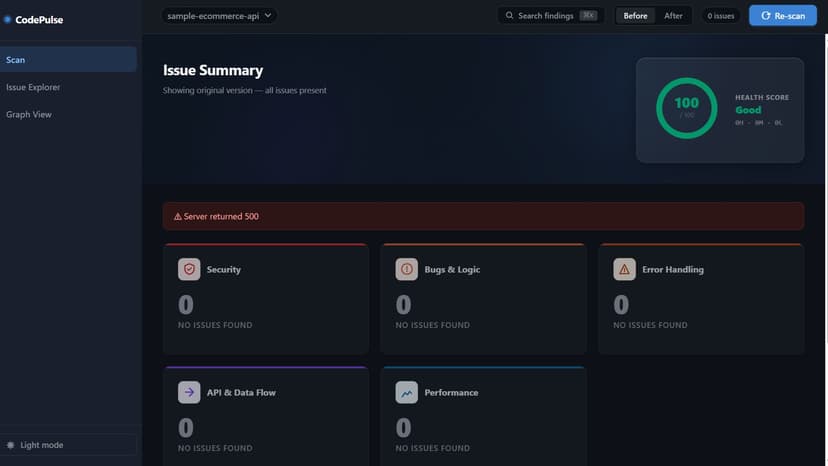
CodePulse — AI Application Issue Explorer
Developers often know something is wrong in their codebase, but understanding the root cause, the execution path, and which components are affected requires slow, manual investigation. Existing tools make this worse by giving developers a flat list of warnings with no context — no explanation of why an issue matters, and no visibility into what it actually touches downstream. CodePulse solves this by acting as a unified issue-understanding layer rather than just another scanner. It follows one continuous pipeline: Scan → Detect → Understand → Visualize → Fix → Re-scan. The tool scans a JavaScript/TypeScript repository using a transparent, rule-based analyzer (six detection rules spanning Bugs & Logic, Error Handling, Security, API & Data Flow, and Performance). For every finding, CodePulse generates a grounded explanation broken into WHERE, EVIDENCE, HOW, WHY, IMPACT, and FIX — explicitly distinguishing confirmed detections from inferred risk, so developers never mistake static analysis for proof of runtime behavior. What makes CodePulse different is its Application Graph View: an interactive pipeline (User Request → API Route → Middleware → Controller → Service → Database) that highlights exactly which components a selected issue affects, turning an abstract warning into a visible, traceable path through the real system. A Before/After re-scan mode lets developers apply fixes and immediately see findings drop, the affected graph paths shrink, and a severity-weighted Health Score improve — closing the loop from detection to verified resolution. Target users are developers, tech leads, and code reviewers who need to triage issues quickly without deep manual investigation — especially useful during onboarding to an unfamiliar codebase, pre-release review, or routine maintenance. Beyond the core MVP, CodePulse supports multi-project scanning (three distinct sample codebases: e-commerce, blog, and auth services), a Command Palette (Ctrl/Cmd+K) for instant fuzzy-search navigation to any finding, and multiple visualization modes (pipeline, pie chart, bar chart, treemap, and a before/after comparison chart) for exploring findings from different angles. CodePulse is creative in treating issue detection as a narrative rather than a checklist — every finding carries a "story" (where it lives, how it happens, why it matters, what it touches, and how to fix it) grounded entirely in real code evidence, with AI never allowed to invent facts beyond what the analyzer actually detected.
27 Sep 2026
