
🤓 Latest Submissions
Project Meridian- Release Convergence Intelligence
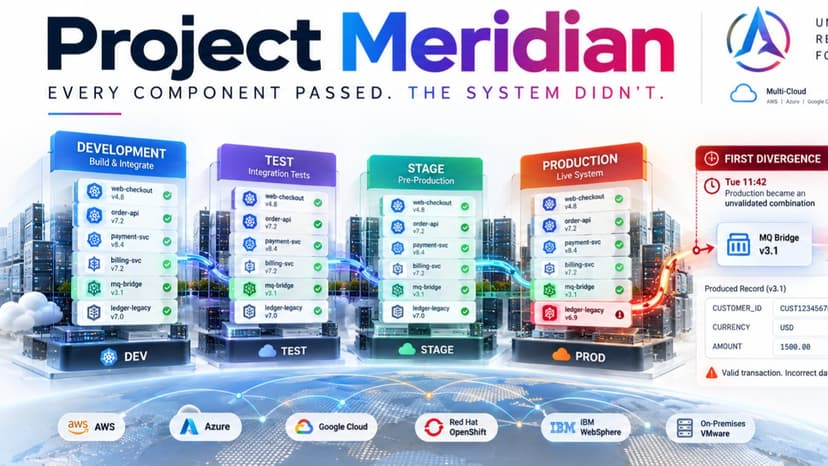
Enterprise software is rarely released as one unit. Different teams deploy different services on different schedules, so production can end up running a combination of versions that nobody tested together. Health checks stay green, pipelines pass, and messages are accepted while business data is silently changed. Meridian is a release-convergence tool built around that problem. Its demo models an order-to-ledger flow with eight components owned by eight teams, spread across Kubernetes, Kafka, IBM MQ, WebSphere Liberty and Db2. The components are released through seven independent pipelines. The example starts with release R-26.9. In Stage, mq-bridge 3.1 runs with legacy-ledger 7.0 and the combination is verified. In Production, an Argo CD auto-sync promotes mq-bridge 3.1 at 11:42 UTC while legacy-ledger remains on 6.9 until the scheduled CR-4471 change window. For the next 38 hours, the infrastructure appears healthy: the HTTP request succeeds, MQ acknowledges the message and Db2 commits the row. The business result is wrong. A 12-character customer ID, CUST12345678, is truncated to CUST123456. An amount of $149.50 becomes $780,000,149.00, and a EUR transaction is interpreted as USD. Meridian works in five steps. It reconstructs the versions actually running in DEV, TEST, STAGE and PROD using read-only adapters. It separates observed coexistence, exercised integration and verified behavior. It narrows 149 environment differences to 63 differences on the business flow, two dependency-boundary changes and one unvalidated version pair. It then reconstructs the undocumented interface contract from the deployed source, release documents and interface spreadsheet. Finally, it runs the exact producer and consumer commits in an isolated sandbox using Stage’s fixtures. The probe fails three of nine semantic assertions, despite the infrastructure being green. Meridian reports this as the First Demonstrated Divergence and attaches the supporting evidence. Before anyone changes Production, a promotion can be rehearsed. Pulling the ledger upgrade forward restores the verified combination; rolling the bridge back creates a different untested boundary. A compatibility strategy can then be drafted and checked with a regression probe. The target users are release engineers, platform teams and SREs responsible for distributed enterprise systems. Meridian is different because it does not treat a green deployment as proof that the complete system is safe. It connects environment reality, validation history, hidden contracts and executable evidence in one workflow. All data in the prototype is synthetic, and Meridian never modifies a target environment.
27 Sep 2026
FourCast — The Caption Factory
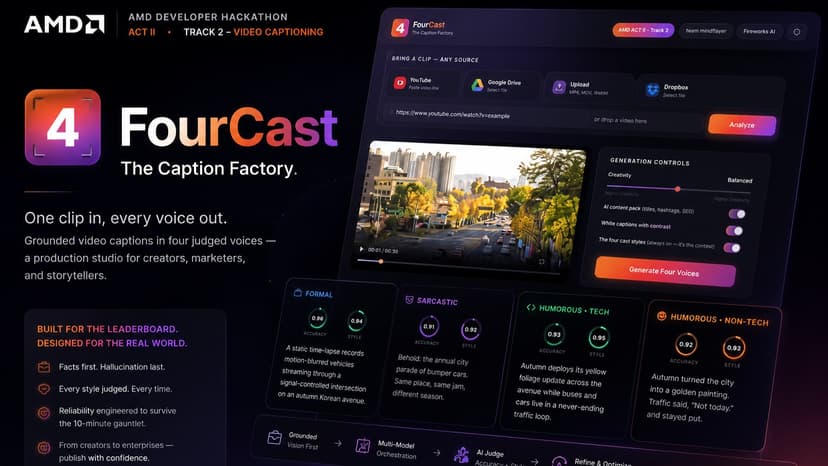
Most caption pipelines are a prompt wrapper. FourCast is a caption factory with quality control. Frames are sampled straight off the video URL (ffmpeg remote seek — no full download), and Kimi K2.6 writes a strict Scene Report: subjects, actions, on-screen text, distinctive details. Facts only — if it isn't visiFireworksble, it doesn't exist. GLM 5.2 then writes three candidates per style against explicit style contracts; humorous_non_tech must additionally survive a regex jargon firewall — one tech word and the candidate dies. A separate model family (gpt-oss-120b) judges every candidate on the exact two axes the official leaderboard uses — caption accuracy and style match — picks the winner, and sends weak ones back for a critique-guided rewrite. The container is engineered for the evaluation harness: results are atomically rewritten after every clip (a timeout still leaves valid partial output), every style always gets a grounded caption (never a missing key), output JSON is ASCII-escaped, and one bad clip can't crash the batch. Three example clips process in ~55 seconds; a 12-clip hidden set fits comfortably inside the 10-minute budget. On the sample clips, our internal judge scores land at 0.85–1.00 on both axes — e.g. "Kitten boots from a stationary state, then begins a slow forward deploy toward the camera, tail raised high as a status indicator." Built on Fireworks AI, with serverless models hosted on AMD hardware.
13 Jul 2026
NebulaX — Self-Correcting Agent Swarm Weave
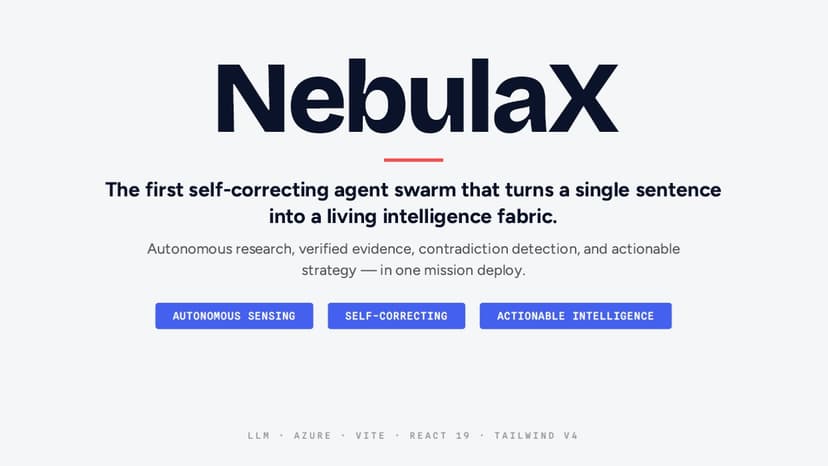
NebulaX is a living team-intelligence fabric that turns a single sentence into verified, actionable insight. State a goal in plain language, and an autonomous agent swarm senses the open web, extracts the real data behind each finding, tags it by category, and cross-checks it across sources — mapping everything into a category-clustered Flow you can read at a glance. When sources disagree, NebulaX surfaces the conflict and lets you reconcile it in one click. Every finding carries its real metrics, a Verified / Needs-review badge, and its sources — no opaque confidence scores. From there, the swarm turns analysis into a prototype spec and a ranked build plan routed into the tools your team already uses: GitHub, Azure, Jira, Figma, Slack. Built on a provider-agnostic AI layer with a metered Green Credits wallet, NebulaX makes research traceable, self-healing, and ready to act on.
19 Jun 2026


