🤝 Top Collaborators


🤓 Latest Submissions

CodeTruth
Software documentation describes what an application is supposed to do, but the actual implementation can gradually become different from those claims. README files, API documentation, feature descriptions, security statements, configuration, tests, and source code can become inconsistent as software evolves. Manually comparing all these sources is time-consuming and makes it easy for developers, reviewers, and users to miss important contradictions. CodeTruth is an autonomous AI software verification agent designed to investigate this gap between software claims and software reality. Instead of acting as a simple code scanner, CodeTruth investigates a repository as evidence. A user provides a software repository and an objective such as “verify whether this project actually delivers what its documentation promises.” CodeTruth creates an investigation plan, analyzes documentation to extract concrete claims, inspects relevant source code, tests, configuration, APIs, and security-related implementation, and then cross-validates the collected evidence. Each claim receives an evidence-based status: VERIFIED when implementation supports the claim, PARTIALLY VERIFIED when only part of the claim is supported, CONTRADICTED when direct implementation evidence conflicts with the documentation, UNVERIFIED when there is insufficient evidence, or NOT APPLICABLE when the claim does not apply to the project. A key principle of CodeTruth is that lack of evidence is not automatically treated as a contradiction. A contradiction requires positive evidence showing that the implementation behaves differently from the documented claim. Findings are linked to relevant files, code locations, documentation, tests, and configuration so users can understand why a conclusion was reached. CodeTruth is intended for developers, engineering teams, software reviewers, security teams, maintainers, and organizations that need greater confidence that software behaves as documented. Its autonomous investigation approach reduces the need for manually searching through large repositories and provides a structured Project Reality Map showing verified claims, contradictions, partial verification, and unresolved claims. CodeTruth can also support a Detect → Fix → Re-verify workflow, allowing developers to address identified contradictions and run the investigation again to determine whether the documentation and implementation are now aligned. The core innovation is shifting AI code analysis from simply asking “Does this code have bugs?” to asking “Does this software actually do what it claims?” CodeTruth combines documentation understanding, code analysis, testing evidence, configuration analysis, and cross-validation into one autonomous software trust investigation.
27 Sep 2026
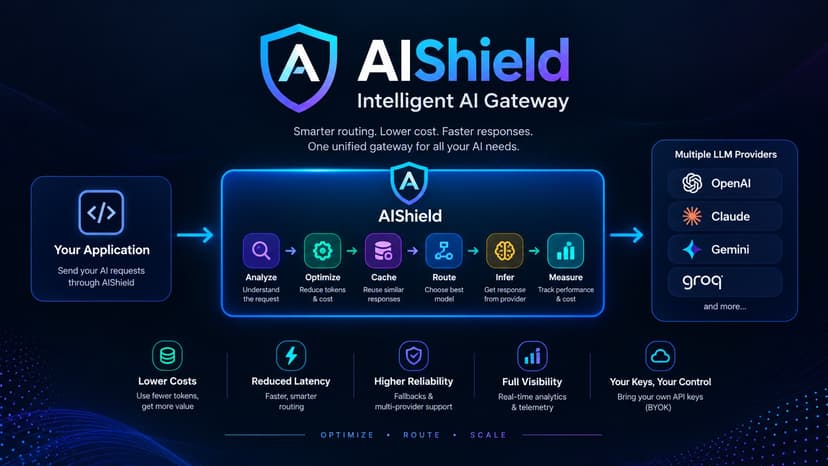
AI Shield – Intelligent AI Gateway
AIShield is an intelligent AI infrastructure gateway designed to make LLM applications more efficient, cost-effective, and responsive. It works as a smart layer between applications and multiple AI providers, including OpenAI, Anthropic, Google Gemini, and Groq. For every request, AIShield analyzes the prompt complexity and required capabilities, optimizes unnecessary tokens and context, checks for semantically similar cached responses, and dynamically selects an appropriate model based on cost, latency, quality, or balanced preferences. If a selected provider fails or becomes unavailable, AIShield can use a fallback provider. The platform also provides real-time telemetry and analytics for token usage, estimated cost, latency, routing decisions, cache performance, and provider usage. Its multi-provider BYOK architecture allows developers to connect their own API keys and test different providers through a unified gateway. AIShield demonstrates how intelligent routing, prompt optimization, semantic caching, and infrastructure-level monitoring can help reduce unnecessary AI resource consumption while maintaining reliable AI application performance.
16 Sep 2026

