

Badal kumar sahu@badalsahu200ns
4
Events attended
2
Submissions made
India
1 year of experience
About me
Results-driven business leader with 5+ years of experience across real estate,BFSI, insurance, and e-commerce, specializing in team management, client engagement, and revenue growth. Adept at leveraging CRM insights, Salesforce, and Power BI to optimize sales pipelines, strengthen client relationships, and drive portfolio expansion. Certified in Six Sigma, strategy consulting, and data analytics, with proven ability to align business strategies with customer needs and regulatory compliance. Results-driven Business,Analytics & Product professional with 5+ years of experience across PropTech,real estate, travel-tech, BFSI, insurance, telecom, e-commerce and enterprise business environments. Specializing in business analysis,team management, client engagement, revenue growth,KPI analytics, stakeholder management and process improvement. Adept at leveraging CRM insights, Salesforce,Advanced Excel, SQL, Power BI and Tableau to optimize sales pipelines, improve forecasting, strengthen client relationships and drive portfolio expansion. Experienced in working with business and product teams to understand customer needs, identify opportunities, prioritize initiatives and support data-driven decision-making. Hands-on experience in Generative AI,Gemini, RAG,AI agents and Google Cloud, with a growing focus on AI-powered products and analytics solutions. Certified in data analytics, Six Sigma and strategy/AI-related disciplines, and currently pursuing an MCA.
🤓 Latest Submissions

RepoPilot 2.0
Developers joining an unfamiliar codebase often spend hours or even days figuring out where the application starts, how its components connect, which files matter for a requested change, and what could be affected by modifying them. Documentation may be incomplete, outdated, or scattered across the repository. This creates unnecessary onboarding time and increases the risk of making changes in the wrong place. RepoPilot 2.0 is a codebase intelligence and developer navigation platform designed to turn an unfamiliar GitHub repository into an understandable working model. The target users are software developers, students, engineering teams, contributors, and developers joining existing projects. A user connects a GitHub repository and RepoPilot analyzes its structure to create a Codebase X-Ray: an organized view of important directories, files, technologies, application entry points, and relationships within the project. Instead of manually browsing hundreds of files, the developer gets a structured starting point for understanding the system. Users can then ask questions about the repository and receive evidence-backed answers grounded in the actual codebase. For a development task, RepoPilot helps identify the likely files and areas that need attention and converts the request into an actionable implementation plan. This creates a workflow from: Connect repository → Understand the codebase → Find where to work → Plan the change → Verify the result. The creative aspect of RepoPilot is that it focuses on developer navigation rather than simply acting as a generic coding chatbot. Its goal is to build a practical mental model of the repository before suggesting where work should happen. This makes the system useful for real-world onboarding, maintenance, contribution, and unfamiliar-project exploration. RepoPilot 2.0 can reduce repetitive repository exploration, improve developer orientation, and help users approach changes with better context. The platform is designed to evolve toward deeper code search, impact analysis, richer evidence-backed Q&A, and guided task execution. The core value is simple: instead of asking developers to understand an entire codebase before contributing, RepoPilot helps them understand the parts that matter for the work they need to do.
27 Sep 2026
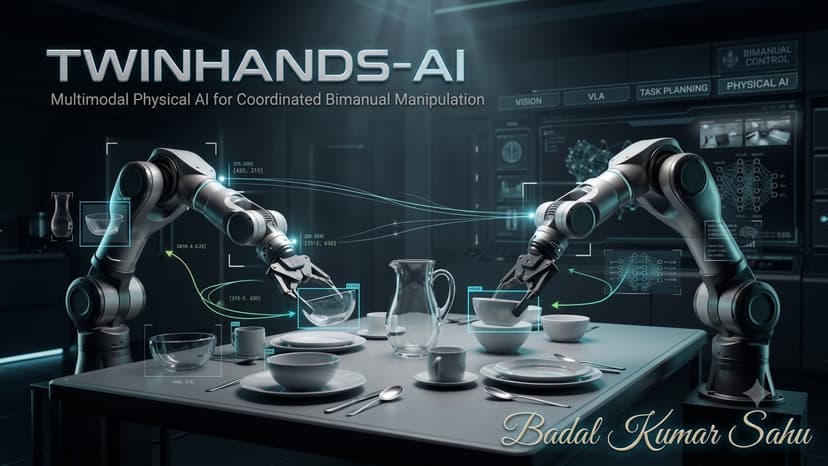
TwinHands-AI: Bimanual Physical AI
TwinHands-AI is a multimodal Physical AI system designed to transform natural-language instructions into coordinated bimanual robotic actions. The project uses two SO-101 robotic arms in a MuJoCo simulation environment and combines multimodal AI reasoning, computer vision, Vision-Language-Action (VLA) concepts, task planning, motion control, and verification into a single workflow. A user can provide a high-level instruction such as “prepare the dinner table for four people.” Instead of manually controlling the robot, TwinHands-AI interprets the instruction, analyzes the simulated scene, identifies the required objects, generates a task sequence, assigns actions between the left and right arms, executes the manipulation sequence, and verifies the resulting environment. The primary demonstration focuses on autonomous dinner-table preparation for different group sizes. The robots can reason about objects such as plates, bowls, cups, spoons, glasses, and a water jug and coordinate their movements to arrange the table. The system is designed around a Vision-Language-Action pipeline: Natural-language command → Scene understanding → Task planning → Bimanual coordination → Robotic execution → Verification and recovery. TwinHands-AI also explores optimized AI inference using Intel OpenVINO, with an architecture intended to provide a pathway from simulation toward real-world robotic deployment. The broader goal is to demonstrate how modern AI infrastructure can connect generative and multimodal AI with physical-world automation, enabling robots to understand human intent and perform multi-step manipulation tasks autonomously.
16 Sep 2026


