WILLIAM MCCORMICK@bill_mccormick417
1
Events attended
1
Submissions made
United States
30+ years of experience
About me
I built a paper-trading bot on Alpaca that hands a 15-minute market snapshot — bars, indicators, headlines, positions — to Claude and asks for a decision, then runs that decision through a hard risk layer the model can't override: symbol whitelist, position caps, daily-loss halt, broker-side stop on every buy. Twelve liquid names, long-only, flattened before the close, free IEX/SIP data. The interesting part isn't the model, it's the accounting around it. Every order, refusal and exit is journaled with the reason; a fixed mechanical rule runs in shadow on the same snapshot so there's a baseline to judge whether the LLM adds anything over the indicators it reads; and the roadmap is gated on evidence — beta decomposition of the live track record and a decision-stability test — before anything gets called an edge. Expectation is noise minus spread; the project is about finding out honestly.
🤝 Top Collaborators
🤓 Latest Submissions
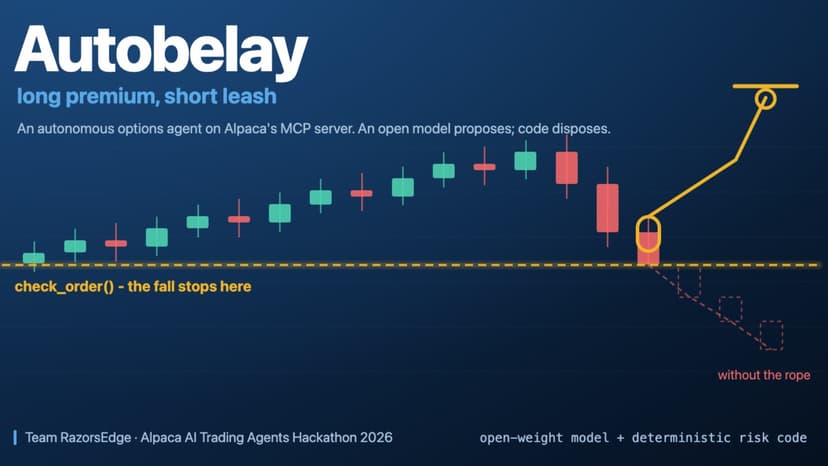
Autobelay - Long Premium, Short Leash
Judged account, Aug 31 - Sep 3: $100,000 to $105,096, +5.1% over 15 round trips, nothing held past expiry. The Kimi-K3 challenger ran the same code and the same gates on a different model and finished -7.0%, halted by the 2% cutoff. That gap is the result we defend. Autobelay is an autonomous options-trading agent - the brake is deterministic code. Thesis: buy defined-risk, short-dated options premium on the five most liquid names when an open-source model sees a concrete reason; code sizes every trade, stops it, and closes it before expiry. The model never touches an order. Every 10 minutes: (1) deterministic exits run first: stop-loss, take-profit, expiry-day close. (2) A snapshot is built through Alpaca's MCP server: account, positions, and per underlying a 12-contract menu (ATM and ~0.40-delta per side, three expiries) with IV and Greeks. (3) The model may call read-only research tools, then must answer with JSON proposals. Featherless models, one per account: Qwen3.8-Flash-Next judged, Kimi-K3/K2.6 challenging. (4) One risk gate that never negotiates: whitelist, notional cap, position count, expiration window, entry cutoff, daily-loss halt. Only our own code calls Alpaca's order tools. The accounting is the point. Every decision, order, rejection and exit is logged with the model and config behind it. The model's prose is audited against its own inputs: quoted figures against the prior it was shown, exit reasons against the account. The priors it is handed are Brier-scored nightly, so the inputs are graded too. The end-of-day critique comes from a model that did not trade that day: no account grades its own homework. The trading is autonomous; the risk envelope is human: runtime knobs expire at the close, hard caps need a pull request, and nothing at runtime can widen what the bot may lose. It self-hosts; halting an account or swapping its model is a phone control. MIT licensed and original to the event; pre-kickoff infrastructure disclosed in the README.
4 Sep 2026

