
🤓 Latest Submissions
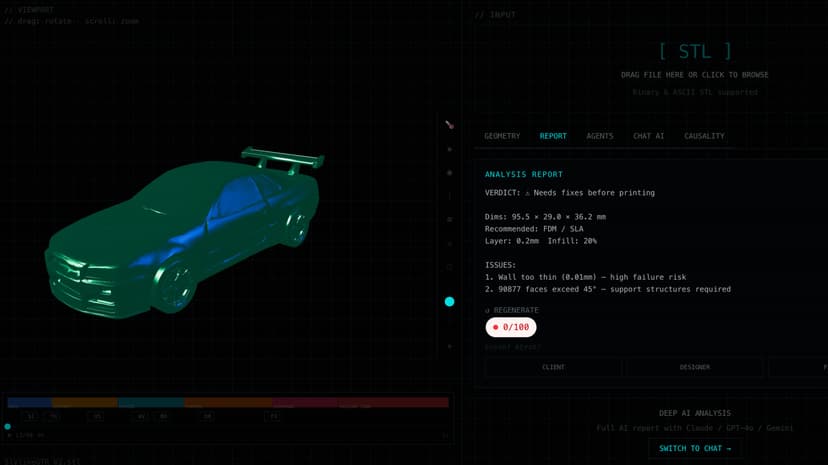
3DP Agent — Multi-Agent STL Analysis for AMD ROCm
3DP Agent is a browser-based tool that analyzes 3D print files before they ever reach a printer. Designers often ship geometry that renders beautifully but fails physically — walls too thin to survive FDM printing, or overhangs so severe that supports become mandatory. These issues are invisible on screen and only discovered after wasting hours of print time and filament. The core of the system is a five-agent pipeline: a Geometry Analyst measures wall thickness and overhang distribution, a Printability Scorer weighs those metrics into a single score, a Failure Predictor flags specific failure modes, and an Optimization Advisor suggests fixes. An orchestrator combines all four into one weighted consensus verdict, with a full voting record available for inspection. Inference is served via vLLM running Qwen3-8B on an AMD GPU instance over ROCm, with a serverless proxy connecting the frontend to it — verified running end-to-end during development. A second provider (Fireworks AI) is available as a swappable fallback, since Track 3 permits any inference provider and shared hackathon GPU availability varied during testing. The frontend and agent scoring run entirely client-side on Vercel, so most analysis completes in milliseconds with no network round-trip. The project is fully open source.
13 Jul 2026
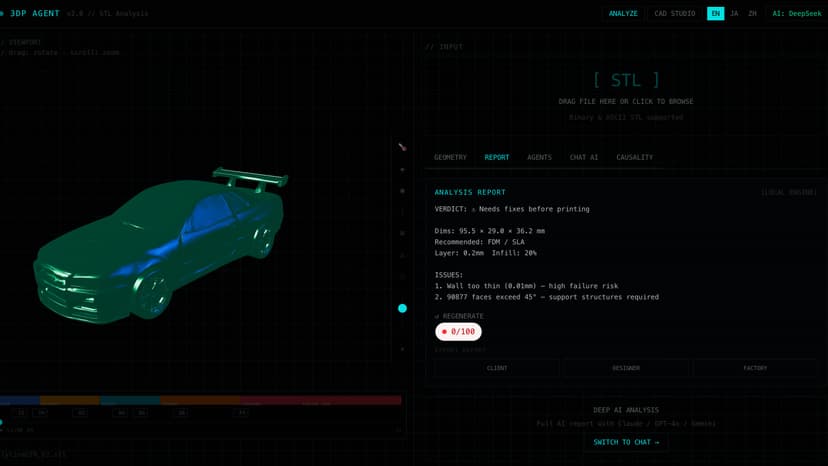
3DP Agent
3DP Agent reimagines pre-print analysis as a multi-agent debate. Most tools give you one answer. 3DP Agent gives you five perspectives in conflict — and then a consensus. A Geometry Analyst maps structural vulnerabilities across the mesh. A Failure Predictor identifies where prints will fail and why — overhang collapse, thermal warping, layer delamination. An Optimization Advisor runs counterfactuals: rotate this, change that material, adjust this parameter — and shows you the delta. A Printability Scorer synthesizes all inputs into a weighted risk assessment. An Orchestrator manages the debate, surfaces disagreements between agents, and produces a final report that shows its own reasoning — not just its conclusion. The visualization layer renders this in real time: layer-by-layer print path preview, thermal field overlays, failure emergence simulation, causality chains that trace risk back to geometry. The interface is built to feel like a scientific instrument — cinematic, restrained, precise. What makes multi-agent architecture matter here is that manufacturing decisions are high-stakes. A wrong call costs material, time, and money. Showing the reasoning process — including where agents disagree — builds a kind of trust that a single answer never can. Built solo — TypeScript frontend, Python agents, Three.js visualization, Anthropic SDK, Band multi-agent framework.
19 Jun 2026


