
🤝 Top Collaborators



🤓 Latest Submissions
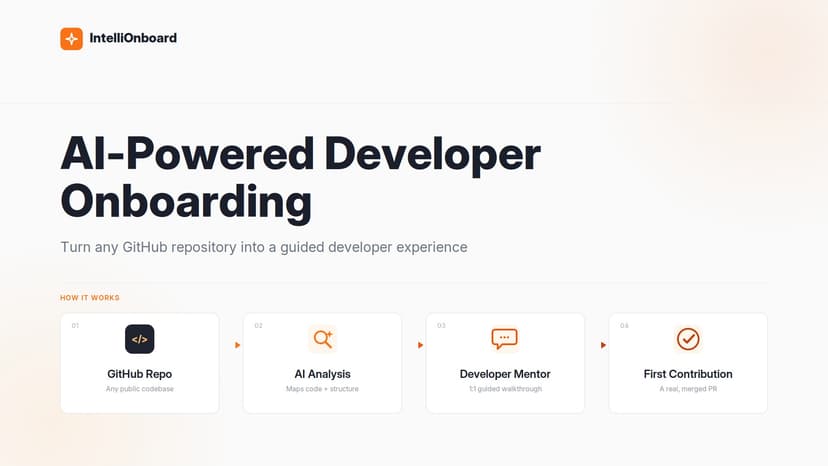
IntelliOnboard – AI-Powered Developer Onboarding
Problem Understanding an unfamiliar software repository is one of the biggest challenges for new developers, interns, students, and open-source contributors. Before making even a small contribution, developers often need to manually explore thousands of files, understand dependencies, read documentation, trace Git history, identify important functions, understand testing practices, and determine where they can safely begin. This makes onboarding slow, fragmented, and highly dependent on experienced developers. Solution IntelliOnboard transforms a GitHub repository into an interactive, AI-assisted developer onboarding environment. A developer provides a GitHub repository URL, and the platform analyzes its structure, source code, documentation, and Git history to create a repository-specific knowledge layer. Instead of providing generic programming advice, IntelliOnboard connects developer guidance to the actual codebase. Developers can understand the repository structure, explore relationships between files and code components, investigate historical changes, identify potential change impacts, discover beginner-friendly contribution opportunities, receive personalized onboarding guidance, ask an AI developer mentor questions, detect documentation drift, investigate bugs, and identify testing gaps. Core Capabilities IntelliOnboard provides 10 AI-powered developer experiences: Repository Brain – builds an understanding of the repository and its code structure. Interactive Architecture / Knowledge Graph – represents relationships between files, classes, functions, and imports. Codebase Time Machine – helps developers explore repository history and previous changes. Change Impact Simulator – identifies potentially affected code areas when a component changes. AI First-Contribution Generator – suggests practical starting points for new contributors. Personalized Adaptive Onboarding – provides onboarding guidance based on developer experience level. AI Developer Mentor – allows developers to ask repository-specific questions. Documentation Drift Detector – identifies potential mismatches between documentation and repository content. AI Bug Investigation Agent – helps investigate bugs using repository evidence and relevant files. AI Test Gap & Test Generation Agent – identifies potential testing gaps and can generate candidate tests for review. Technical Innovation The platform combines repository ingestion, multi-language source-code parsing, Git history analysis, semantic retrieval, vector storage, local LLM-based assistance, caching, and structured analysis into one developer onboarding workflow. The system also uses repository filtering, bounded analysis stages, incremental processing, caching, and error isolation to make analysis practical for large repositories. Validation IntelliOnboard was tested across repositories with significantly different sizes. For example, the Kubernetes repository was successfully analyzed and produced metrics including 6,712 indexed files, 6,413 functions, 946 classes, and 30 commits. The system was also tested with smaller and other large repositories including Requests and TensorFlow. Target Users and Impact IntelliOnboard is designed for new developers, interns, students, open-source contributors, engineering teams, and organizations onboarding developers to existing software projects. By bringing repository exploration, learning, debugging, contribution guidance, documentation analysis, and testing assistance into one workflow, IntelliOnboard aims to turn the experience of joining an unfamiliar codebase from a manual exploration task into a structured, interactive developer journey. Vision IntelliOnboard's goal is simple: turn an unfamiliar GitHub repository into a guided developer experience, reducing the time between joining a project and making a meaningful contribution.
27 Sep 2026
