🤓 Latest Submissions
Cascade
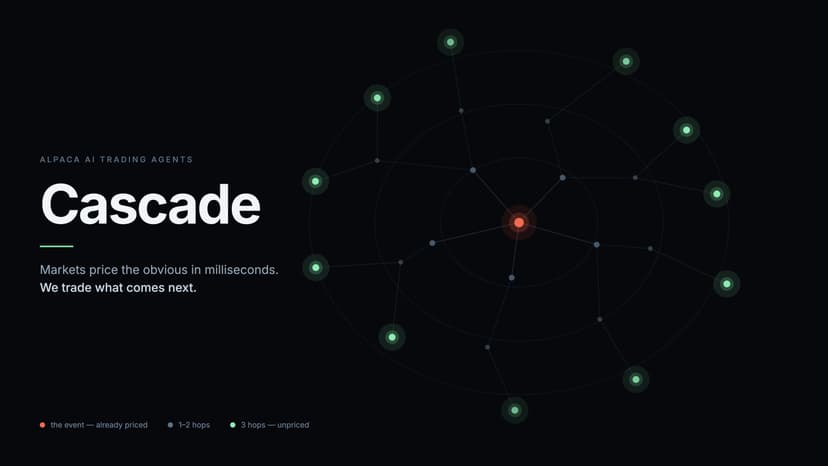
Markets price the obvious in milliseconds. A shock to a big company is in its share price before you can read the headline. But the propagation of that shock through its suppliers, customers and distributors takes hours to days — and traversing that gap is knowledge reasoning, which is the one thing an LLM does better than an existing trading algorithm. Cascade mines customer-concentration disclosures out of SEC filings ahead of time, using each filer's own structured XBRL facts. That produces a directional graph of 78 relationships across 79 companies, each stored with the accession number, the source URL and the filer's verbatim wording. B&G Foods earns 31% of its revenue from Walmart; Scotts Miracle-Gro earns 34% from Home Depot. Nobody inferred those. The companies disclosed them. The graph is built offline; only traversal happens at runtime. The LLM ranks verified edges — it never discovers a relationship live. If a relationship is not in a filing, it does not exist, and Cascade will not trade it. When an event fires, the agent walks two to three hops out and asks which downstream companies are materially exposed but have not moved yet. "Not moved" is a vol-normalised residual z-score, computed after stripping market and sector beta — not a flat percentage. The same statistic triggers the exit. Eight gates run before any order: relationship type, positionability, materiality, dollar-volume liquidity, option spread and open interest, priced-in, shock type, and a portfolio cap. Most candidates are refused, and the interface shows every refusal with its reason. It runs unattended on Railway, scanning every three minutes, executing equities and options through Alpaca's MCP server, and reporting to Telegram.
4 Sep 2026
