
🤓 Latest Submissions
SortSmart Business Advisor
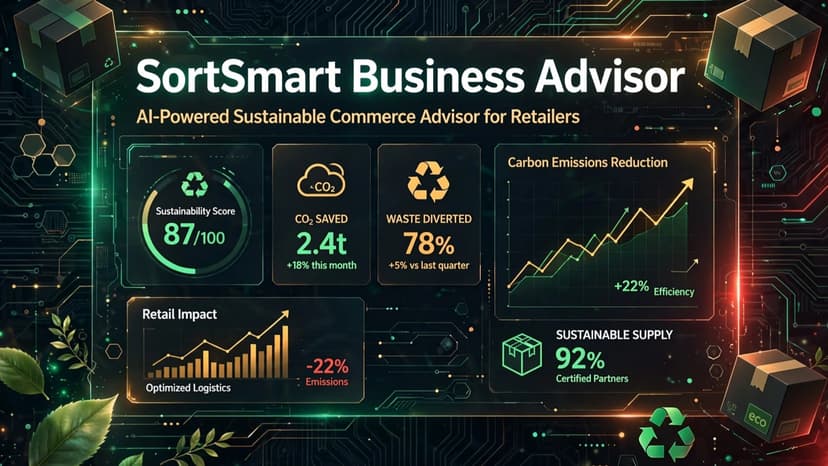
### Inspiration Every day, small and mid-size businesses make packaging and waste decisions with no data: which mailer to buy, whether composting pays off, what their waste actually costs. Sustainability consultants charge thousands for audits most businesses will never buy. Meanwhile, packaging is often a business's most visible environmental footprint — and a controllable cost line. We built SortSmart Business Advisor to put a sustainability analyst on every business owner's phone, for free. ### What it does Ask a plain-English question and get a dollar-quantified answer. The app also produces full business briefs: a 0–100 sustainability score with transparent breakdown, current waste cost estimates, and ranked recommendations with projected annual savings. Every number is traceable to its source — the LLM never invents figures. ### How we built it Three layers: (1) Deterministic rule engine — waste-stream knowledge base, sorting advisor. (2) Business intelligence layer — cost models on US national averages (EPA, tipping-fee surveys), 0–100 sustainability scoring, ROI-ranked recommendations. (3) LLM advisor layer — model-agnostic OpenAI-compatible client; the LLM narrates grounded figures, never calculates. Backend is Python stdlib only; UI is a single HTML file. ### The AMD angle The LLM is the product's core intelligence and is built to run on AMD infrastructure. Configured entirely by env vars — moving to an AMD-hosted model is a config change, zero code. On AMD Developer Cloud, the model serves via vLLM on ROCm-ready Instinct GPUs (same OpenAI-compatible API). A meaningful part of the workload runs on AMD infrastructure, per the requirement. ### Business value Packaging switches save $1,000–$5,000/yr for mid-size shippers. 30M+ US small businesses make packaging decisions daily with zero tooling today.
18 Oct 2026

WebRetriever — Deterministic Web Retrieval Agent
WebRetriever is an autonomous web information retrieval agent built for AMD AI League Match 4: Intelligent Web Information Retrieval. Ask in plain English and get back the specific information you asked for, with the exact source URLs behind it — or an honest refusal when no verifiable answer exists. How it works — five-stage pipeline with a deterministic core: Understand — parses the request into intent (price, contact, hours, spec, definition, how-to, date, fact), entities, and 2–4 search query variants. No ML model required. Search — provider chain with automatic fallback: TinyFish Search for the best quality (JS-aware), and DuckDuckGo HTML as the keyless fallback with no signup needed. Fetch + navigate — fetches top hits, then follows promising in-page links within a fixed budget (8 pages, 2 hops) when the answer looks like it is one click deeper. Extract — structure-aware parsing: JSON-LD (Product, Organization, FAQPage), HTML tables such as spec sheets, intent-specific patterns for prices, phone numbers, emails, hours and dates, plus ranked text spans. Verify — every candidate is checked against its own source text; independent multi-source agreement boosts confidence. If nothing is supported by evidence, the agent refuses instead of guessing. The core pipeline uses no LLM, so results are reproducible and cheap. Citations are mandatory, and the agent runs on the free tier with no paid APIs. MIT licensed and Docker-ready, with 12 unit tests.
1 Dec 2026


