
DEEPAK BHARATHWAJ@deepak_bharathwaj
1
Events attended
1
Submissions made
India
1 year of experience
About me
I see myself as a builder, innovator, and problem solver. I don’t want to limit myself to just learning technology—I want to use it to create something meaningful. My vision is to become someone who can identify real-world problems and turn them into practical, intelligent, and scalable solutions. I’m especially interested in AI, software development, and building products that can actually be deployed and used by people. I want to keep learning, experimenting, and challenging myself to create ideas that are different from what already exists. For me, success is not just about getting a job or earning a degree; it is about building something valuable, becoming technically strong, and eventually creating solutions that can make a real impact. I want to grow from a student who learns technology into a person who uses technology to create the future.
🤝 Top Collaborators




🤓 Latest Submissions
Release guard
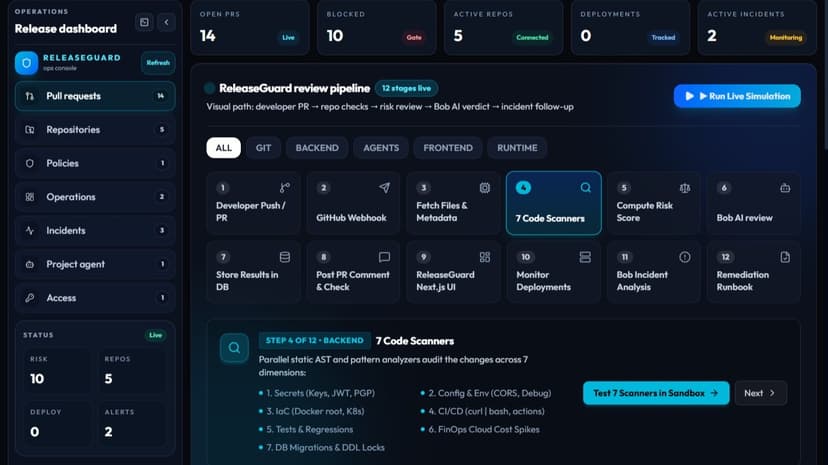
## Long description ReleaseGuard AI is a modern DevSecOps governance platform built to help software teams make safer, faster, and more informed release decisions. It brings together pull request analysis, repository intelligence, security scanning, infrastructure validation, deployment monitoring, and incident response into a single operational workflow. The platform is designed to answer one core question before and during a release: “Is this change safe to ship?” By analyzing the code, infrastructure, tests, and deployment context, ReleaseGuard evaluates the risk of each PR and provides a clear recommendation such as GO, CONDITIONAL, or NO-GO. At the center of the platform is a risk engine that combines findings from multiple focused scanners. These include checks for secrets exposure, insecure configuration, infrastructure as code issues, CI/CD weaknesses, database migration risks, test coverage gaps, and cost impact. The system reviews file changes, flags risky patterns, and correlates them with repository policy thresholds. Instead of leaving teams to interpret fragmented results manually, ReleaseGuard consolidates the evidence into a release score and actionable review summary. The product also incorporates a multi-agent architecture inspired by IBM Bob-style specialist agents. Different agents focus on security, infrastructure, databases, cost optimization, and rollback planning. These agents analyze the same release from different perspectives and provide coordinated guidance. This makes the platform more than a static scanner—it becomes a decision-support system that helps teams understand not just what is wrong, but what the likely business and operational impact is and what should be done next. In addition to pre-deployment review, ReleaseGuard supports runtime operational workflows. It can connect incidents to recent releases and pull requests, identify likely root causes, and provide recovery runbooks for rollback or restoration steps. This makes it valuable during production incidents, where teams must quickly assess which release introduced the issue and what corrective action should be prioritized. The same workflow can also support approval gates, merge enforcement, and policy presets for repository governance. From a technical standpoint, ReleaseGuard combines a Python FastAPI backend with a Next.js frontend, making it adaptable for both local demos and real-world repository environments. It supports GitHub integration, repository authorization, PR browsing, security findings, policy management, and release controls in a unified dashboard. The result is a platform that helps organizations reduce release risk, enforce governance standards, and improve operational resilience across the software delivery lifecycle. This makes ReleaseGuard AI particularly useful for teams operating in high-velocity development environments where security, reliability, and release quality must be balanced against speed. It turns release review from a manual checklist into a continuous, evidence-based decision system that scales with the complexity of modern software delivery.
27 Sep 2026
