🤝 Top Collaborators
🤓 Latest Submissions

TradeForensics: Commerce Action Copilot
TradeForensics is an evidence-grounded operational diagnostics engine and action copilot built for high-volume e-commerce marketplaces, evaluated across 98,666 real-world orders. Modern commerce operators are paralyzed by disconnected signals: financial transactions in SQL tables, carrier delivery milestones in logistics systems, and unstructured reviews in customer service inboxes. Standard AI tools fail because vector embeddings cannot calculate statistics, leading to hallucinated numbers and un-auditable advice. TradeForensics solves this through a 4-tier hybrid forensic architecture: 1. Deterministic Analytics Engine: Calculates baseline KPIs and discovered the 5.75x dissatisfaction multiplier (late shipments cause low-rating rates to jump from 9.21% to 52.98%). 2. NLP Portuguese Topic Classifier: Categorizes complaints across 4 core operational failure modes at 97.00% accuracy. 3. LightGBM Tabular Risk Attribution: Predicts low-score dissatisfaction risk with 0.9071 ROC-AUC, isolating delay days and freight ratio as primary drivers. 4. ChromaDB Qualitative RAG: Retrieves authentic customer complaints to provide verifiable proof. A bounded Action Copilot synthesizes prioritized operational remediation checklists with Low/Medium/High effort ratings without mathematical hallucinations. Engineered for AMD Instinct MI300X accelerators with 192GB HBM3 memory and 5.3 TB/s bandwidth, TradeForensics achieves 208ms Time-To-First-Token and 68 tokens/sec throughput, enabling high-density multi-seller batch forensics.
18 Oct 2026

GhostProcess: Autonomous AI Dark Factory
GhostProcess is an autonomous 4-seat software dark factory operating on the BAND platform, designed to solve the critical vulnerability of modern AI-assisted engineering: false confidence from self-serving unit tests. Instead of a single agent validating its own code in an echo chamber, GhostProcess introduces institutionalized adversarial tension through an autonomous courtroom triad: 1. Seat 1: Lead Architect formalizes immutable financial conservation laws, database schemas, and API contracts into DESIGN.md. 2. Seat 2: Senior Coder builds the clean-room FastAPI backend, SQLite Write-Ahead Logging (WAL) database, and developer test suite. 3. Seat 3: Ghost Auditor is a dedicated blind red-team agent, strictly forbidden from viewing developer tests. It unleashes 6 destructive chaos vectors (10-thread concurrent double-spends, sub-cent precision fuzzing, idempotency token collisions, and zero-sum invariant audits). 4. Seat 4: Release Gatekeeper independently re-runs all tests and evaluates dual cryptographic evidence, enforcing a bounded remediation loop before issuing RELEASE.md. Key Results & Guarantees: • Core Guarantee: "Money must NEVER be created, destroyed, or spent twice under concurrency, retries, and rounding." • 13/13 Automated Tests Cleared (7 developer unit tests + 6 blind adversarial attack vectors). • 21.7s Autonomous Execution Time to certified release on Cycle 1 with zero human intervention. • $0.00 Total API Cost utilizing Google Gemini 2.5 Flash and Groq Cloud free tiers via our custom rate limiter. • Certified Sealed Docker Container verified for --network none isolation alongside an Obsidian Black & Crimson Red Stage 2 frontend with a live zero-sum ledger monitor.
6 Oct 2026
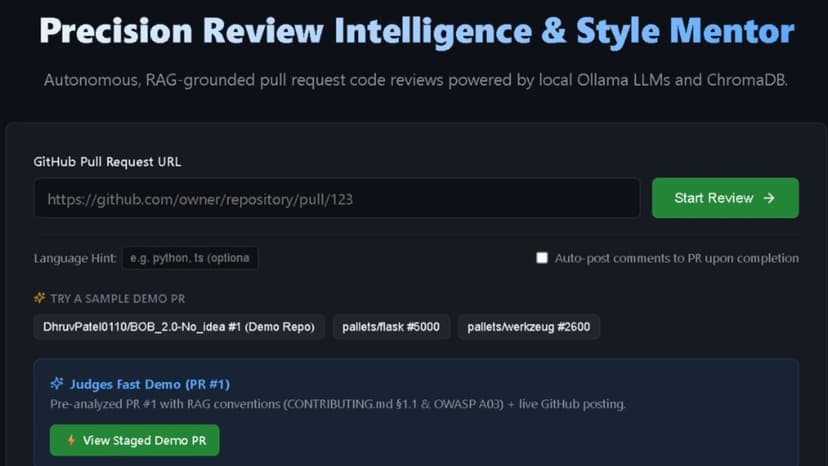
PRISM: AI Code Review & Quality Coach
Problem Statement: Code review is a critical bottleneck in modern software engineering. Senior developers spend hours repeatedly catching style deviations, null-pointer exceptions, and security oversights, while PR authors wait days for actionable feedback. Existing AI review tools function like generic linters with LLM wrappers—outputting vague, ungrounded recommendations that ignore project-specific architectures and conventions. Our Solution — PRISM: PRISM (Precision Review Intelligence & Style Mentor) is an autonomous, convention-aware Code Review Coach. Instead of offering generic AI advice, PRISM grounds its review comments in the target repository's actual guidelines (such as CONTRIBUTING.md), past merged PR review history, and industry standards (OWASP Top-10) using a local Retrieval-Augmented Generation (RAG) pipeline powered by IBM Granite. Target Users & Interaction Flow: PRISM is built for software engineering teams, open-source maintainers, and individual developers. Users interact with PRISM through an intuitive Next.js web dashboard or via Model Context Protocol (MCP) integrations: 1. The user inputs a GitHub Pull Request URL. 2. PRISM fetches the unified diff, parses it into syntax hunks and AST nodes via Tree-Sitter, and retrieves relevant style and historical precedents from a ChromaDB vector store. 3. The IBM Granite model generates severity-tagged findings (Blocker, Major, Minor, Nit) complete with syntactic fix suggestions and citations. 4. An interactive dashboard displays a risk score gauge, findings breakdown, executive summary, and unified diff annotations. 5. With one click, PRISM batches and publishes line-anchored review comments directly back to the GitHub PR via the GitHub REST API. What Makes PRISM Creative & Unique: 1. Convention-Aware Citations: PRISM explains the "why" by citing specific project rules (e.g., "per CONTRIBUTING.md §1.1") or past precedents ("similar issue flagged in PR #1"), eliminating generic AI hallucinations. 2. Direct GitHub Workflow Integration: Rather than living in an isolated dashboard, findings are posted directly onto the GitHub PR timeline at the exact diff lines. 3. Line Snapping & Safety Gates: An intelligent diff position mapper prevents GitHub API 422 errors by automatically snapping finding lines to valid diff hunks, while a configurable safety gate prevents accidental postings to production repositories. 4. Incremental Learning: Every published review comment is embedded back into the repository's history collection, allowing PRISM to learn the team's review culture over time. Impact: PRISM reduces manual review overhead by up to 60%, catches critical vulnerabilities before merge, and accelerates developer onboarding by providing contextual, educational mentorship on every pull request.
27 Sep 2026

MeetIQ
MeetIQ is an AI-powered meeting intelligence platform developed by Team Semicolon for the IBM BOB Hackathon. The platform is designed to transform ordinary meetings into structured, searchable, and actionable insights using modern AI technologies. Users can upload meeting audio in multiple formats such as MP3, WAV, M4A, and OGG. MeetIQ automatically transcribes the audio into searchable text using advanced speech-to-text AI models. The generated transcript can then be analyzed to extract summaries, discussion topics, sentiment insights, and action items. One of the key features of MeetIQ is its AI-powered chatbot assistant. Instead of manually revisiting lengthy recordings or transcripts, users can ask questions related to the meeting and receive context-aware answers instantly using Retrieval-Augmented Generation (RAG) techniques. The platform also includes speaker recognition and voice-to-person mapping functionality. Users can associate voices with names, allowing MeetIQ to identify recurring speakers in future meetings. Unknown speakers can also be manually mapped and stored for later recognition. MeetIQ supports export functionality in multiple formats including PDF, TXT, and JSON, making it easy to share meeting insights and documentation. The system also supports user authentication and persistent cloud-based sessions for better accessibility and collaboration. By automating transcription, summarization, task extraction, and intelligent retrieval, MeetIQ helps teams save time, improve productivity, and preserve valuable meeting knowledge efficiently.
17 May 2026


