
🤓 Latest Submissions
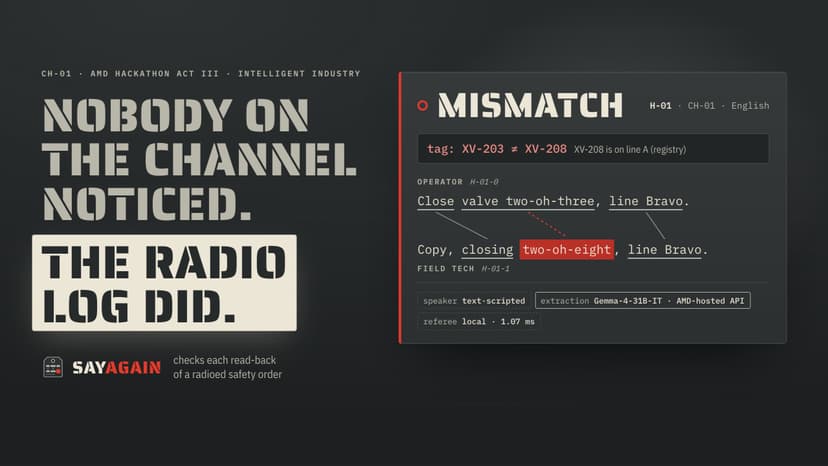
SayAgain — catches wrong radio read-backs
Intelligent Industry. An operator radios "Close valve two-oh-three, line Bravo." The technician answers "Copy, closing two-oh-eight": a valve on another line, and sometimes nobody notices. SayAgain checks every read-back against the order and the plant registry and puts the one wrong word in front of the shift supervisor, who confirms or dismisses the card. A model on the AMD Token Factory (JSON mode) only points at the action, tag and line words. Plain Python decides: VERIFIED, MISMATCH, NO-READBACK or ABSTAIN. A failed call is NOT AUDITED, never a guess; every call leaves a receipt. The ladder rule was pre-registered in git (tag prereg-v1) for the audio row; using it on written rows is a logged deviation. On 89 held-out scripted exchanges, no rung passed a wrong read-back; an LLM judge passed 2. Gemma-4-31B-IT was the only model to meet the rule (2/48 false alarms, after one re-audit of failed gateway calls); a plain regex met it too on clean words. Exploratory synthetic speech (ElevenLabs voices, simulated radio, local Whisper) still passed 0, but false alarms rose to 16/48 (regex, no added noise); no human recording is measured. Who pays: the HSE/K3 manager. Indonesia's SMK3 (PP 50/2012) requires a safety management system, and the timestamped order, read-back, verdict and supervisor decision serve as audit evidence. Priced per radio channel; wedge: a free 30-day listen-only baseline at one mill. Built by one developer with Claude Code; every result re-derives offline (eval.py --rescore). Replay: https://sayagain.edycu.dev/replay/ · MIT.
18 Oct 2026

