
🤓 Latest Submissions
ContractGuard — API Safety for AI Coding Agents
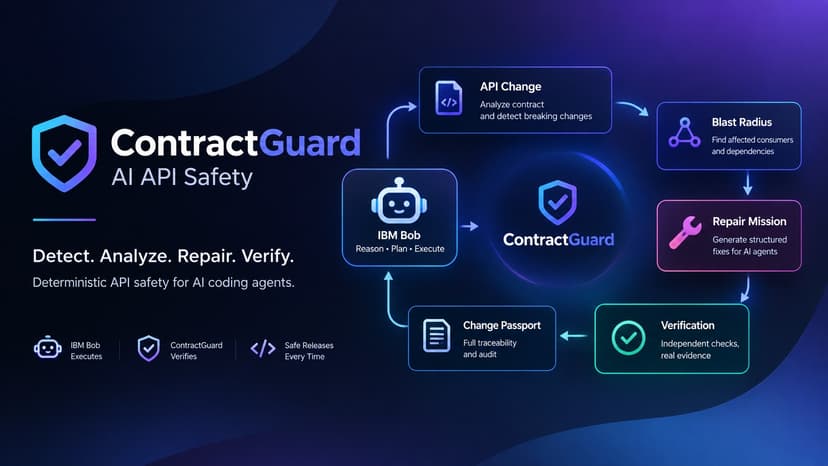
AI coding agents can modify software faster than ever, but they can also introduce changes whose impact is difficult to predict. When an API contract changes, developers need to know which consumers are affected, what must be repaired, and whether the final result is actually compatible. ContractGuard is a deterministic verification layer designed to work alongside AI coding agents such as IBM Bob. It analyzes API contracts, detects breaking changes, calculates their blast radius across known consumers, generates structured repair missions, and independently verifies the resulting state. The workflow is simple: a developer simulates or introduces an API change, ContractGuard determines its impact, and IBM Bob uses the resulting structured information to repair the affected consumers. ContractGuard then runs deterministic compatibility checks and tests to determine whether the release is ready. A Change Passport and evidence record provide a reproducible trace of what was changed, what was affected, and what was verified. The target users are software developers and engineering teams using AI coding agents to maintain APIs and multi-service applications. Developers interact with ContractGuard through its web interface, CLI, and MCP integration with Bob. What makes ContractGuard different is the separation between AI execution and deterministic verification. Bob can reason, plan, modify code, and iterate, but it does not get the final say on compatibility. ContractGuard acts as an independent verification layer that provides structured feedback until the system reaches a verified READY state. The prototype demonstrates this with a producer API and three consumers: an API response field is renamed from status to paymentStatus. ContractGuard identifies the breaking change and affected consumers, Bob repairs them, and ContractGuard independently verifies that all three consumers are compatible again. AI reasons. Deterministic checks decide. Bob executes. Evidence proves.
27 Sep 2026
