
🤓 Latest Submissions
Spread Sentinel
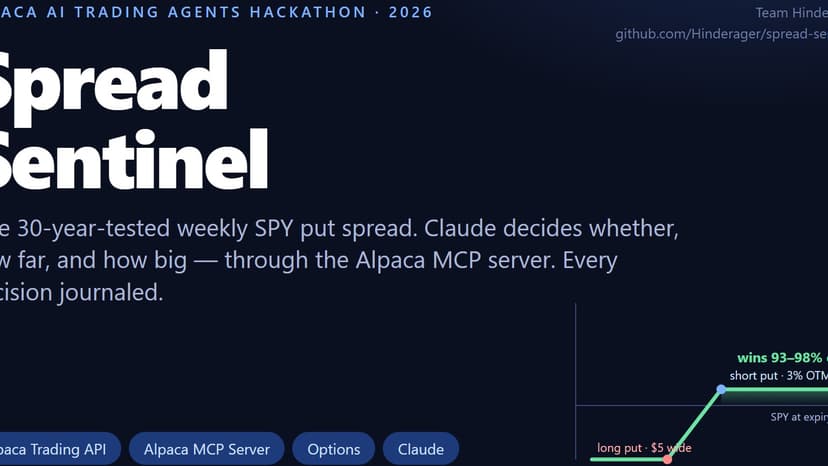
Most "AI trading agents" ask a model to predict direction. Spread Sentinel doesn't. It runs one boring, well-tested trade — sell a defined-risk SPY put spread ~3% below the market each week and let it expire — and uses AI for the part a rule can't do: deciding whether this week is the week to run it, how far out, and how big. The rule comes from a backtest of 1,751 weeks (Jan 1993 – Aug 2026) built on Alpaca's own historical options feed — real last-trade prices for both legs for every week since Feb 2024, a VIX-calibrated model before that, real SPY settlement throughout. It wins 93–98% of weeks and loses only when SPY drops more than ~3% by expiry. Everything else we tried was rejected by the same data: stops on the short-strike touch (60% of touches recover), take-profit exits, iron condors, single-name underlyings, sitting out payroll weeks. Before each entry the agent builds the trade from live quotes, then hands it to Claude running headless with the official Alpaca MCP server and web search. Claude sanity-checks the chain through the MCP tools (stale marks, wide markets, skew), reads the calendar and the tape, and returns a JSON verdict — enter or skip, 3% or 4% out of the money, 70% or 50% of the account at risk — with a reason a human can read. The agent executes as a single multi-leg order, works the price for twenty minutes, marks the position every half hour, and buys it back for pennies on the last morning so nothing is open when the account is judged. The journal it writes as it goes is this write-up.
4 Sep 2026
