Faheemuddin Sayyed@faheem219
2
Events attended
1
Submissions made
India
1 year of experience
About me
Final-year CS undergraduate building enterprise GenAI systems as a Software Developer Intern at Bajaj Finserv Health. Co-author of four peer-reviewed publications (two IEEE conference papers, a Q1 and a Q2-indexed journal) and one filed patent, alongside national hackathon wins including 1st place at the ISB-Cardiff Cyber AI Hackathon. Focused on LLM retrieval architecture, applied ML, and full-stack systems engineering.
🤝 Top Collaborators


🤓 Latest Submissions
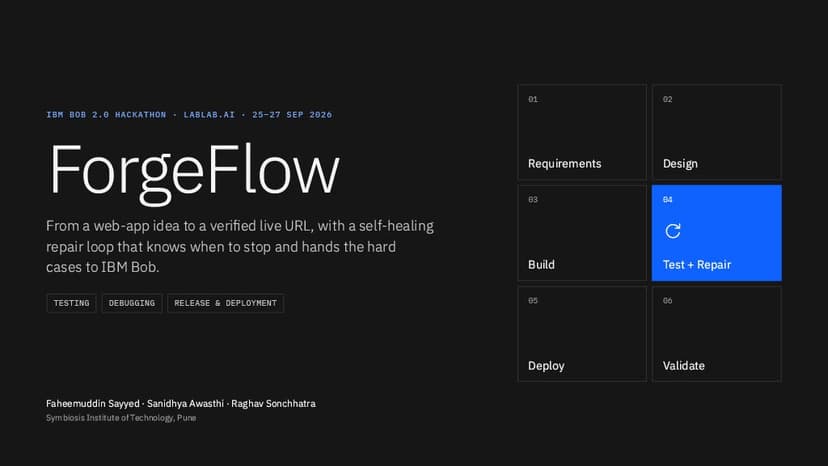
Forgeflow
THE PROBLEM AI app builders made generating a web app fast, but proving that it works is still manual. Developers write tests after the code, paste CI logs into a chat, retry fixes with no stopping rule, and click through the live site hoping nothing broke. Studies show the cost: two frontier models deployed their generated infrastructure successfully on the first attempt only 30.2% and 26.8% of the time; most of a repair loop's gain arrives in the first one to three iterations; and repeated AI self-refinement can make code less secure. An open-ended fix loop wastes budget and adds risk. OUR SOLUTION ForgeFlow is a human-in-the-loop Progressive Web App that carries a web-app idea, given as screenshots or a structured spec, through six stages: requirements, design, build, test and repair, deploy, and live validation. It targets the verify, debug and release workflow. - Tests come from your acceptance criteria. Each criterion's ID travels into the generated test, its result, the repair context and the live-validation report. - Failures go to a bounded, diff-aware repair loop. The agent sees only the failing tests, the sources they exercise, the git diff since the last green run and the criterion text. The loop stops at the first of four guards (regression, no progress, iteration cap, budget cap) and escalates with a plain-language summary of what it tried. - Deployment is infrastructure-aware: the SPA and Node API go to Vercel, data to MongoDB Atlas, and the same suite re-runs against the live URL. Live failures re-enter the same bounded loop. - Continue in IBM Bob: when the loop escalates, one click exports the workspace with AGENTS.md, Bob rules and a BOB_HANDOFF.md of failing tests and patches tried, ready for IBM Bob IDE. WHO IT'S FOR AND HOW THEY USE IT Student and indie builders, agencies prototyping for clients, and teams adopting AI coding tools who need proof before they ship. In the browser, they describe the app or drop in screenshots, edit requirements, refine the design in one sentence, watch code and a live preview update in real time, follow each repair iteration, and deploy with one action. Any stage can be entered, skipped or revisited; only deploy needs a build, and validation a deploy. WHAT MAKES IT DIFFERENT Most builders treat generation as the finish line. ForgeFlow treats verification as the product: a repair loop designed to terminate, escalation as a normal outcome instead of an error, and tests re-run on the deployed URL. Pairing it with IBM Bob gives every hard case a real next step, with the developer in charge. EFFICIENCY Untrusted code runs only in per-project Docker sandboxes with no host network. Models are routed by role, so the expensive model runs only for code, tests and repair, and cost is tracked per project against a budget cap. ForgeFlow ships with 2,000+ automated tests built across 65 incremental parts, six quality gates before every commit, and a 10-app benchmark tracking first-pass versus post-repair pass rate, iterations and cost.
27 Sep 2026

