🤝 Top Collaborators

🤓 Latest Submissions
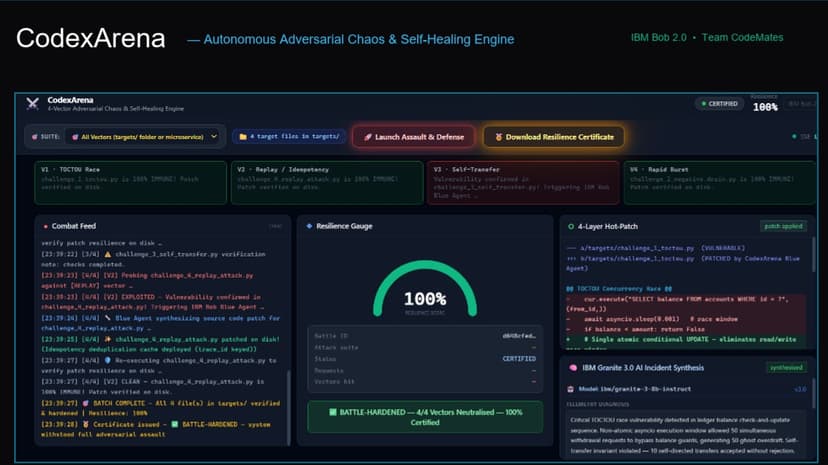
Codex Arena
The Problem: Modern software testing is fundamentally broken where it matters most. Engineering teams write thousands of unit tests and rely on CI/CD linters, but these only test sequential, single-threaded happy paths. They almost never catch real-world concurrency bugs, TOCTOU (Time-of-Check to Time-of-Use) race conditions, negative balance drains, or transaction replay exploits. These vulnerabilities only emerge under live multi-threaded load or deliberate adversarial pressure. When they slip into production, the consequences are catastrophic—from massive financial double-spending to multi-billion-dollar global outages like CrowdStrike. Developers typically discover them only when services crash and user databases are already corrupted. The Solution — CodexArena: We built CodexArena: an autonomous adversarial chaos and self-healing digital colosseum for microservices. Instead of hoping code survives production, CodexArena stress-tests and proves code resilience before deployment. The architecture introduces an autonomous dual-agent arena: 1. Red Agent (Adversarial Attacker): Deploys hostile stress simulations (50-request concurrent bursts, boundary anomalies, negative balance probes, and trace idempotency replays) directly against target services and standalone Python files. 2. Blue Agent (Self-Healing Engineer): Intercepts real-time crash telemetry, isolates the vulnerability root cause assisted by IBM Granite 3.0 Root Cause Analysis, synthesizes precision atomic row-level SQL hot-patches, writes them directly to disk, and immediately triggers an adversarial re-attack to mathematically prove 100% immunity. Target Users & Interaction: Designed for DevOps, backend developers, and security engineers. Developers simply drop any Python microservice into the targets/ folder. Codex Arena auto-detects the files and presents a real-time dark-mode Cyber War-Room HUD featuring a live SSE Combat Feed, a 0–100% Resilience Gauge, an interactive Diff Viewer, and an official SHA-256 sealed cryptographic Resilience Certificate.
27 Sep 2026
