
🤝 Top Collaborators

🤓 Latest Submissions
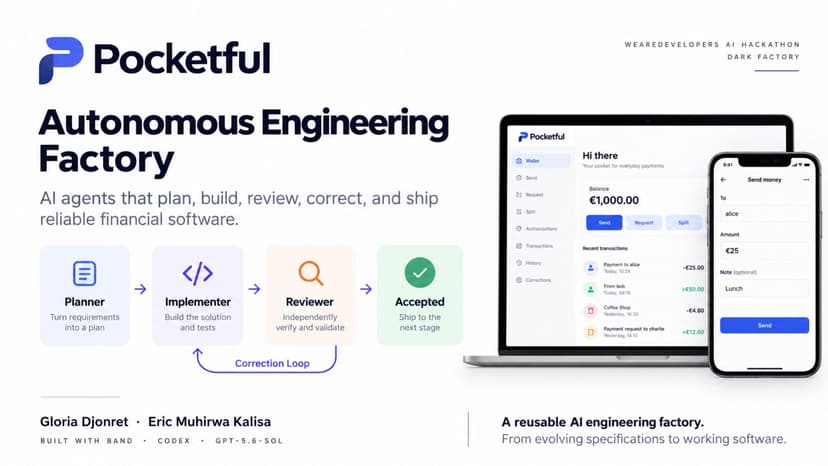
Pocketful Autonomous Engineering Factory
Pocketful Autonomous Engineering Factory demonstrates a different approach to AI-assisted software development: instead of using a single AI coding assistant, we built a coordinated software engineering factory that takes evolving specifications through planning, implementation, independent review, correction, and acceptance. The factory consists of three specialized AI roles: Planner, Implementer, and Reviewer. The Planner analyzes requirements, tracks invariants, delegates work, and controls final acceptance. The Implementer develops the application, validates behavior, runs tests, and produces committed revisions. The Reviewer operates independently as an adversarial quality gate, verifying each implementation against the specification rather than simply trusting the code or existing tests. The core of our system is a closed-loop correction workflow. Passing automated tests is necessary but not sufficient. If the Reviewer discovers a BLOCKER or MAJOR issue, the revision is rejected, corrected by the Implementer, and independently reviewed again before acceptance. This process proved valuable during development. In Stage 3, the Reviewer discovered a historical-state reconstruction defect even after the automated harness passed. In Stage 4, the Reviewer found a refund-import integrity issue after another passing harness run. Both revisions were rejected, corrected, re-reviewed, and only then accepted. Pocketful evolves across four dependent stages, from wallet transfers and payment requests to authorization flows, temporal ledger behavior, refunds, correction batches, and state portability. The result is both a working financial application and a reproducible demonstration of an autonomous AI software engineering organization, backed by agent handoffs, automated verification, independent review, corrective commits, exact Git history, and exported BAND collaboration evidence.
6 Oct 2026
