🤓 Latest Submissions
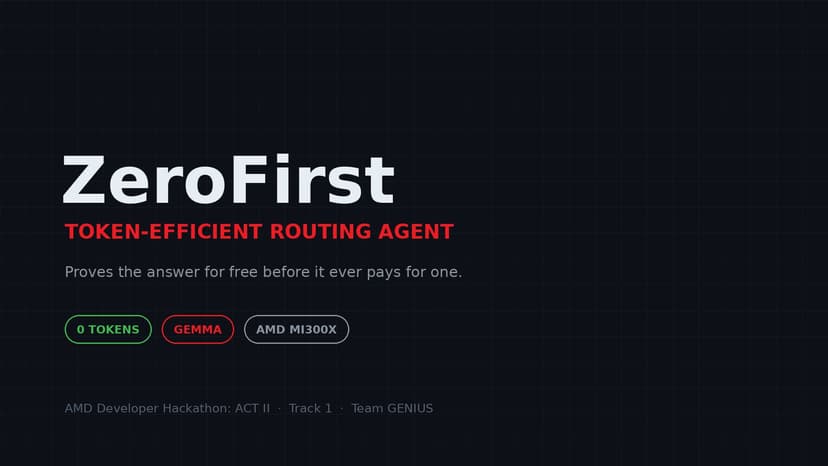
ZeroFirst — Token-Efficient Routing Agent
Most routing agents still pay an LLM to decide where to route. ZeroFirst refuses to spend a single token on a decision it can make for free — and refuses to spend one on an answer it can prove for free. The agent runs three layers, cheapest first. Layer 0 — Deterministic solvers, zero Fireworks tokens. Arithmetic is evaluated through a safe AST evaluator, so math is not "probably right", it is provably right. Sentiment is resolved by lexicon scoring. Named entities are extracted by a positional-capitalisation heuristic that discounts sentence-initial words. These answers cost nothing and cannot hallucinate. Layer 1 — Zero-token classification. Tasks are sorted into eight categories (math, sentiment, NER, factual, summarisation, logic, code debugging, code generation) by regex and heuristics. No model is consulted to decide where a task goes, so routing itself is free. Layer 2 — Cheapest sufficient model. Only what Layer 0 cannot prove reaches Fireworks. Factual and summarisation tasks route to Gemma 2 9B; only logic and code escalate to a stronger model. Every paid call is deliberately token-starved: temperature 0, a hard per-category max_tokens cap, and a system prompt that forbids reasoning, preamble and markdown. Chain-of-thought is what dominates the token bill on this task, so we suppress it outright rather than paying for prose nobody scores. Gemma is the default paid tier, so the majority of billed inference runs on Gemma via Fireworks. Shipped as a public linux/amd64 container with a public GitHub repository and setup instructions.
13 Jul 2026

ComplyForge — EU AI Act Compliance Agent
ComplyForge — Autonomous EU AI Act Compliance Agent PROBLEM On August 2, 2026, the EU AI Act's high-risk system rules become binding. Penalties reach €35M or 7% of global revenue. Over half of enterprises have no AI inventory, no Article 11 technical file, and no Fundamental Rights Impact Assessment. Compliance teams have 75 days to a deadline they cannot meet manually. AUTONOMOUS AGENT DESIGN One Orchestrator plus five specialised sub-agents. No agent-to-agent chains. 1. PlannerAgent — emits an explicit four-step ExecutionPlan with rationale, durations, and a dependency graph, visible in the dashboard before execution starts. 2. ClassifierAgent — reasons about the AI system against the full EU AI Act taxonomy (Article 5, Annex III, Article 50). Drops hallucinated citations against a whitelist; auto-promotes to HIGH_RISK under low confidence (precautionary principle). 3. CriticAgent — independent second-opinion reviewer. Surfaces up to three concerns and a confidence delta. Falls back gracefully if Gemini is unavailable. 4. DocAgent — 10 concurrent Gemini calls across nine Annex IV sections plus the Article 27 FRIA. Renders a 13-page regulator-ready PDF. 5. PolicyAgent — emits a Veea Lobster Trap YAML in the real upstream schema (verified by reading serve.go and handler.go). Hard-locked to the eight documented actions. End-to-end in 60 seconds. MULTIMODAL POST /api/extract-descriptor accepts JSON, PNG / JPEG diagrams, or PDF model cards. Gemini Vision extracts the AgentDescriptor; the same pipeline then runs. ENTERPRISE UTILITY 13-page Article 11 + FRIA + datasheet PDF, plus a Lobster Trap YAML that blocks PII egress, prompt injection, and decisions without Article 14 human oversight. JSONL audit log drops into any SIEM. TECH Python 3.14, FastAPI, Pydantic v2, Google Gemini (2.5-flash-lite + Vision), ReportLab; React, Vite, TailwindCSS, zustand. 116 backend tests passing. Sponsor tech: Google Gemini + Veea Lobster Trap. Built solo. MIT.
19 May 2026


