

Halima Hafir@hafirhalima
1
Events attended
1
Submissions made
Morocco
3+ years of experience
About me
Hello everyone! My name is Halima Hafir, and I'm from Morocco. I'm an AI developer, builder, and tech entrepreneur who loves creating practical solutions with artificial intelligence and automation. I'm passionate about building AI agents, web applications, and developer tools using technologies like n8n, large language models, and modern web frameworks. I enjoy turning ideas into real products that solve real-world problems. I'm here to learn from talented developers, collaborate on exciting projects, and challenge myself by building something impactful. I believe the best way to grow is by building, sharing knowledge, and working with amazing people. I'm excited to meet you all, exchange ideas, and create something great together. Thank you!
🤓 Latest Submissions
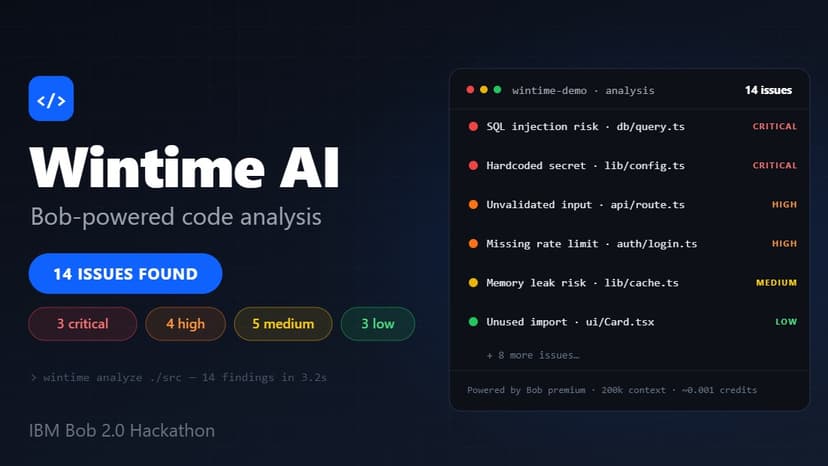
Wintime AI
PROBLEM Developers spend hours reviewing unfamiliar codebases and hunting for bugs that linters and static analysis tools miss. Traditional tools pattern-match known vulnerabilities — they don't reason about cross-file logic, unhandled promise rejections, or missing error middleware. When AI now generates large amounts of code, the review bottleneck has shifted from writing to validating, and human review doesn't scale. SOLUTION Wintime AI is a Next.js web app that sends an entire codebase to IBM Bob's inference API and returns a structured, actionable bug report. It reads every source file, traces cross-file dependencies, and surfaces findings grouped by severity: critical, high, medium, and low. Each issue includes the file path, line number, a plain-English description, and a suggested fix. The demo target is a deliberately-broken Node.js/Express application seeded with 10 known issues: a hardcoded API key, missing input validation, an outdated Express dependency, unhandled promise rejections, missing error middleware, and zero test coverage. In the live demo, Bob found all 10 — plus 4 more that were not planted, including a null-reference crash path in db.getUser and an unhandled rejection on GET /api/tasks. TARGET USERS - Developers onboarding to unfamiliar codebases - Reviewers evaluating AI-generated code at scale - Teams performing pre-merge quality checks - Maintainers inheriting legacy applications HOW IT WORKS 1. The user opens the Wintime AI web app and clicks "Analyze Demo Project." 2. The Next.js API route reads every file in the target codebase recursively, skipping node_modules and .git. 3. The files are packaged into a structured prompt and sent to Bob's inference endpoint using the premium model (200k context window). 4. Bob returns strict JSON describing each issue with severity, file, line, title, description, and fix. 5. The client-side parser strips markdown fences and validates the schema. 6. The UI renders the results as a summary bar plus severity-grouped issue cards. WHAT MAKES IT UNIQUE - Real analysis, not pattern matching. Bob found 4 issues we didn't seed, proving it reasons about the code rather than matching a checklist. - Strict structured output. A custom prompt and parser force Bob to return machine-readable JSON, so the same engine can power CI, PR comments, or IDE plugins. - Extreme efficiency. A full codebase analysis costs roughly 0.001 credits on Bob's premium model — the entire demo runs for less than the cost of a single API call. - Bob IDE + Bob API. Built with Bob IDE for development, powered by Bob inference at runtime — a full demonstration of the platform, not just a wrapper. IMPACT A manual review of this demo project would take a developer 30–60 minutes. Wintime AI returns the same result in seconds, with consistent output and no missed findings. The workflow improvement is quantifiable: time, effort, and error rate all drop dramatically for code review, onboarding, and maintenance tasks. NEXT STEPS - GitHub PR integration: auto-comment findings on pull requests - Multi-language support: Python, Go, Rust - CI hook for automated pre-merge analysis - Test generation triggered by detected coverage gaps
27 Sep 2026


