🤝 Top Collaborators
🤓 Latest Submissions

Umbra
Most entries used an agent as a faster keyboard. A dark factory is a production line. You hand it one task. It plans the work, writes the code, tries to break the result, and refuses to ship until a different seat has reproduced the proof. Umbra is that line. Seven seats share one repository and one Band room. Lead turns a specification into numbered requirements. Builder is the only seat allowed to write the service, and it cannot grade that service. Verifier checks each requirement against a run it produced itself. UIReviewer drives the real screens at phone width and desktop width. Certifier re-executes the evidence and is the only seat that can seal a stage. Breaker is the seat that makes the line unusual. It is a different model, DeepSeek, and it has a binding veto. It races transfers, retries requests, and tries to spend the same money twice. A green report from the builder means nothing if Breaker says no. A clock watches the room every minute. When a seat hangs, the clock ends the turn and a supervisor restarts the runtime. The clock never types as the human. That line built Pocketful, a wallet in the Venmo shape, through all four stages. People pay each other, ask for money, split a bill, place a hold, correct the past, and refund what they received. Nothing is deposited and nothing is invented. Balances stay exact, and a retry cannot move the same money twice. Stage 4 sealed at revision 79af98560dd9. On the next fields, set the track to Pocketful. For technologies, pick Band, Docker, and Featherless if they are on the list.
6 Oct 2026

ShowMe
Agents still do not learn a job by being shown it. Ask IBM Bob, Cursor, Claude, or Codex to check a repository for new issues, export a customer PDF, or file the same report every morning, and the model re-derives the whole procedure from scratch. It spends tokens, clicks the wrong control when a label moves, and gives a different result tomorrow. The model was never the missing piece. A way to teach it was. ShowMe is that teacher. A person performs the workflow twice, on purpose, with one thing changed: a different customer, a different repository, a different folder. ShowMe’s inducer compares the two recordings step by step. A value that changes becomes a parameter. A click, a path, or a success check that changes is a different workflow, and ShowMe refuses to guess. It then compiles the lesson into an Agent Skill: SKILL.md, a trace, and a player. Any agent that can read a skill can run the job again. The repeat follows the trace. It does not ask a model to invent the clicks. The person interacts with it the way they would train a new teammate. They show the work. They say what the work is for. ShowMe writes the skill. Next time, the agent is told the new input only, such as owner=openclaw and repo=openclaw, and it opens that repository’s issue list and pull requests and writes the live titles into notes. We proved this on the public OpenClaw repository: the skill returned real issue and pull-request titles from GitHub, not titles written by a model. The same compiler turns a billing-portal demonstration into a skill that exports a customer tax PDF, and it stops if the Export button has been renamed instead of clicking a neighbor. Target users are developers and operators who repeat the same portal, repository, or file workflow every day, and the agents they already use. One taught skill runs in IBM Bob, Cursor, Claude Code, and Codex, because the skill format is the open Agent Skills folder, not a private plugin. ShowMe also exposes the compiler as an MCP server, so the agent can induce, compile, and run a skill without leaving the chat. What is new is the division of labor. The human teaches. The inducer decides what is allowed to change. The agent only executes. That is the practical form of an agent that learns a job: not a larger model, a lesson the model is no longer allowed to improvise.
27 Sep 2026
Metis
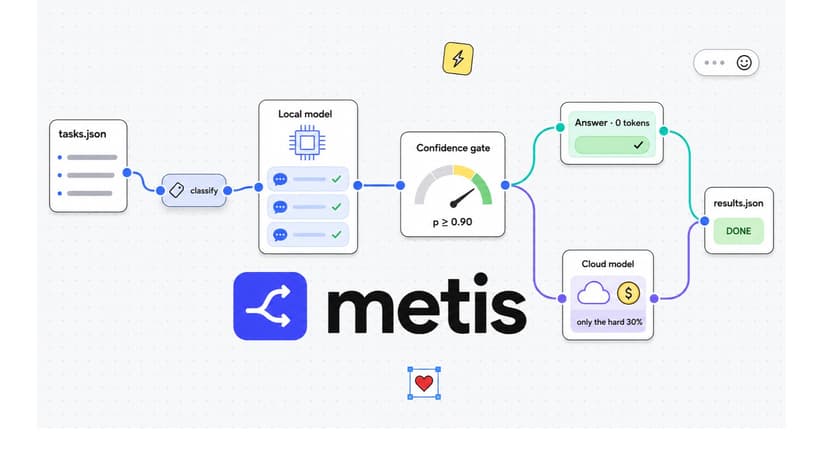
▎ Metis is a general-purpose AI agent built on one thesis: most tasks don't need a frontier model, and the ones that do should be identified before you pay for them — not after. ▎ ▎ Every task first runs on a small quantized model (Qwen2.5-3B) baked into the container, executing locally at zero API cost. Metis samples the local model several times in parallel and measures agreement: consistent answers across independent samples are strong evidence of correctness. That evidence — consensus, token-level confidence, and per-category signals — feeds an isotonic-calibrated confidence gate fitted on real observations. Only when the gate predicts the local answer would miss the accuracy bar does Metis escalate to a paid Fireworks model, chosen per task category with reasoning effort tuned so escalations cost single-digit tokens where possible. ▎ ▎ Known-hard categories (multi-step math, entity extraction) are force-escalated based on measured failure data, math gets a program-aided verification pass first, and an adaptive governor watches the runtime budget and downshifts sampling if the clock runs short. The whole system degrades gracefully: any failure at any layer falls back to the next-best answer rather than crashing. ▎ In our full 48-task rehearsal, Metis hit 95.8% judged accuracy while escalating only 29% of tasks — spending just ~1,400 total paid tokens, versus tens of thousands for a naive route-everything-to-the-cloud agent at comparable accuracy.
13 Jul 2026

Elixire
Solo clinic doctors lose 15+ minutes per patient on intake paperwork before they ever examine anyone. Elixire fixes that with a clinic operating system powered by three Band-coordinated AI agents. Patients check in through a friendly chat portal. The Receptionist agent validates identity and routes the visit. The Intake agent runs doctor-configured clinical protocols — asking specialty-specific questions, processing uploaded documents, and pausing for human-in-the-loop follow-ups when information is incomplete. The Brief agent generates a structured pre-visit summary so the doctor walks into the room already prepared. Band is the coordination backbone: each patient session gets an isolated chat room where agents hand off structured JSON via @mentions — every step is observable and auditable, not buried in a single opaque LLM chain. Safety is built in, not bolted on. A deterministic emergency gate triggers crisis resources before any LLM call. Intake never diagnoses — it only collects. Prescription drafts pass through AI/ML API verification for drug interactions and contraindications. Doctors configure intake per specialty (general practice, ophthalmology, cardiology, dental) via JSON clinic protocols — no code changes required. Elixire is your AI front desk, intake nurse, and medical scribe — coordinated by Band, ready before the patient enters the exam room.
19 Jun 2026
Gurren - Copilot for Development
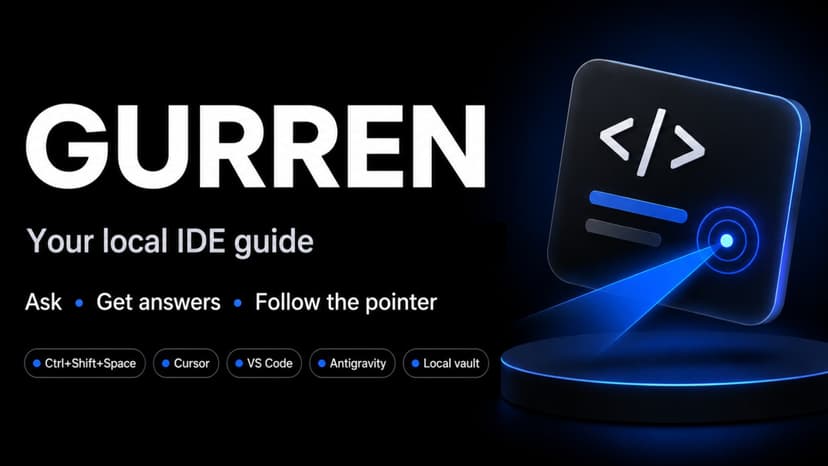
Modern IDEs are powerful but overwhelming. New features hide behind menus, shortcuts differ between tools, and generic chatbots hallucinate steps or ignore which editor you actually have open. Gurren is a Windows desktop copilot built for developers who live in Cursor, Visual Studio Code, or Google Antigravity. Press Ctrl+Shift+Space anywhere in your workflow to open a lightweight panel. Ask natural-language questions—“How do I open the command palette?” or “Where is GitHub Copilot?”—and get answers grounded in a curated markdown vault, not random web guesses. Gurren detects your active IDE and file context automatically, then routes each question through a three-tier retrieval pipeline designed for speed and privacy: • Level 1 — Instant tag lookup over a pre-built index for common questions with zero latency. • Level 2 — Semantic search with ChromaDB and local embeddings (Transformers.js) over hundreds of structured vault notes scraped from official docs. • Level 3 — Optional escalation to Anthropic Claude when the vault is not confident, including a dedicated PRD/spec mode that turns product requirements into IDE-specific build guides. When an answer references a UI control, Gurren draws an on-screen pointer overlay on top of your desktop so you know exactly where to click. A persistent memory layer writes usage patterns to vault/user (profile, history, unknown queries) so the assistant improves with you over time. The stack is Electron + React + TypeScript on the front end, Python scripts for vault seeding and indexing, and ChromaDB running locally—routine answers work offline; only Level 3 needs an API key. Gurren is local-first, context-aware, and built for real IDE workflows—not another browser tab.
17 May 2026


