
Muhammad Kamran@hmuhdkamran
3
Events attended
1
Submissions made
Pakistan
20+ years of experience
About me
I'm Muhammad Kamran, a Software Architect with over 20 years of experience building enterprise applications, with deep expertise in Microsoft .NET technologies, AI/ML integration, and blockchain solutions. Based in Lahore, Pakistan, I've spent my career architecting and delivering complex systems across healthcare, education, retail, and telecommunications. Currently, I serve as Lead Software Architect at TechSol, where I lead the development of AI-powered healthcare platforms. I've architected Granite, a medical organization management system that uses Retrieval-Augmented Generation (RAG) for intelligent document processing and automated clinical summarization, and KilliFlow, a clinic management platform with real-time analytics and AI-driven clinical decision support for individual practitioners. Over the years, I've taken on technical leadership roles across a wide range of industries. At Sefam, I spearheaded BizFlow, an end-to-end operations platform, along with AI-powered retail solutions like StepSense, which uses computer vision to count customer foot traffic, and EcoSpare, a smart appliance control system. Before that, as Lead Software Architect at Tower Technologies, I built large-scale education and healthcare management systems that are still running today — including a university management system serving over 600 faculty members and nearly 17,000 students, and an education management platform deployed across more than 750 campuses of the Punjab Group of Colleges, supporting over half a million students. I've also worked extensively in emerging technologies. I've engineered blockchain and DeFi applications on Ethereum and Polkadot, including a cross-border remittance stablecoin platform for HBL, and built a Rust-based enterprise AI voice bot that combines Whisper, text-to-speech, and Ollama to handle sales, customer support, and telemarketing calls autonomously.
🤝 Top Collaborators

🤓 Latest Submissions
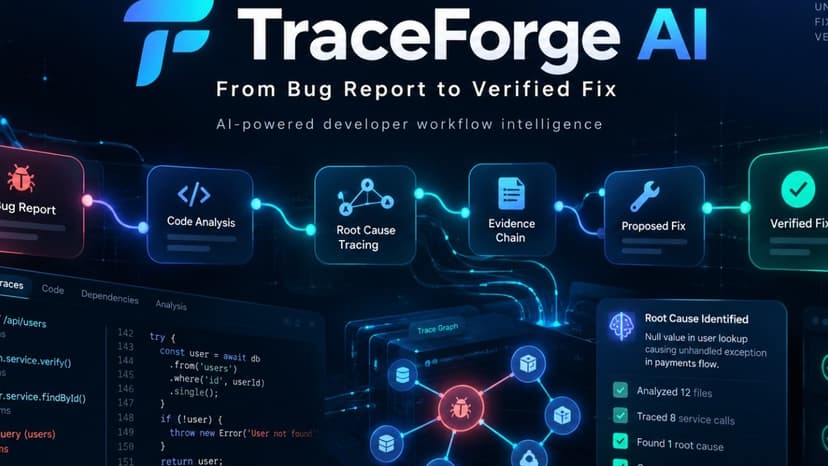
Trace Forge AI
TraceForge AI — ContractGuard is a production-oriented developer workflow application that orchestrates the complete lifecycle of API contract investigation and repair. Its tagline — From Bug Report to Verified Fix — describes the system precisely: it takes a bug report as input and produces an independently verified, evidence-backed, human-approved fix as output, with every decision recorded and traceable. The Problem Full-stack applications suffer from API contract drift. Over time, the frontend implementation, backend handler logic, automated test suite, and API documentation become subtly inconsistent with each other. When a failure surfaces, developers must manually cross-reference multiple layers of the codebase, reproduce the failure, reconstruct the original intent, coordinate changes across components, and confirm that the correction resolves the complete problem. This investigation process is fragmented, error-prone, and nearly impossible to audit after the fact. The Solution ContractGuard replaces this fragmented workflow with a structured, tool-assisted pipeline consisting of ten coordinated stages: Bug intake — Developers submit a bug report with expected behavior, observed behavior, and reproduction steps through the React dashboard. Workspace isolation — The Rust backend creates a dedicated, immutable working copy of the sample project, protecting the original fixture from modification. Baseline reproduction — The verification engine executes the existing test suite against the broken fixture, capturing failing test identifiers, exit codes, and logs as objective evidence of the defect. IBM Bob investigation — A structured prompt directs Bob to read the API documentation, OpenAPI specification, frontend source, backend handler, and existing tests. Bob uses parallel subagents for independent frontend, backend, and contract investigations, then synthesizes findings into a validated diagnosis.json artifact, an investigation summary, and a fix plan. Artifact import and validation — The backend validates every imported artifact against a published JSON schema, checks source-file references, enforces workspace path boundaries, and rejects malformed data without altering the investigation's current valid state. Human approval — The developer reviews the findings, proposed corrections, affected files, regression-test plan, and associated risks. Approval is recorded with a content hash of the plan; any material modification requires renewed approval. Bob-assisted implementation — A second structured prompt instructs Bob to apply only the approved corrections in the isolated workspace, add regression tests, and produce an implementation summary and code diff. Independent verification — The backend's verification engine re-executes the full test suite using Tokio process management against a predefined allowlist of commands, enforcing execution timeouts, output-size limits, and path canonicalization. Verification status is determined entirely by actual test exit codes. Contract Evidence Graph — Each investigation builds a persistent, queryable graph connecting requirements, frontend findings, backend findings, root causes, approved fixes, and passing tests. Missing evidence links are displayed explicitly rather than fabricated. Final report generation — A complete investigation report is produced in HTML and JSON, covering all nineteen required sections including the original bug report, root causes, approved plan, code diff, regression results, evidence graph, and productivity measurements.
27 Sep 2026


