
🤓 Latest Submissions
ForgeSight AI
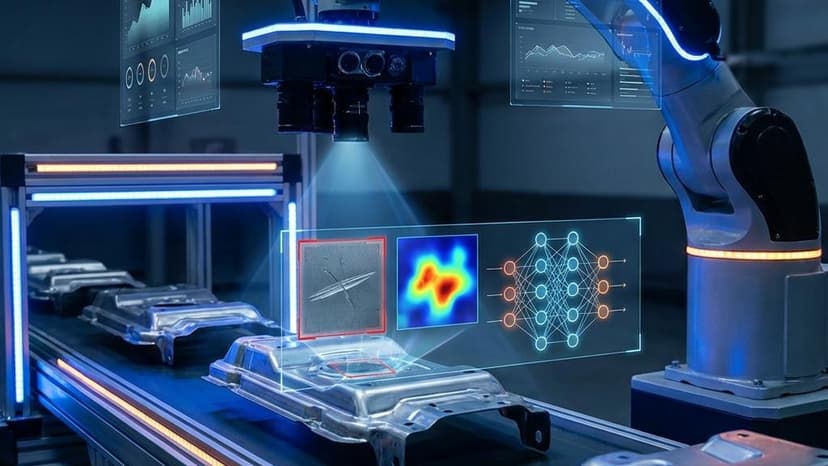
ForgeSight AI is a mobile-first industrial inspection platform that helps factories identify quality issues earlier using computer vision and AI. Operators can capture or upload images and videos of manufactured components, machine surfaces, production equipment, and packaging directly from a phone or tablet. The platform analyzes visual evidence to identify suspected defects, highlight relevant image regions, classify potential issues, estimate confidence, and assign preliminary severity levels. Each inspection creates a traceable evidence record with annotated images, timestamps, asset information, observations, and recommended next steps. ForgeSight AI transforms individual inspections into actionable quality intelligence through a cinematic, intuitive dashboard that displays inspection history, recurring defect patterns, high-priority alerts, quality trends, and potential production risks. Operators can generate professional inspection reports containing original evidence, annotated findings, defect summaries, recommendations, and review status for sharing with quality engineers and maintenance teams. The platform is designed to support manufacturing environments ranging from automotive components and metal surfaces to electronics and packaging. Its goal is to reduce avoidable downtime, improve inspection consistency, prevent defective products from progressing through production, enhance operational safety, and reduce material waste. The prototype distinguishes AI-generated findings from confirmed engineering decisions, displays confidence transparently, and allows human reviewers to verify or reject findings. It supports a practical workflow from image capture to detection, evidence review, corrective action, and reporting, with a scalable architecture for future integration with factory systems and edge AI.
18 Oct 2026

EvidenceRAG — GPU-Powered Enterprise Document QA
EvidenceRAG is a GPU-accelerated retrieval-augmented generation (RAG) system designed to answer questions from mixed enterprise document collections while identifying the exact files that support each answer. The solution indexes PDFs, Word documents, Excel workbooks, CSV files, text files, production logs, Python source code, and images. It combines document parsing, OCR, pretrained semantic embeddings, and evidence-based retrieval to locate relevant information across different formats. The embedding model, sentence-transformers/all-MiniLM-L6-v2, converts document content and questions into vector representations for semantic similarity search. A two-stage execution design separates indexing from question answering. During indexing, document content and embeddings are prepared for reuse. Each query then retrieves relevant evidence and produces a concise, value-only answer with corpus-relative source paths in a structured JSON response. Citation precision is a core design requirement. The system aims to return only the files necessary to establish an answer, including multiple sources when a question requires connecting evidence across documents. When the corpus does not support an answer, it returns an empty answer and an empty citation list rather than guessing. The container is designed for the AMD ROCm environment and the challenge's execution contract, including repeated query invocations, startup and query time limits, and resilience to empty directories, unreadable files, encrypted documents, and unsupported file types. EvidenceRAG targets reliable enterprise knowledge retrieval, where correctness, traceability, and the ability to abstain are as important as finding an answer. Its objective is to make internal technical information easier to query while keeping every response auditable through precise document citations.
1 Dec 2026
Tablekeeper — BAND Reservation Factory
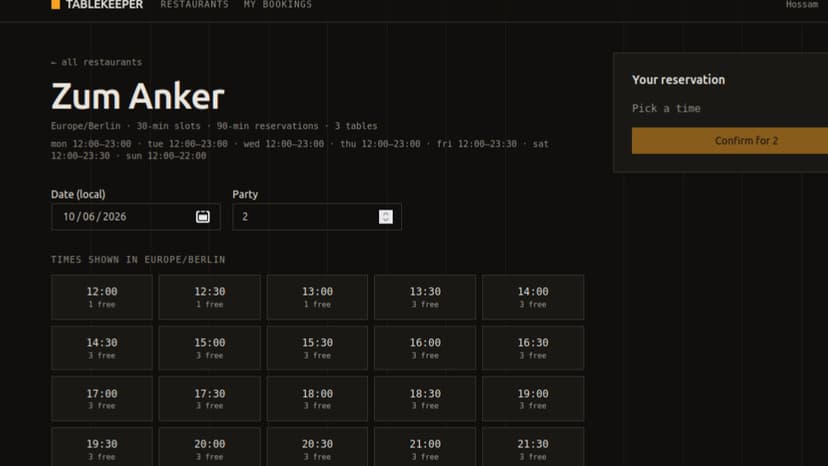
Tablekeeper prevents overlapping restaurant table reservations, including under concurrent requests and retries. Planner coordinated the task, Developer implemented the service, and Reviewer independently tested committed revisions and returned defects for repair. Stage 1 passed all 120 shipped official harness checks in an isolated run and 456 independent reviewer probes. Hidden tests remain unverified. The repository includes generic seat mandates, FACTORY.md, the full BAND room export and a standalone Docker service. After the BAND run, a Lovable frontend was connected for a browser demonstration and packaged with the backend using Docker Compose. This later integration is documented separately from the original agent run. The current backend stores state in memory, so reservations are lost on restart. Additional limitations are documented in FACTORY.md.
6 Oct 2026
TableMate — Voice-Driven Bimanual Physical AI
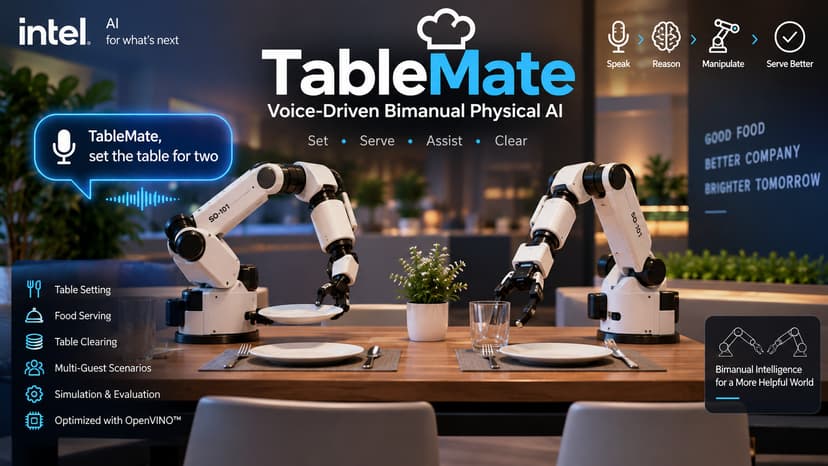
TableMate is a voice-driven Physical AI system for intelligent bimanual robotic manipulation in restaurant and table-service environments. The project uses two simulated SO-101 robotic arms in MuJoCo to transform natural-language instructions into coordinated, multi-step physical actions. Rather than executing a fixed sequence, TableMate represents restaurant requests as structured task plans and dynamically assigns actions to the left arm, right arm, or both arms cooperatively. The system supports parallel operations such as placing a plate and cutlery simultaneously, as well as cooperative bimanual tasks such as transporting a main dish. Current scenarios include fine dining, quick lunch, shared dinner, selective table clearing, and changing guest requests. TableMate is designed around the hackathon’s multimodal Physical AI challenge: combining language understanding, visual scene information, task context, bimanual coordination, manipulation, and verification. The architecture is being developed to support randomized MuJoCo environments and evaluation across multiple seeds to measure robustness to changes in object placement and scene conditions. The deployment pipeline targets Intel Core Ultra Series 2/3 and uses OpenVINO for supported AI inference optimization. The project also incorporates Intel Physical AI tooling and a reproducible simulation, evaluation, and benchmarking workflow. Speechmatics integration extends the interface from written commands to real-time spoken instructions, allowing a guest or operator to naturally request actions such as setting, serving, modifying, or clearing the table. The goal of TableMate is to demonstrate how Physical AI can move beyond isolated robotic actions toward an interactive agent that can understand what a person wants, reason about a changing environment, coordinate two arms, execute safely, and verify that a real-world-style task has been completed correctly.
16 Sep 2026


