
🤓 Latest Submissions
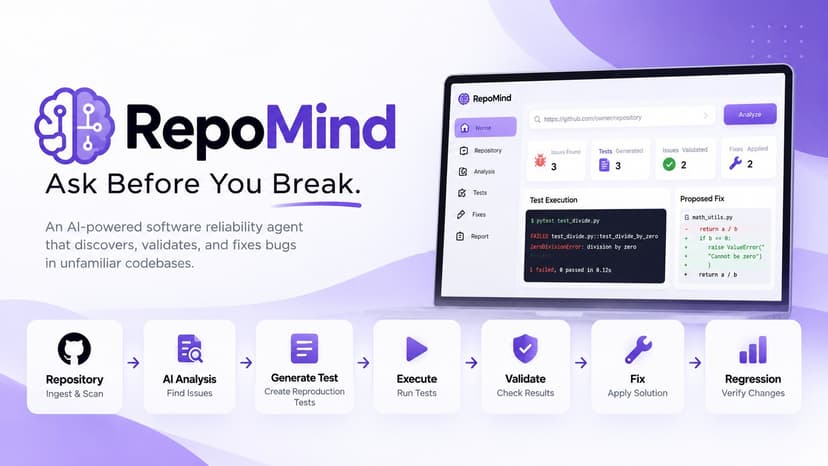
RepoMind — Ask Before You Break
PROBLEM: Modern AI coding assistants can analyze source code and identify potential bugs, but an AI-generated finding is still a hypothesis. Static reasoning alone cannot guarantee that an issue actually occurs at runtime. Generated tests can also fail because of incorrect assumptions, imports, or test-generation errors, making it difficult for developers to distinguish a real software defect from an invalid AI conclusion. Developers therefore still spend significant time reproducing, validating, and regression-testing AI-generated findings. RESEARCH QUESTION: Can an AI agent autonomously discover and validate software reliability issues in an unfamiliar codebase using repository-level context and iterative experimentation? RepoMind explores this question by treating AI-generated software-engineering findings as testable hypotheses and using executable experiments to determine whether those hypotheses are supported by actual runtime evidence. SOLUTION: RepoMind is an AI-powered software reliability agent built around an execution-based validation loop: Analyze → Detect → Generate Test → Execute → Validate → Fix → Regression Test A developer provides a GitHub repository through the RepoMind web interface. The system ingests and scans the repository, builds repository-level context using source-code and AST analysis, and sends this context to the Bug Hunter Agent to identify potential reliability issues. For each finding, the Test Generator Agent creates an executable pytest reproduction test. RepoMind then runs the generated test against the actual repository. The Validation Agent interprets the execution result and distinguishes reproduced issues from rejected findings and test-generation or infrastructure errors. This prevents an execution problem from automatically being treated as evidence of a bug. When an issue is validated, the Fix Agent generates a proposed code change. RepoMind can safely apply the change, re-run the relevant reproduction test, and execute regression tests. Failed validation can trigger rollback, while a fix is only considered verified when the required validation and regression conditions are satisfied. TARGET USERS: RepoMind is designed for software developers, AI-assisted development teams, and engineers who want an additional automated reliability layer when working with unfamiliar repositories or AI-generated code. WHAT MAKES IT DIFFERENT: The core idea is to treat AI-generated software-engineering conclusions as testable hypotheses rather than final answers. Instead of stopping at an LLM-generated explanation, RepoMind closes the loop by generating experiments and using actual execution evidence to validate the hypothesis. RepoMind combines repository-level context, specialized AI agents, executable test generation, runtime validation, automated fix proposals, and regression testing into a single workflow.
27 Sep 2026
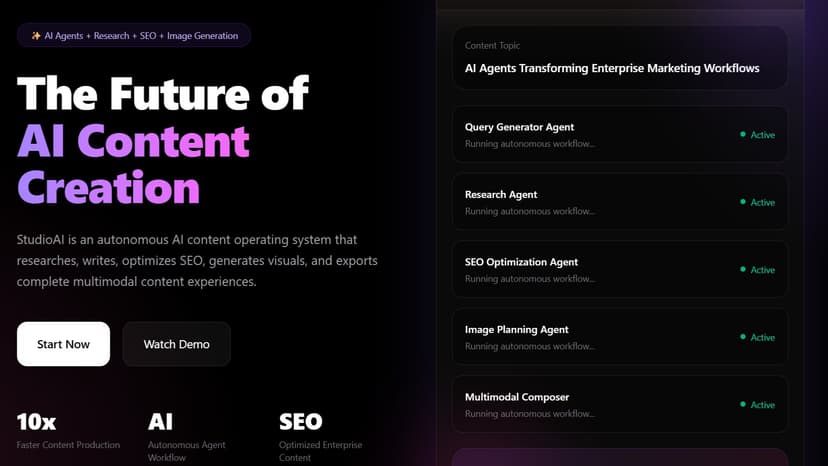
StudioAI: AI-powered enterprise marketing platform
StudioAI is a multimodal AI publishing platform designed to automate the entire content creation workflow using modern AI orchestration and open-source models. The platform enables users to generate SEO-optimized blogs, newsletters, LinkedIn posts, marketing content, and research-style articles from a single topic input. The system combines AI-powered query generation, web research, content writing, SEO enhancement, image planning, AI image generation, and PDF exporting into one streamlined workflow. Users can visually track each generation stage in real time through an interactive React dashboard, making the content pipeline transparent and engaging. StudioAI is built with FastAPI, React, Groq LLMs, Tavily Search, Pollinations AI, and WeasyPrint. It supports multimodal article composition by integrating AI-generated visuals directly into exported documents and web previews. The platform is designed with scalability and modular AI tooling in mind. Future development goals include expanding StudioAI into a complete AI-powered marketing suite capable of generating email marketing campaigns, ad copy, landing page content, social media strategies, automated campaign workflows, brand-specific content generation, and multi-platform publishing support. Additional planned features include streaming generation, multi-model support, collaborative workspaces, authentication systems, analytics dashboards, and cloud deployment infrastructure for enterprise-ready usage.
19 May 2026


