🤓 Latest Submissions
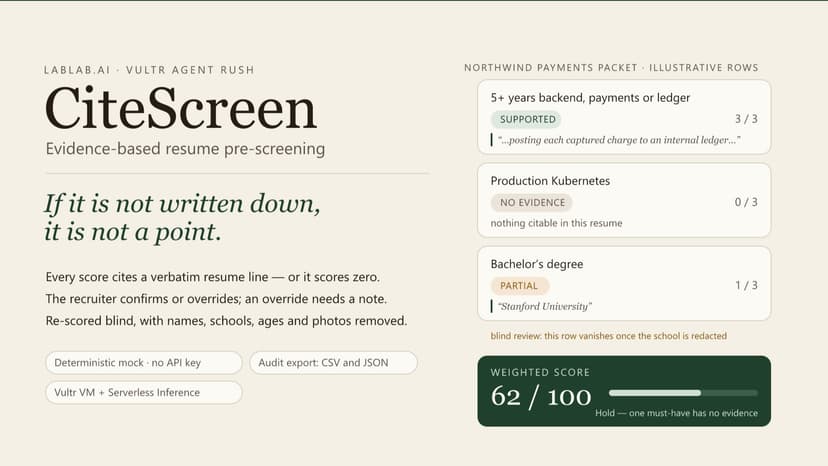
CiteScreen — Evidence-Based Resume Screening
AI resume screeners have an audit problem: they produce confident scores nobody can trace, and they quietly reward signals that should never matter — a famous school, a name, an age. CiteScreen is built the other way around. It reads a job description and up to eight resumes (PDF, DOCX, TXT), converts the job into a weighted rubric (must-haves ×3, responsibilities ×2, nice-to-haves ×1), and for every requirement it may only cite lines that actually appear, word for word, in the resume. A citation that fails the verbatim check is discarded. "No evidence" scores 0 — the system never guesses from a job title, a date range, or a school name. The scoring itself is deterministic code; in live mode the model (Vultr Serverless Inference) may only *propose* requirement text and quotes, never assign the number. Every recommendation (advance / hold / decline) stays a draft until a recruiter confirms it or overrides it with a note. All actions land in an audit log exportable as CSV or JSON. The fairness check is the second pass: the same rubric is re-run on a redacted copy of each resume — names, pronouns, photo references, schools, ages, and contact details removed. If a score shifts by 8+ points, or a requirement loses all of its citations, the candidate is flagged. In the live demo run, blind re-scoring moves several scores once identity cues are stripped — Diego Alvarez drops from 22 to 16 — while candidates whose citations are pure work evidence barely move. That is the point: a score that depends on who the candidate is, rather than what the resume says, should not survive a blind read. Built and deployed on Vultr: the app runs in Docker on a Vultr Cloud Compute VM (Singapore), and live mode calls Vultr Serverless Inference through its OpenAI-compatible API. All sample resumes and job descriptions are synthetic.
8 Nov 2026
