🤓 Latest Submissions
Moneta: a four-seat dark factory
Coding agents can now write a whole service, but nobody can trust code that no person has read. A single agent marks its own homework: it writes the code, writes the tests and reports green, while the requirements nobody tested stay broken. In a payments app, a quiet bug means money created, lost or moved twice. Moneta is a dark factory of four Claude Code seats in one Band Desktop room, each with one job and hard limits. The lead turns every sentence of the spec into a numbered ledger and marks the lines the sample tests never check, because that is where hidden tests live. The builder is the only seat that writes code. The examiner writes a black-box exam from the spec alone, before seeing any code, and runs every revision itself with no network. The guest uses every screen in real Chrome on a phone and a desktop, forcing slow, lost and refused moments. A stage is accepted only when independent reviewers pass the same commit, and nobody accepts their own work. On the pocketful track, one human message started the run. Moneta completed stages 1 and 2 in about 78 minutes for about 12 dollars of model usage. The app sends money by handle, handles requests, holds and captures, and splits a bill with friends, showing every share live before anything is sent. In stage 2 the examiner caught a real money bug: a delayed refresh overwrote the amount a user had typed, so a capture could move the wrong money. It rejected the work, the builder fixed it, and the fix passed 15 runs out of 15. Both stages pass BAND's harness in isolated mode on a fresh clone. The run stopped at the start of stage 3 when the Claude Pro session limit was reached, and we chose not to nudge it; FACTORY.md explains what we would change.
6 Oct 2026
Usher — your app, in the dark
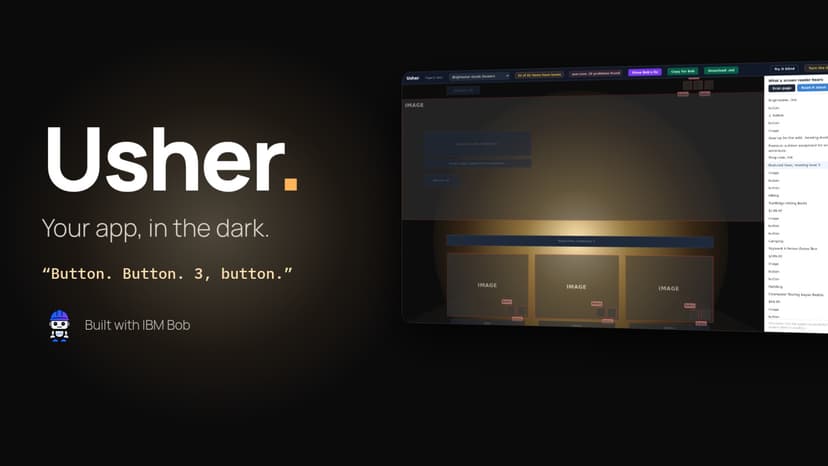
Close your eyes and try to buy something online. For a lot of blind people that's just how the web works: a screen reader reads the page out loud and they move around with the keyboard. The trouble is that most pages are never actually heard by the people who build them. A little cart icon with no label looks perfectly fine on screen, but the screen reader just says "button". A whole shop can sound like "Button. Button. 3, button. Button. Image." Which one pays? Which one empties your cart? You can't tell. And the developer never finds out, because on their screen everything looks fine. Since June 2025 this is also a legal problem for anyone selling online in the EU. There are tools that check for this already, but they hand you a list of rule codes. A list doesn't make you feel anything, and it misses things. So I built Usher. You open your page in it and it reads the page back to you the way a screen reader would, marking every line a blind user would get stuck on. Then you press "Turn off the lights" and the page falls apart into what that person actually gets: grey boxes that just say "Button", with a little torch following the voice. That's usually the moment it clicks. Then IBM Bob fixes it. I made a custom Bob mode called Usher Fixer, with its own rules: use real buttons, give every control a name that says what it does, and never make up what a photo shows. One click copies Usher's findings for Bob. Bob fixes a copy of the page and writes a short note for every change: what the screen reader said before, what it says now, and why that mattered. After that you press "Show Bob's fix" and every grey box flips to its real name: "Cart, 3 items, button". An independent checker, axe-core, scores the page again, because I don't think a fix should count until something other than the fixer has checked it. That turned out to matter. On my demo shop, Bob's first pass took the problems from 29 down to 2 and said it was done. Usher caught the last 2, Bob fixed them, and it went to 0. I also wanted to know if this works on a page I didn't write, so I tried a popular open-source template (Start Bootstrap Freelancer, 2,600 stars on GitHub). The standard checker finds 11 problems. Usher hears 13 more that it misses: 7 pictures that get read out as "dot dot dot, image", and 6 portfolio projects you can never open without a mouse. And if you just want to feel it for yourself, press "Try it blind". The screen goes black, you press Tab, and you hear the page. It's for front-end developers and QA teams, and for companies who now carry the responsibility for this. To be honest about the limits: the voice is a simulation, so real screen readers word things a bit differently, and a clean score doesn't mean a page is perfect. Bob also left 7 photo descriptions for a human on purpose, because a wrong description is worse than none. Try it: https://imprint-hash.github.io/usher/
27 Sep 2026

