🤝 Top Collaborators
🤓 Latest Submissions
TraceLab
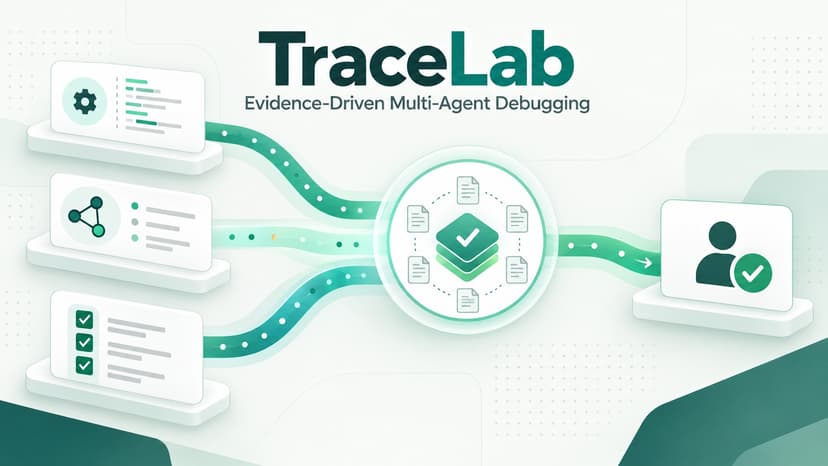
Software teams lose significant time diagnosing defects because evidence is scattered across issue trackers, source code, Git history, test results, and developer knowledge. Existing AI coding tools can suggest changes quickly, but suggestions based only on model confidence may be incorrect, introduce regressions, or lack reproducible proof. TraceLab is a multi-agent differential debugging platform designed to turn a bug report into an evidence-backed diagnosis. It ingests structured issue context, including the symptom, expected and actual behavior, affected area, repository, branch, and known evidence. Three specialized agents then investigate the defect in parallel. The Code Path Agent traces execution through relevant files and functions. The Git History Agent examines commits and change history to identify when and why the behavior was introduced. The Test Behavior Agent focuses on reproducing the failure and defining an effective regression test. Each agent produces an independent hypothesis rather than converging prematurely on one explanation. TraceLab’s Verification Engine evaluates every actionable hypothesis inside an isolated Git worktree. A hypothesis is marked verified only when the original failure is reproduced, a regression test fails before the fix, the same test passes after the patch, and the existing test suite remains green. An Arbiter then compares the recorded evidence, selects the supported diagnosis, and explains why alternative hypotheses were rejected. The primary users are developers, QA engineers, technical leads, and engineering teams handling production defects. They interact with TraceLab through a dashboard that displays ticket context, agent activity, hypotheses, experiments, patch diffs, test evidence, and the final diagnosis. TraceLab is unique because it separates investigation, verification, and approval. It does not select a solution based solely on AI confidence and never automatically merges code. A human must review and approve the evidence-backed diagnosis before a draft pull request can be created. This combines the speed of parallel AI investigation with reproducible testing and human-controlled software delivery.
27 Sep 2026
