🤓 Latest Submissions
RootFlow
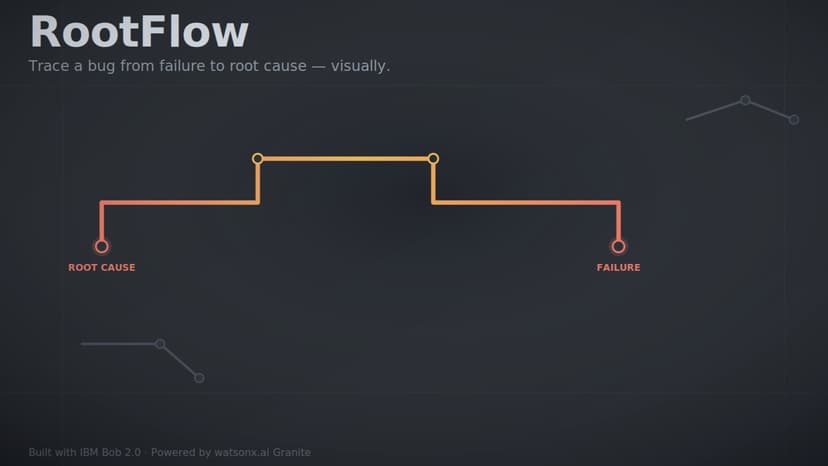
When a runtime error surfaces, the stack trace only shows where the failure happened not where it actually started. In any codebase beyond a few files, a developer has to manually walk backward through function calls, guess which file is really responsible, and cross-check neighboring code that might be involved. This is slow and error-prone, and worsens in unfamiliar or legacy modules. Even agentic AI debugging tools rarely close this gap they read the error, explain the code, and hand back a fix in text, without showing how the failure actually traveled through the codebase to get there. RootFlow is an IDE extension that closes that gap directly inside the editor. A developer copies a failing test, an error message, or a stack trace from the terminal and triggers RootFlow from the command palette and pastes it. RootFlow first performs static AST and call-graph analysis to resolve exactly how the failure propagated: which function called which, in what order, from the point of failure back toward its origin. This structural trace is handed to watsonx.ai Granite, built and integrated using IBM Bob 2.0, which reasons over the error, stack trace, and resolved code context to produce a plain-language explanation and a suggested fix. A confidence score is also computed. The IBM Granite model then generates a structured JSON output, which is passed to the frontend to render the interactive metro-style map visualization. The result renders as an interactive, metro-map-style visualization inside a IDE webview: each involved file or function is a station, the propagation path is a single highlighted line from origin to failure, and files checked but ruled out appear as separate, muted stations nearby showing the investigation looked beyond the obvious. Clicking a station opens its code and detail; the suggested fix appears as a reviewable diff, never applied automatically. RootFlow is built for developers and small teams working in VS Code anyone debugging a codebase they didn't write, onboarding onto an unfamiliar module, or resolving a failing test without losing an afternoon to manual tracing. The interaction is lightweight: select the error, run one command, get a visual answer in the same editor window, with no context-switching. What makes RootFlow distinct is that it doesn't ask a model to guess from an isolated snippet, and it doesn't stop at a text explanation the way agentic assistants typically do. Structural analysis narrows the problem first; the LLM reasons only over already-resolved context; and the result is shown visually, not just described. This ordering also makes it efficient: the model receives small, pre-scoped input rather than a whole repository, so responses stay fast and cheap even on a compact model important for something meant to run inline during active development. Because the propagation path renders as a familiar transit-map metaphor instead of a flat list or a paragraph of text, a developer sees the shape of a bug's cause at a glance.
27 Sep 2026


