
🤓 Latest Submissions
QuantDesk: Safe AI Trading Infrastructure
QuantDesk is an AI-powered quantitative trading infrastructure platform designed to make autonomous trading systems more measurable, auditable, and safe. Many trading agents combine research, model reasoning, and broker execution inside one loosely controlled workflow. QuantDesk deliberately separates those responsibilities. Python is used for offline research, feature engineering, backtesting, experiment validation, and read-only AI/MCP tooling. A C#/.NET runtime is the sole execution authority, enforcing deterministic risk controls, account and asset checks, broker reconciliation, order lifecycle tracking, and fail-closed execution gates. The system evaluates equities and crypto opportunities, but a model cannot place a trade simply because it produced a signal. Before execution, QuantDesk checks whether the research artifact is validated and current, whether market and account state are healthy, whether exposure is attributable, and whether spread, slippage, fees, and risk constraints are acceptable. Every approved paper trade is reconciled against actual broker fills and recorded as evidence for later analysis. The project currently integrates Alpaca paper trading, a dedicated research MCP server, an external market-data MCP boundary, containerized services, automated tests, durable experiment records, and a bounded BTC/USD diagnostic lifecycle that has already exercised the broker entry, exit, recovery, and final zero-exposure reconciliation path. For the AI Infra Summit, QuantDesk demonstrates an infrastructure-first approach to financial AI: models can propose decisions, but deterministic systems govern whether those decisions are allowed to reach the market. The goal is not simply to automate trading; it is to build the control plane required for trustworthy autonomous financial agents.
4 Sep 2026
ShelfWise - Agentic AI Store Operations
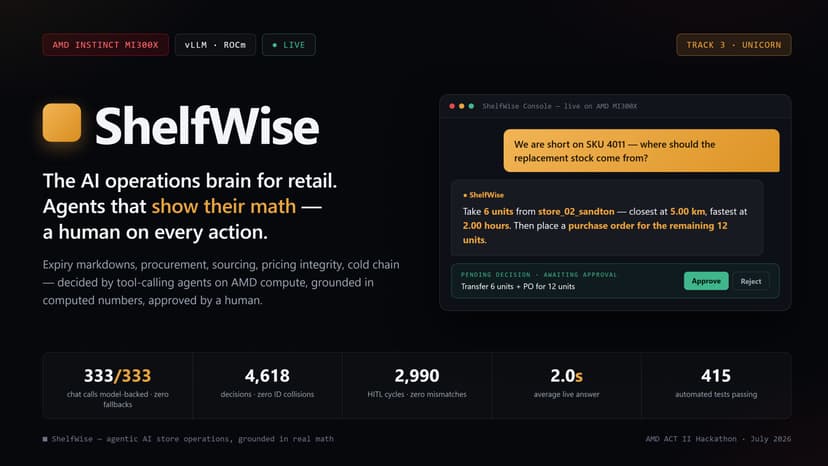
A supermarket runs on hundreds of interlocking decisions a day - most made late, on gut feel. Yoghurt expires because nobody ran the markdown math. A shortage gets answered with "transfer some stock" - which branch, DC, or supplier, at what lead time? Till prices drift and silently eat margin. A fridge failure starts a countdown on thousands in stock. Retail loses its profit in a thousand small decisions made without the math. ShelfWise makes those decisions with the numbers in hand - and never acts without a human signature. Every decision runs through a Critic/Executive agent pair powered by google/gemma-4-E4B-it on an AMD Instinct MI300X GPU via vLLM on ROCm, with native tool calling. Agents reason through a bounded loop over 11 read-only tools - stock, demand forecast, expiry risk, reorder policy, supplier ranking, cold-chain risk, price integrity, markdown simulation, and a multi-source sourcing optimizer ranking branches, DCs, and suppliers by availability, distance, and lead time. A grounding guarantee is enforced in code: an answer citing a figure no tool produced is rejected and re-run - never shipped. Every recommendation lands as a pending decision requiring human approval before any write-back - full audit trail, tenant isolation, and a learning loop that adjusts thresholds from real outcomes. Chat is the front door: one question triggers multiple live tool calls and returns a structured report. Beneath it, each store gets a digital twin - an evolving virtual replica where agents train and prove themselves before touching the real shop floor. Proof, not promises: a 15-minute live soak on the MI300X endpoint - 333/333 chat calls model-backed, zero fallbacks, 4,618 decisions, zero ID collisions, 2,990 HITL cycles, zero mismatches, answers < 6s. 415 tests pass; CI verifies a 165-capability manifest. Retail AI demos well and governs badly. ShelfWise inverts that: agents that show their math, a human on every action, receipts for every claim.
13 Jul 2026


