

🤓 Latest Submissions
MARKGAP — the P&L an agent can actually collect
The observation. An options book marked at the midpoint reports money it cannot collect. On a wide-spread multi-leg book that gap is material, and it is invisible on every dashboard. Why it matters here. This competition takes one number at one timestamp. A book that is up at 11:00 on Friday and still open is not up — it is holding an unpriced liability. What MARKGAP does. Two books, the markgap as the headline metric, a clock state machine that decays its own risk budget to zero, and a hard flatten before the horizon. The barbell. ~90% defined-risk credit spreads at 1–3 DTE on SPY/QQQ; ~10% long convexity. The regime is low-vol with a scheduled jobs print inside the window — pure premium selling into that is the wrong shape. Where the AI sits. A Featherless-hosted open-weight model returns one clamped scalar that can only shrink risk, and writes the journal. It never picks a strike, never sizes, never orders. Everything that touches money is deterministic and tested. Alpaca depth. Multi-leg orders with the net-price sign convention handled, a combined-close path with a leg-by-leg fallback for error 42210000, our own Black-Scholes Greeks because Alpaca returns none for 0DTE, indicative-feed handling, trade_updates reconciliation, the CLI driving the headless session and the MCP server as the inspection surface. Honesty. Paper flatters execution. The markgap is the correction, and we show it rather than hide it.
4 Sep 2026
CLAUSE — every decision, cited
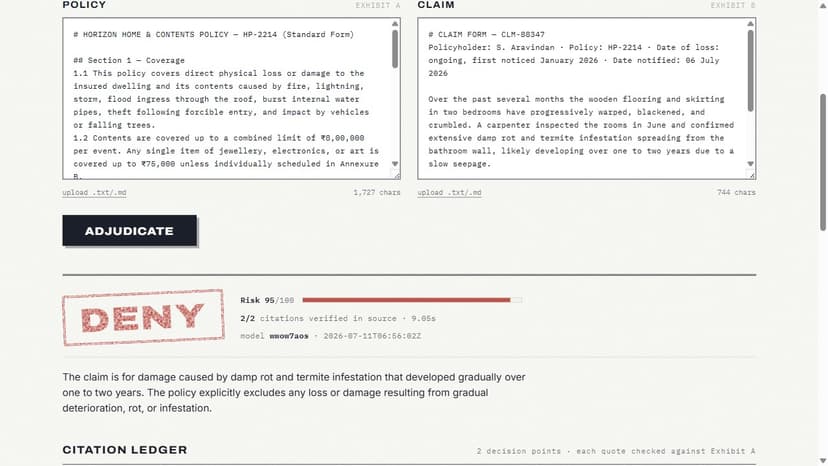
Auditable AI claims adjudication. CLAUSE reads an insurance policy and a claim, renders APPROVE / FLAG / DENY in seconds, and grounds every decision point in a verbatim policy clause — each citation programmatically verified to exist in the source before it is shown. Citations that fail verification are visibly rejected, never silently dropped. Trust enforced by code, not promised by prompt. Built for the AMD Developer Hackathon: ACT II (Track 3 — Unicorn). Powered by open-weight Google Gemma served on AMD: Fireworks AI by default, or self-hosted on an AMD Instinct MI300X with vLLM on ROCm — switching is one environment variable. How the trust core works 1. One structured Gemma call (no chains, no agents) returns a decision + points, each with a verbatim policy quote. 2. app/validation.py normalizes both sides (whitespace, unicode quotes/dashes) and requires an exact substring match, mapping the match back to a character span in the original text. 3. Verified points get a ✓ VERIFIED IN SOURCE stamp and a click-to-highlight of the exact clause. Failed points render struck-through: ✗ NOT IN SOURCE — excluded from decision basis. 4. Every adjudication produces a downloadable audit record: SHA-256 of both inputs, model ID, endpoint, timestamp, latency, per-citation validation results.
13 Jul 2026


