
Kholofelo Robyn Rababalela@kholofelo_robyn_rababalela38
3
Events attended
2
Submissions made
South Africa
5+ years of experience
About me
Jesus is King. ✝️ 🥋 Artist | 2x Business Owner | Friend Founder Director & Sovereign Systems Engineer Kopano-Phu Governance System [KPGS] Unity through technology, sovereign digital infrastructure for African realities.
🤓 Latest Submissions
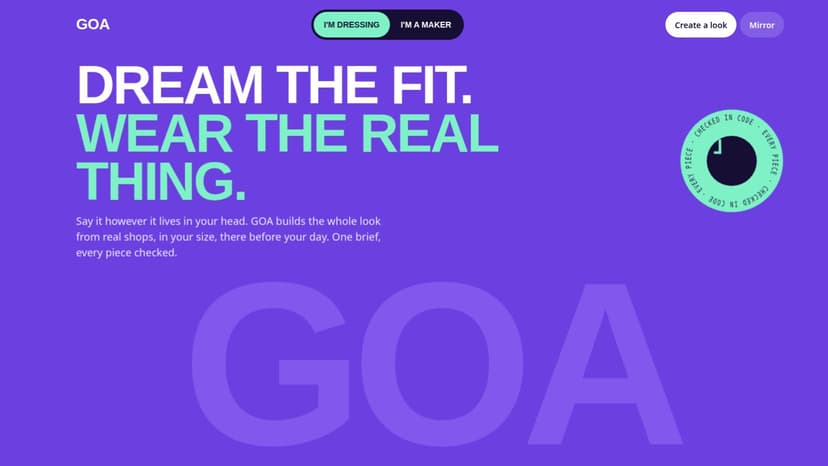
GOA: Shop from a Sentence
Shopping starts with a need, not always a product name. Alice is graduating in Cape Town. She wants a green, elegant, reusable outfit for a warm December day, but conventional keyword searches leave her bouncing between shops. Independent designers remain hard to discover, while merchants cannot see what customers tried to find. GOA: Shop from a Sentence is a working creative-commerce prototype built by Busi Ndlovu and Kholofelo Robyn Rababalela for the AMD Developer Hackathon Act III, Track 3: Reinvent Commerce. A shopper describes an outfit in natural language or supplies reference photos. Gemma-4-31B-IT through AMD Token Factory interprets the brief into garment, footwear and accessory needs. Semantic catalogue matching proposes items; deterministic Python rules verify size availability, stock, arrival before the event and budget including delivery. Shoppers can swap pieces, ask why they fit, save a look and explicitly send demo quote enquiries. Unmet needs are shown honestly as "not on offer yet" and recorded in a maker demand-gap view. We evaluated GOA using 20 frozen briefs, 20 live Gemma calls and the same synthetic catalogue for a keyword-search baseline. GOA produced 55% fully valid looks versus 30%, 100% first-shown item grounding versus 82%, and 80% sendable enquiries versus 35%. Median steps were 3 versus 8, and GOA captured 12 unmet parts versus none for the baseline. Keyword search filled more individual parts (93% versus GOA's 83%), so our claim focuses on verified outcomes, not superficial coverage. The prototype runs on Vercel. Merchants, product inventory and quote inbox are fictional demo data; no purchases, actual merchant fulfilment or sales uplift are claimed. GOA demonstrates a more accountable bridge between human imagination and available supply.
18 Oct 2026

LEFA AI - Governed Autonomous Alpha Companion
Most finance products introduce themselves with charts, balances, and buttons. You speak to LEFA. LEFA is the user-facing base intelligence. The complicated architecture underneath exists to help LEFA make a better decision — not to make the user learn the architecture. You bring the human question. LEFA brings governed financial intelligence. See the engine room Inspect assets. 👁️ Observe → 📖 Ledger → ✨ Reveal Animated LEFA Observe Ledger Time Reveal timeline LEFA does not treat a convincing first answer as reality. Observe what is happening. Ledger what was known. Let time continue. Reveal what survived. The frontend tells the story. The backend preserves the truth. Time decides what survives. 🧠 What moves under LEFA? Animated LEFA backend control room The public experience stays light. The backend is intentionally heavy. HUMAN ↓ LEFA — base identity / final decision-maker ↓ CRUD — capture the event ↓ ARK — governed structured bloat ↓ BMP—stress test, filter and compress ↓ MAO — route bounded responsibility ↓ SWFUS — five internal ecosystems ↓ EVIDENCE + RECEIPTS + UNCERTAINTY ↓ LEFA ↓ DECISION / EXPLANATION The internal system does not replace LEFA's judgment. It filters unsupported certainty, preserves useful ambiguity, and returns better governed evidence to the base model. OPEN // Why the backend expands before it compresses 🌱 Five agents. Five ecosystems. One LEFA. Animated LEFA SWFUS five-agent ecosystem The five internal agents do not talk to the user. They receive governed information from LEFA's backend and operate inside bounded ecosystems. S Sovereign Ingestion What may enter as a governed signal? W Witness Isolation What must be preserved independently as testimony? F Fluid Vectoring What interpretations or directions remain plausible? U Unified Synchronization What accepted state must align before action? S Severance Execution What must be cut, held, or rejected? Rich at the center. Minimal at the edges.
4 Sep 2026


