🤓 Latest Submissions
HIPnosis: Verified CUDA to ROCm Ports
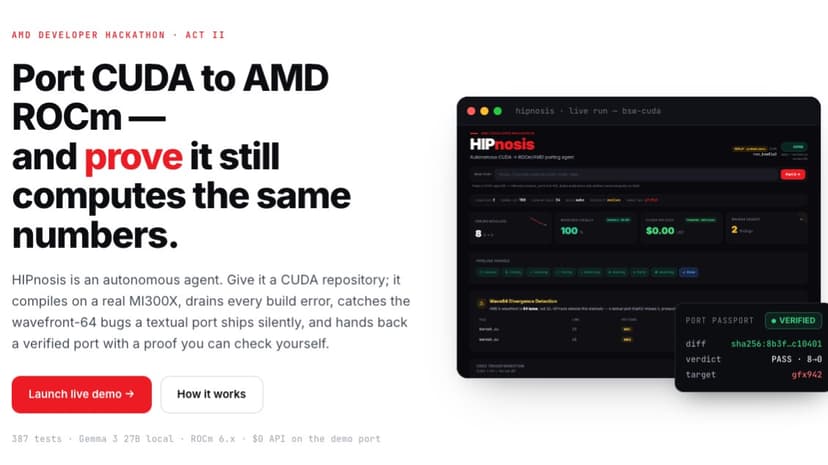
There are billions of dollars of CUDA code locked to one vendor. AMD's MI300X offers 192 GB of HBM3 at a fraction of the cost of an H100, but the migration path is where teams give up: hipify translates most of the syntax and stops exactly where the problems begin. The port does not compile, nobody fixes it, and nobody proves it still computes the same numbers. HIPnosis is an autonomous porting agent that finishes the job and shows its work. Paste a CUDA repo URL and it scans the code, translates it with hipify, adapts the build system, and then enters a deterministic loop on a real MI300X: compile, parse every error, classify it against a 14-class taxonomy, propose a fix by rule table when possible and by LLM when not, apply it as an atomic git commit, and repeat until the build is green. It then runs the ported binary and verifies numerical parity against the reference with rtol/atol tolerances. The output is a branch, a pull request, and a port certificate listing what was fixed, by whom, and what still needs a human. Every number in the certificate comes from code, never from a model. Two things set it apart. First, a static wave64 audit that catches silent correctness bugs (warp size 32 vs 64 assumptions) that compile cleanly and ship wrong numbers; textual translators miss these entirely. Second, architecture: the LLM decides content, the orchestrator decides control. Success is judged only by compilers, tests, and a numerical comparator, never by asking a model if the result looks right. Fixes are routed to a locally hosted Gemma 3 27B on the MI300X via vLLM, at zero API cost. The whole system is containerized, and a replay profile lets anyone rerun our recorded MI300X pipeline on a laptop with one docker compose command.
13 Jul 2026

CerberusGuard: Three-Head Defense for AI Agents
CerberusGuard is a defense in depth trust layer for production AI agents. It unifies three best-in-class open-source primitives into one deployable product with shared policy, shared audit, and cross-layer correlation, so security teams can sign off on agentic workloads the way they sign off on any other workload. The product enforces three independent controls: - Head 1, Veea's Lobster Trap, runs regex-based deep prompt inspection in front of the LLM across 21 metadata fields (intent, risk, PII, credentials, sensitive paths) in sub-millisecond time. -Head 2, PennyPrompt, runs atomic pre-execution budget checks against a SQLite cost ledger and trips loop detection on similar consecutive prompts. -Head 3, ClawCrate, wraps every shell command in a kernel-level sandbox (Landlock plus seccomp on Linux, Seatbelt on macOS) and scrubs credential-pattern environment variables before the child process starts. What makes this a product rather than three tools in a folder is the integration layer. Every event serialises to one unified TrustEvent schema, correlated by agent_id and correlation_id, so a session reconstructs across all three heads from one audit log. The policy compiler turns one YAML into three native configs (Lobster Trap YAML, PennyPrompt TOML, ClawCrate YAML), so the security team holds one source of truth and the three engines never drift. A Next.js dashboard flashes red on DENY events and reconstructs cross-layer session timelines. A Python SDK propagates correlation IDs across LLM calls and shell execs in one line. Everything is MIT-licensed end to end. The stack runs on a single Linux or macOS machine with no cloud dependency. Total added latency is p95 36.87 ms, well under our 50 ms ceiling. All three heads run out of process, so the agent cannot disable what it does not control. Audit export is structured NDJSON, ready for SOC2, ISO 27001 and EU AI Act mappings. Three heads, one guardian, zero trust between layers. Deployable today.
19 May 2026


