🤝 Top Collaborators


🤓 Latest Submissions

Veritas-Agent
VERITAS is an execution-aware autonomous AI trading agent built for the Alpaca AI Trading Agents Hackathon. Its goal is not simply to predict market direction, but to determine whether a proposed options trade is trustworthy enough to execute. VERITAS focuses on defined-risk short-DTE credit spreads on SPY and QQQ. A deterministic candidate engine first generates valid options spreads using predefined constraints. An AI reasoning layer then evaluates and ranks those opportunities using market context, technical signals, volatility information, and the strategy's rules. The AI does not have unrestricted control over execution: every proposal must pass deterministic mathematical validation and a multi-layer risk gate before an order can be submitted. The project's core principle is: “LLM proposes, math disposes.” The system independently recalculates option spread width, credit, maximum loss, breakeven, position size, and other critical values instead of trusting the language model's numerical output. It also applies an Execution Reality Layer that evaluates whether a trade remains attractive after conservative assumptions about liquidity, slippage, and paper-trading execution behavior. A key feature of VERITAS is its Execution Confidence Score, which measures the quality and trustworthiness of each candidate based on factors such as quote quality, liquidity, data freshness, spread characteristics, and execution assumptions. Low-confidence opportunities can be rejected or traded at reduced size. The agent also continuously reconciles positions and account activity, polls for options activities that are not delivered through streaming events, and uses a hierarchical risk system with per-trade limits, daily loss protection, position-count limits, portfolio heat, liquidity checks, DTE constraints, and an emergency kill switch. The default strategy avoids holding options into expiration and prioritizes controlled, defined-risk exposure.
4 Sep 2026
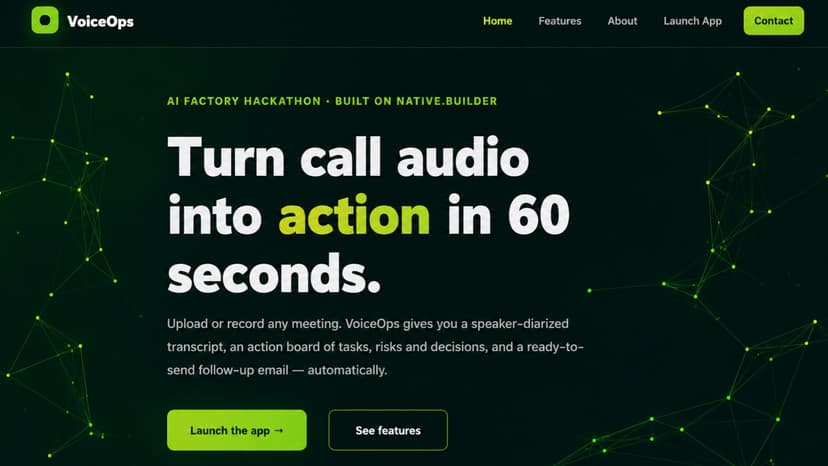
VoiceOps - Post call intelligence,not a transcript
Customer-success, B2B sales and product teams waste 15-20 minutes after each call: taking notes, gathering commitments and putting together the follow-up in their head. VoiceOps fills that gap. Upload or record a 2-speaker call and then VoiceOps analyses this call within one minute: Speechmatics transcribes with speaker diarization, an auto-summary, and sentiment out; an AI/ML API compatible LLM extracts strictly formatted text: action items who has to do them and when, risks ranked by severity, decisions made and a draft for follow up email. Our Value Proposition is quote grounding: Every item that is pulled is effectively linked to a word-for-word excerpt from the call; VoiceOps does not "make up" any commitment that was never made. The follow-up letter has been written for you to read and send, it is designed to be human-in-the-loop. If it's possible to build anything mainly on native.builder (UI, data, deploy), with a tiny sized zero dependency Node machine storing all API keys server-side. There is no “killed” transcript, and no one click will appear to retrieve again in case of an extraction failure.
10 Aug 2026

CaptionDB
CaptionDB is an AI-powered platform that transforms videos into structured, searchable, and caption-rich content through an intelligent multi-stage processing pipeline. Instead of treating a video as a single asset, CaptionDB automatically detects scene boundaries, extracts representative keyframes, filters low-quality or duplicate images, performs vision analysis using multimodal AI, and generates context-aware captions tailored to different tones and use cases. The system is built with a production-grade architecture using Clean Architecture principles, ensuring complete separation between the Domain, Application, and Infrastructure layers. The backend is powered by FastAPI, PostgreSQL, SQLAlchemy, Redis, and Celery for scalable asynchronous processing, while the frontend uses Next.js 15, React Query, Zustand, and TypeScript to deliver a modern user experience. CaptionDB is designed to be AI-provider agnostic. Vision analysis, caption generation, authentication, storage, and background processing are all abstracted behind interfaces, making it easy to replace or extend providers without changing business logic. The platform includes OAuth authentication, project management, task monitoring, progress tracking, and an optimized AI pipeline that minimizes unnecessary token usage through scene detection and intelligent keyframe selection. By combining computer vision, multimodal AI, and scalable cloud architecture, CaptionDB significantly reduces the time required to generate meaningful captions and structured metadata for videos. The result is a fast, extensible, and production-ready platform suitable for content creators, educators, marketers, media teams, and developers who need automated video understanding at scale.
13 Jul 2026


