
minteeq ahmed@minteeq_ahmed400
3
Events attended
2
Submissions made
Pakistan
2+ years of experience
About me
Computer Science student & AI developer focused on end-to-end prototype execution. My builds cover multimodal LLMs, retrieval systems (RAG), and agentic workflows. When joining a sprint, I bring strong system architecture skills, fast iteration cycles, and clean integrations across Python/FastAPI backends and modern web frontends. Let’s team up and ship something great.
🤝 Top Collaborators

🤓 Latest Submissions
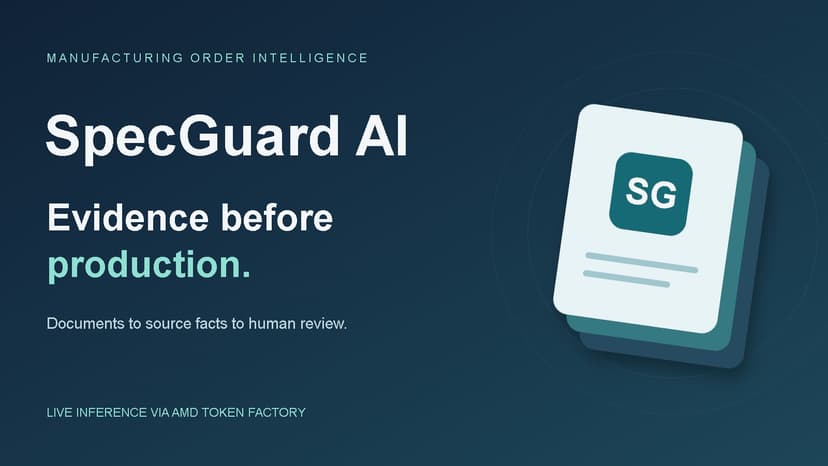
SpecGuard AI Manufacturing Order Review
Manufacturers often receive one order across buyer messages, technical PDFs and size spreadsheets. Conflicting quantities, colors or materials can be missed during manual review, creating avoidable production errors. SpecGuard AI is a working application that helps order coordinators compare these documents before production. Built with Python and Streamlit, it uses AMD Token Factory with MiMo-V2.6-Flash to extract manufacturing facts alongside source quotes and locations. Schema validation and independent checks for supported templates help identify incomplete or unsupported results. Deterministic rules then compare requirements and flag discrepancies. The demonstration uses three synthetic hoodie documents: the buyer requests 300 black hoodies, the technical PDF specifies 280 in charcoal, and the size spreadsheet totals 300. SpecGuard flags the quantity, color and size-total conflicts, preserving evidence for review. Users can record confirmed corrections and reviewer notes without overwriting original facts, then export JSON, CSV and clarification reports. READY means the configured checks have no remaining blockers; independent human production approval is still required. Validation includes 99 passing automated tests, 27 synthetic regression cases and a successful hosted AMD inference smoke test. These results demonstrate controlled behavior rather than general real-world accuracy. Next steps include manufacturing pilots, authenticated reviewers and persistent review records.
18 Oct 2026
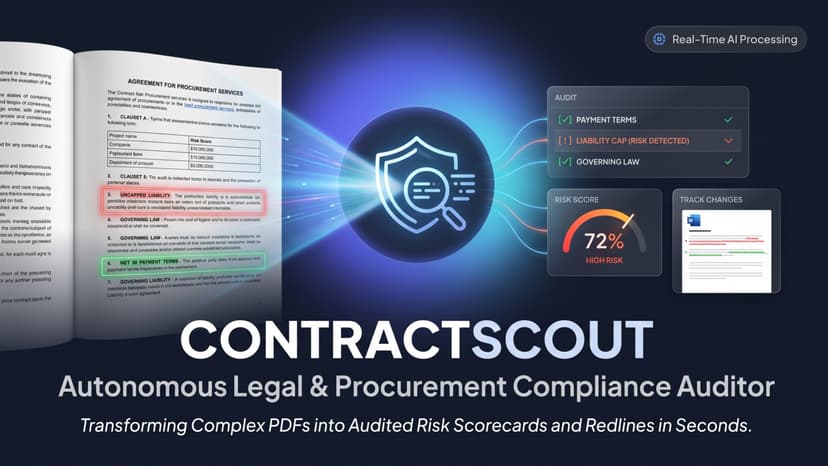
ContractScout: Autonomous Legal Auditor
Problem Statement: Procurement teams, CFOs, and enterprise lawyers spend countless hours manually reviewing 30+ page tender agreements and vendor contracts. This manual review is not only incredibly slow but highly error-prone. Standard "chat with your PDF" tools fail because they lack structural awareness—missing hidden liabilities, cross-clause contradictions, and failing to provide actionable deliverables in standard business formats. Solution & Target Users: ContractScout is an autonomous document pipeline that audits messy procurement and legal PDFs against strict, pre-configured compliance checklists. Designed for enterprise legal and procurement teams, it parses complex documents (including multi-page tables), indexes the semantic meaning, and uses an agentic workflow to cross-check every clause. User Interaction: A user simply drops a complex contract into the ContractScout UI. Within seconds, the system outputs a validated risk scorecard (Pass, Fail, Conditional Risk). What Makes It Unique: ContractScout moves beyond generic AI chatbots by providing real-world utility through three standout features: Visual Grounding: It doesn't just extract text; it captures exact bounding box coordinates and highlights the offending clause directly on the rendered PDF canvas, building immediate trust. Dollar-at-Risk Calculator: It translates legalese into business impact by calculating the estimated financial liability in real dollars (e.g., explicitly flagging "Unlimited Exposure" for missing liability caps). Native Word Export: It bridges the gap to the lawyer's workflow by generating a native .docx export featuring standard Word "Track Changes" (red strikethrough for violations, green for suggested safe fallbacks) that is instantly ready for negotiation. Efficiency: By combining localized semantic chunking with direct document coordinates and actionable exports, ContractScout slashes review time from hours to seconds and actively prevents hidden financial traps.
27 Sep 2026


