🤓 Latest Submissions
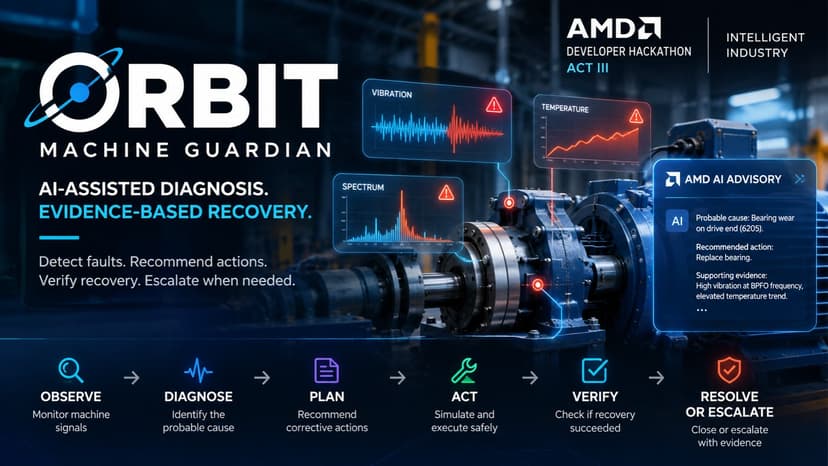
ORBIT Machine Guardian
ORBIT Machine Guardian is an AI-powered industrial reliability agent designed to help maintenance teams detect machine faults, investigate their causes, coordinate corrective actions, and verify recovery. Traditional monitoring systems can detect anomalies, while AI copilots can recommend repairs. However, recommending or executing an action does not prove that a machine has recovered. ORBIT addresses this gap through an evidence-driven workflow: OBSERVE → DIAGNOSE → PLAN → ACT → VERIFY → RESOLVE OR ESCALATE. ORBIT analyzes simulated machine sensor signals, identifies potential faults, and produces diagnosis and recovery recommendations. Its AMD Token Factory integration provides an AI advisory layer that can contribute reasoning and suggested actions. A deterministic controller validates recommendations against permitted actions and safety rules rather than allowing the language model to independently control the system. After a simulated corrective action, ORBIT evaluates the available post-action evidence. When verification succeeds, the incident can be marked resolved. When a fault persists, evidence conflicts, or information is insufficient, ORBIT can escalate instead of falsely declaring success. The interactive dashboard presents machine status, incident timelines, sensor trends, recovery outcomes, and an evidence ledger that makes decisions easier to inspect and audit. ORBIT's central principle is simple: executing an action is not the same as fixing a machine. By combining AI-assisted diagnosis with deterministic safeguards and explicit recovery verification, ORBIT demonstrates a more accountable approach to industrial AI. The current prototype uses simulated machine scenarios. Its results demonstrate behavior within that environment and should not be interpreted as validated performance on real industrial equipment. AMD-hosted AI is used for advisory reasoning; the system does not claim AMD GPU execution unless separately demonstrated.
18 Oct 2026
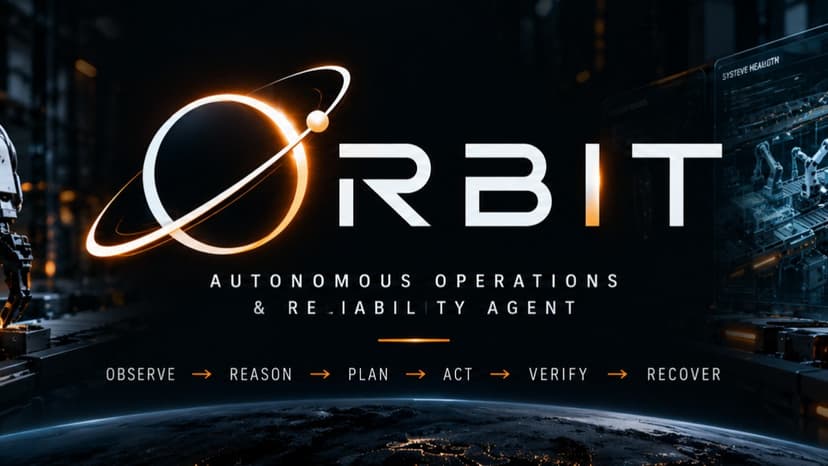
ORBIT — Autonomous Software Factory
ORBIT is an autonomous software factory built in BAND Desktop to demonstrate reliable multi-agent software production. A single human task is dispatched to a coordinated team of coding agents that plans the work, assigns responsibilities, implements the product, reviews the implementation, runs verification, and recovers from failures without human steering. The factory is designed around a closed loop: Observe → Reason → Plan → Act → Verify → Recover. Specialized agent seats communicate through BAND, exchange evidence and handoffs, challenge each other's work, and only allow validated results to progress. The mandates are designed to remain reusable across different software problems rather than encoding the target application's implementation details. For the Dark Factory challenge, ORBIT applies this process to the selected clean-room product track. The resulting repository contains the staged application, factory mandates, documentation, and evidence needed to reproduce the run. The goal is not simply to generate code, but to demonstrate that a team of autonomous coding agents can collaborate, detect bad work, correct failures, and independently deliver a working service from a specification.
6 Oct 2026


