
Muhammad Mubashar@muba12
4
Events attended
3
Submissions made
2+ years of experience
About me
Muhammad Mubashar Usman is a Computer Science undergraduate with a passion for building technology that makes an impact. With hands-on experience across software development, data science, and AI/ML, he brings a well-rounded technical foundation to every project he takes on. Proficient in Python, C++, and SQL, Muhammad has applied his skills across multiple domains — from developing functional applications to exploring the possibilities of artificial intelligence and machine learning. His intermediate-level experience reflects a developer who has moved beyond theory and into real-world problem solving. Currently pursuing his bachelor's degree, Muhammad is driven by curiosity and a commitment to continuous learning. He is eager to collaborate with like-minded innovators, contribute to cutting-edge AI projects, and grow as a builder in the global tech community.
🤝 Top Collaborators

🤓 Latest Submissions
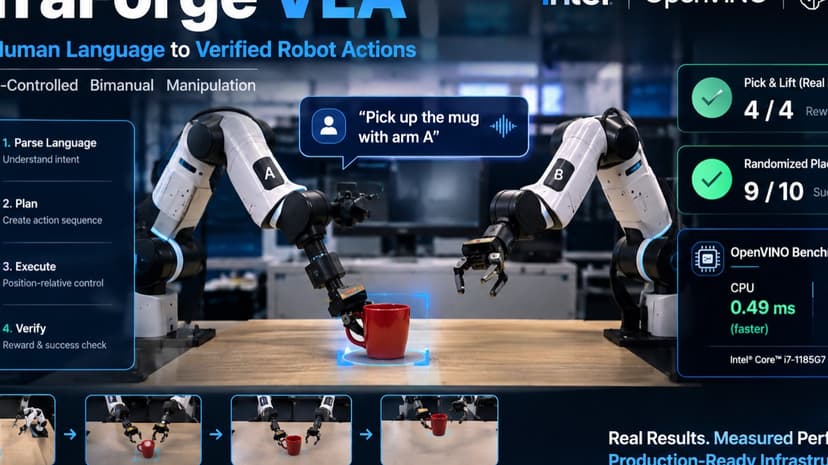
InfraForge VLA: Language to Robot Action
InfraForge VLA is a language-controlled robotic manipulation pipeline built for Intel's Bimanual VLA Manipulation Online Challenge, part of the AI Infra Summit Hackathon. How it works: a plain-language instruction such as pick up the mug with arm A is parsed by a rule-based language interface into a structured action plan. That plan drives a simulated bimanual robot, built on MuJoCo and LeRobot's ALOHA environment, through a real pick-and-lift sequence using end-effector control. What is verified, not just claimed: pick-up succeeds and is reproducible, reaching reward 2 out of 4 for the right arm and 4 out of 4 for the left arm, both confirmed on real hardware. The pick-up mechanic is position-relative, computed from the object actual position using a measured geometric offset rather than hardcoded coordinates. We validated that this generalizes with a 10-seed randomized placement test, succeeding on 9 out of 10 seeds within an empirically measured safe range. Inference is benchmarked with Intel OpenVINO on real CPU and integrated GPU hardware, including an honest finding that for this small policy model, CPU outperforms GPU, since GPU dispatch overhead dominates at this model size. What is honestly still in progress: two-arm hand-off, passing the object between grippers, is not yet reliable. We root-caused the actual blocker through direct physics measurement rather than guesswork, documented in full in the repository technical notes. We prioritized a smaller, genuinely working, well-documented pipeline over a larger scenario attempted unreliably, given the online-only timeline.
16 Sep 2026
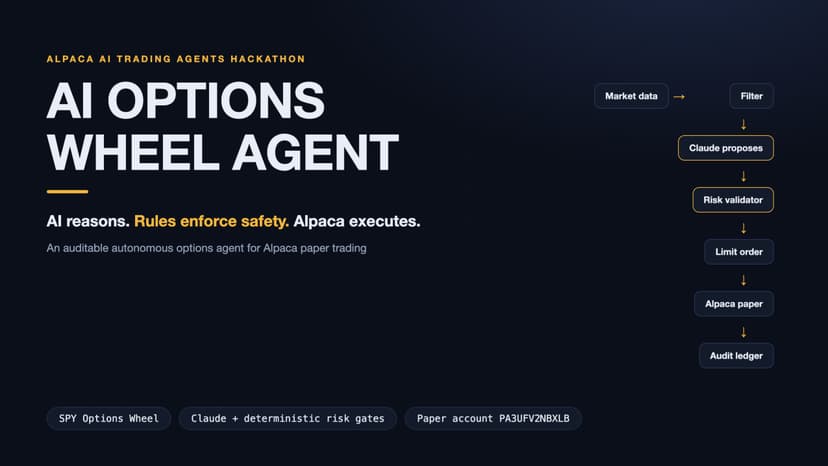
AI Options Wheel Agent
AI Options Wheel Agent is an auditable autonomous trading system combining LLM-based reasoning, deterministic risk controls, and Alpaca paper trading infrastructure. The project explores a key question in AI trading: how much autonomy should an AI agent have, and where should deterministic controls take over? The agent implements an Options Wheel strategy across two portfolio states: CASH and SHARES. In CASH, it evaluates cash-secured put opportunities. After assignment, it transitions to SHARES and evaluates covered-call opportunities. When shares are called away, the cycle returns to CASH. Claude acts as the reasoning layer, evaluating pre-filtered candidates and proposing structured trading actions. The model cannot bypass risk controls — every proposal passes through deterministic validation before execution. The risk layer validates collateral, exposure, contract validity, option type, quantity, quote quality, liquidity, duplicate orders, portfolio state, and covered-call cost-basis constraints. Invalid or malformed output fails closed instead of reaching the broker. Alpaca provides market data and paper-trading execution via limit orders, with an auditable decision and transaction ledger. A Streamlit dashboard provides visibility into decisions, portfolio state, performance, orders, and trading history. The system includes replay-based evaluation, baseline-versus-agent comparison, adversarial testing, and live paper-trading validation backed by an 88-test automated suite. Live validation exposed and corrected real API response-shape assumptions around option-chain data, open interest, and order parsing. The core principle: AI reasons. Deterministic systems enforce safety. Alpaca executes. The goal is not unrestricted AI control, but a verifiable, testable, auditable boundary where AI reasoning operates within deterministic safety constraints.
4 Sep 2026

BrainOS — Enterprise Knowledge Execution Platform
Every company runs on knowledge scattered across policies, SOPs, and the heads of whoever's been there long enough to remember the exceptions. AI agents don't have that instinct. Most "enterprise AI" tools just search documents and hand back a paragraph — which isn't enough for an agent to safely act on its own. BrainOS reads uploaded company documents and builds a structured company brain: entities, rules, and reusable Skill Cards — an auditable, executable definition of a business process, with its inputs, conditions, and action. Ask BrainOS a real question, and it retrieves the matching skill, checks each condition against the situation, and returns an answer with a full step-by-step reasoning trace, not a black-box response. The pipeline runs document upload, text extraction, LLM-based entity and skill extraction, vector storage in Qdrant, and agent reasoning, all through a provider-agnostic API layer. During development we used the Google AI Studio (Gemini) API; for judging, the same code path points at Fireworks AI, which serves inference on AMD Instinct GPUs, via a one-line environment swap. The working prototype: upload a policy document, watch entities and skills extract in real time on the dashboard, inspect the generated Skill Card, then ask a live question and watch the reasoning trace resolve. Not a search tool wrapped in a chat window — the structured knowledge layer AI agents need to act safely inside a real company.
13 Jul 2026


