

Mubashir Hussain@mubashir-h
3
Events attended
2
Submissions made
Pakistan
1 year of experience
About me
Aspiring software developer and cyber security enthusiast currently learning computer science, programming, AI, and cloud technologies. I’m working through CS50x and exploring generative AI, machine learning, and practical AI development. I enjoy building projects, solving technical problems, and continuously learning new technologies.
🤓 Latest Submissions
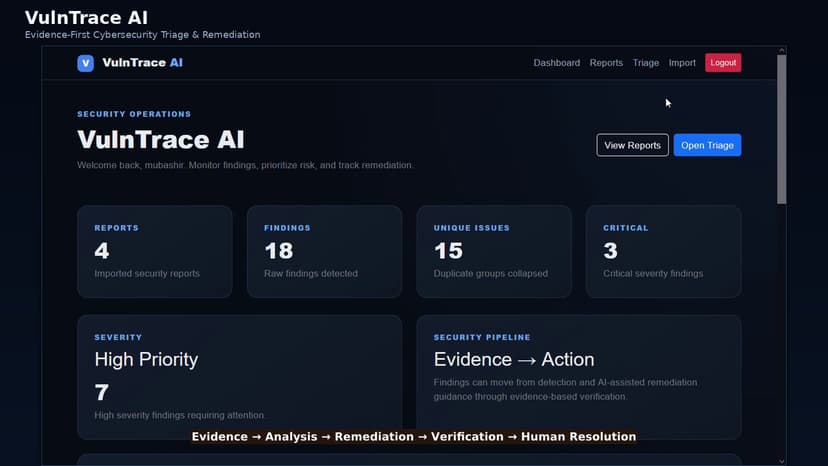
VulnTrace AI
VulnTrace AI is an evidence-first cybersecurity triage and remediation verification platform designed to help security teams turn structured security reports into actionable findings. The problem it addresses is that security reports can contain many findings with different severity levels, confidence levels, evidence quality, and duplicate issues. Reviewing these findings manually can make it difficult to identify priorities, understand the technical impact, plan remediation, and track whether an issue was actually fixed. VulnTrace AI processes structured JSON security reports and normalizes their findings into a centralized workflow. A deterministic analysis engine evaluates severity, confidence, evidence quality, risk score, and duplicate relationships. This creates a reproducible triage view where findings can be prioritized without depending on an AI model to make the underlying security decision. The platform also provides a local AI analysis layer using Ollama and Qwen 2.5 1.5B. The AI analyzes the supplied finding information and provides a summary, potential impact, possible root cause, remediation guidance, and verification guidance. AI output is advisory and is explicitly separated from the deterministic risk engine. A key part of the solution is the remediation verification workflow. After remediation, a user submits new verification evidence. The finding enters a NEEDS REVIEW state rather than being automatically marked as fixed. A human reviewer can then explicitly resolve the finding. Verification information is stored in SQLite to preserve an auditable history. The target users are security analysts, developers, and small security teams who need a lightweight way to organize vulnerability findings and track remediation. The project is creative in how it combines deterministic security analysis, local AI assistance, evidence preservation, duplicate correlation, and human-controlled verification into one workflow. It demonstrates how AI can assist cybersecurity work without replacing evidence-based security decisions. The complete flow is: Security Report → Parsing → Deterministic Analysis → Risk & Evidence Assessment → Triage → Local AI Analysis → Remediation → Verification Evidence → Human Review → Resolution
27 Sep 2026

RePlanTable AI
RePlanTable AI is a voice-driven bi-manual robotic manipulation system built in MuJoCo. It converts natural-language voice instructions into robot actions using Speechmatics and a task planner, then executes pick-and-place tasks with two SO-101 arms. The key capability is closed-loop verification and recovery. Instead of assuming that execution succeeded, the system checks the resulting robot state and verifies object positions through vision. When a placement fails, the system detects the failed object, reads its actual current position, generates a recovery plan from that state, executes the recovery, and verifies the result again. The system then continues processing new voice instructions without restarting the simulation. Each new instruction is planned using the current world state, allowing the robot to adapt to previously completed or recovered actions. The demonstrated session includes a deliberately injected failure, automatic recovery, robot and vision verification, and two subsequent state-aware replanning tasks.
16 Sep 2026


