
Muhammad Hanzla@muhammad_hanzla_451
16
Events attended
14
Submissions made
Pakistan
1 year of experience
About me
Hello! this is Hanzla, a student of computer science in the Government College University Faisalabad.I have solved over 200 LeetCode questions using Python and Java. I am passionate about AI and am also learning full-stack development. In this journey, I have learned HTML, CSS, and JavaScript, and I am currently learning React and other technologies. I have also completed a couple of projects using C++, HTML, CSS, and JavaScript in web development. Additionally, I have been a trainer for Data Structures and Algorithms (DSA) and LeetCode at iCodeGuru for the past few months.
🤝 Top Collaborators




🤓 Latest Submissions

Autofix-ai
The Problem Every AI coding tool today — Cursor, GitHub Copilot, Codex — stops at diagnosis. They tell you "here's the bug" and leave the rest to you: apply the fix, run the test suite, discover the fix broke something else, and start over. That's still 30–60 minutes of manual work per bug, and there's no safety net — the assistant never verifies its own fix. Our Solution AutoFix AI is a self-healing debug agent. Broken code goes in; fixed, tested, verified code comes out. It runs a fully autonomous Diagnose → Fix → Verify → Retry pipeline: Diagnosis Agent — reads the entire repository (not just searched snippets) and returns a root cause with file:line evidence. Fix Agent — writes a minimal patch as full-file rewrites, with strict rules against touching lockfiles or dependencies. Verification Agent — applies the patch and runs the real test suite (npm test or pytest) inside the project. No simulation. Head Agent — orchestrates everything, snapshots the project before each attempt, and retries up to 3 times if verification fails, feeding the new error output back into the diagnosis. Every AI call goes to IBM Bob 2.0's inference API (premium model). Every run is logged to Supabase for analysis. Target Users Developers dealing with failing CI or unfamiliar legacy code who want a first-pass fix, not just a hint. Engineering teams who want automated debugging on pull requests — the long-term vision is a GitHub bot that opens a fix PR whenever a test suite fails. Students and learners who can watch the agent's reasoning and learn how the fix was derived. How Users Interact With It Three ways to start a run: Pick a seeded broken sample project (broken-node, broken-logic, broken-python). Paste a public GitHub URL — the app clones it and runs the pipeline. Upload source files directly. The UI streams each agent step in real time via Server-Sent Events. A live pipeline tracker lights up Diagnose → Fix → Verify, shows retry attempts visually, and ends with a report card: root cause, the patched file, test output, and the killer stat — "Manual debugging: 45 minutes. AutoFix: 8 seconds." What Makes It Unique Closed loop. We don't just find bugs — we fix and prove the fix works by running the real tests. Whole-repo reasoning. Bob reads the entire codebase before deciding, avoiding the tunnel vision of snippet-based tools. Real verification. Other agents "propose" fixes; we shell out to the project's actual test runner and read the exit code. Self-correcting. If the first fix fails, the loop runs again with the new error output as fresh context. Language-agnostic. The verifier auto-detects Node.js or Python and picks the right test runner. Why It Works By combining IBM Bob's inference quality with a real verification step and bounded retries, AutoFix turns a 45-minute manual debug into an 8-second autonomous run — with a permanent, queryable audit trail in Supabase
27 Sep 2026
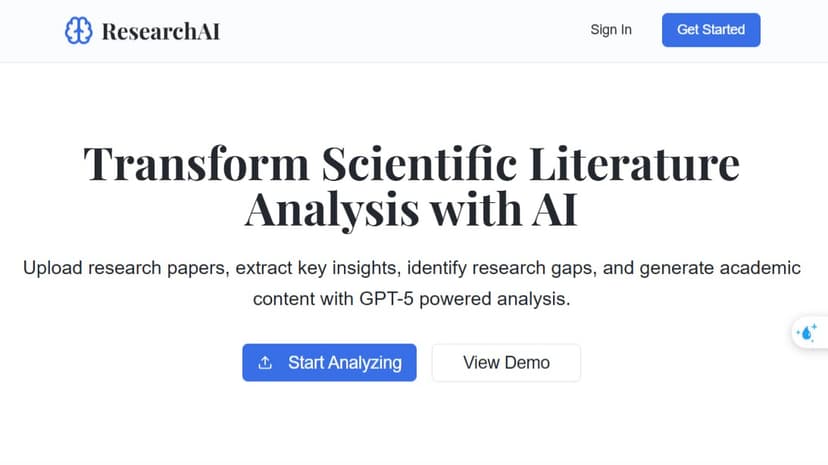
Scientific Literature Analysis Platform
ResearchAI is a comprehensive web application designed to streamline the academic research process. It empowers researchers, students, and academics to manage, analyze, and interact with scientific papers more effectively. Users can upload PDF documents, and the system will automatically process and index them. The platform offers several key features: AI-Powered Analysis: Leverages AI models to perform in-depth analysis of research papers, helping to identify key findings, methodologies, and potential research gaps. Interactive Chat (RAG): Includes a sophisticated "ask anything" feature that allows users to have a conversation with their documents. The system uses Retrieval-Augmented Generation (RAG) to provide accurate, context-aware answers based on the content of the uploaded papers. Content Generation: Assists with academic writing by providing tools to draft content, generate outlines, and summarize complex information. Project and User Management: Features a full dashboard for managing projects, tracking analysis history, and handling user authentication. The application is built with a modern tech stack, featuring a Next.js frontend for a responsive user experience and a robust FastAPI backend to handle file processing and AI-powered analysis.
24 Aug 2025

AI Voice Powered Restaurant Assistant
Agentic Foodie is a voice-powered restaurant ordering app built using Streamlit for the frontend UI. It features a modern interface for browsing the menu, recording voice input, and managing orders. Key Streamlit components like st.columns, st.button, and st.session_state handle layout and interaction, while custom CSS enhances styling and responsiveness. audio_recorder_streamlit enables in-browser audio recording, returning WAV bytes. These are processed with pydub (AudioSegment) and speech_recognition (Recognizer with recognize_google) to convert audio to text for voice-based interactions. Groq API (LLaMA 3) provides the core NLP via HTTP requests made using the requests library. The app sends user messages and history to the API and receives structured JSON responses with intents, item IDs, quantities, and replies. Rate-limiting is managed using x-ratelimit-remaining-requests and timestamps with the time module. JSON is used throughout for defining menus, promotions, and exchanging data with the Groq API. The io module (io.BytesIO) handles in-memory audio processing for seamless transcription. A custom Multi-agent Control Plane (MCP) organizes tasks like checking availability and suggesting items. Agents are registered using decorators (e.g., @inventory_agent.task) and simulate modular multi-agent interactions. Overall, this tech stack enables an AI-driven, interactive restaurant ordering experience with support for voice input, menu browsing, upselling, and conversational responses — all in a sleek, real-time Streamlit app.
8 Jul 2025

SupplyShield - Smart Risk Detection
SupplyShield 2.0 is an AI-powered logistics intelligence system designed to monitor global shipments in real time, detect risks proactively, and automate decision-making and communication to reduce costly disruptions. Supply chains today face unpredictable events — weather delays, port strikes, roadblocks, and geopolitical risks — yet most systems rely on manual reporting, slow updates, and siloed communication. These gaps lead to delayed actions, misinformed stakeholders, and massive financial losses. SupplyShield 2.0 solves this with a full-stack AI-driven dashboard that uses real-time inputs (shipment logs, weather, news) to identify potential disruptions. It uses Claude LLM via Anthropic to summarize risks, suggest optimal decisions (like rerouting or expediting), explain severity levels, and even draft professional messages or Slack updates for stakeholders — automatically. The system is built using Streamlit for interactive visualization, LangChain + LangGraph for smart logic flows, and ChromaDB to store historical decisions and learn from them. It integrates OpenWeatherMap, GNews, and Slack Webhooks, providing a 360° view of each shipment — including weather at its current location, breaking news alerts, AI-generated risk summaries, and cost comparisons between action choices (e.g., penalty vs air freight vs rerouting). Users can upload new shipment entries or choose from samples. The app allows for one-click PDF and CSV report exports and features an internal chatbot interface that remembers the current session. It is built with modular architecture, real-time visuals (Plotly maps and charts), memory-driven chat, and customizable alerts. By automating insight, communication, and contingency logic, SupplyShield 2.0 helps companies reduce operational losses, speed up decision-making, and improve reliability in their global supply operations. It combines the power of LLMs with logistics domain intelligence to build the next-generation smart supply chain layer.
1 May 2025
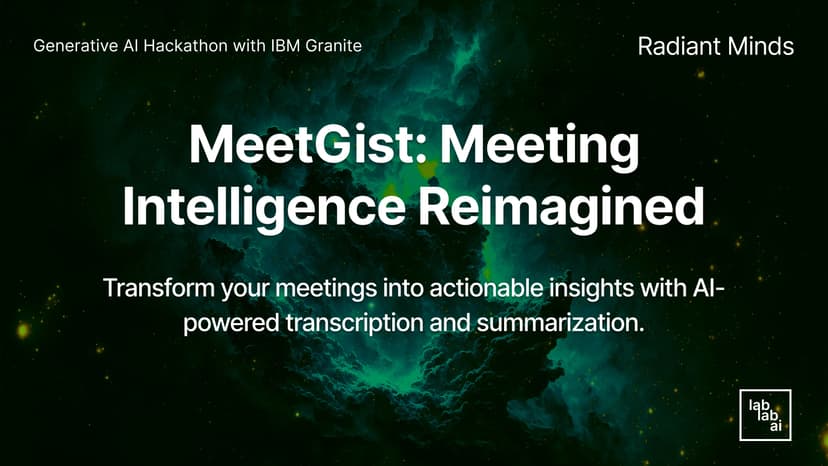
MeetGist AI-Powered Meeting Intelligence Platform
MeetGist is an innovative meeting intelligence platform that revolutionizes how teams capture, process, and share meeting information. The application combines cutting-edge AI technologies with intuitive user experience to solve common challenges in meeting documentation and knowledge sharing. Key Features: Versatile Input Processing: Support for audio recordings (WAV/MP3), text transcripts, and synthetic meeting generation AI-Powered Summarization: Automatic extraction of key points, decisions, and action items using IBM Watson AI Smart Team Collaboration: Slack integration for automated sharing and interactive command support Comprehensive Dashboard: Centralized access to all meeting transcripts and summaries Technical Stack: Frontend: Streamlit for responsive user interface Backend: FastAPI for efficient API endpoints AI Integration: AssemblyAI for transcription, IBM Watson for summarization Database: Supabase for secure data storage Integration: Custom Slack bot implementation User Benefits: Time Savings: Reduce manual documentation effort through automation Improved Accuracy: Consistent and comprehensive meeting documentation Enhanced Accessibility: Easy search and retrieval of meeting content Better Team Alignment: Automatic sharing keeps stakeholders informed Flexible Usage: Multiple input options for different workflows MeetGist addresses the challenge of effective meeting documentation and knowledge sharing, making it essential for modern teams focused on productivity. Its combination of AI capabilities, user-friendly design, and integration features creates a complete solution for meeting intelligence management.
23 Feb 2025

AI-Powered Cardiovascular Disease Diagnosis
CardioCare is an AI-powered cardiovascular disease diagnosis and treatment recommendation system. It analyzes key health metrics such as body temperature, blood pressure, and cholesterol levels, along with medical reports (PDFs), to detect potential heart conditions early. Using DeepSeek AI, it provides personalized treatment plans, including diet, exercise, medication, and prevention tips. The system is designed to be affordable, accessible, and scalable, making advanced healthcare available to underserved communities. With a user-friendly interface and cloud-based deployment, CardioCare empowers individuals to take control of their heart health while reducing the burden on healthcare systems through early intervention and AI-driven insights.
16 Feb 2025

AI Space Data Explorer Smart Insights from NASA
AI Space Data Explorer 🌌🚀 AI Space Data Explorer is an advanced AI-powered platform designed to make space data more accessible and understandable for students, researchers, and space enthusiasts. Organizations like NASA and ESA generate vast amounts of data, but navigating and interpreting this information remains a challenge for the general public. Our solution leverages cutting-edge AI models and frameworks to simplify data retrieval, analysis, and visualization, making space insights more interactive and user-friendly. 🔹 Key Features: ✅ Conversational AI – Users can ask space-related questions and receive real-time insights from NASA and ESA datasets. Llama models, integrated via LangGraph and Groq API, ensure intelligent, context-aware responses. ✅ Smart Visualization – The AI transforms complex space data into intuitive graphs, charts, and reports, making it easier to analyze patterns and trends. ✅ Personalized Space Learning – The platform adapts to user preferences, recommending space topics, celestial events, and scientific discoveries based on individual interests. ✅ Seamless Data Retrieval – Using LangChain and NASA APIs, the system fetches and processes real-time space data, ensuring accuracy and relevance. ✅ Interactive Dashboard – Built with Streamlit, the user-friendly interface allows smooth interaction with AI-driven insights and visualizations. 🔧 Tech Stack & AI Models: Llama (via LangGraph & Groq API) – Powers intelligent Q&A interactions. LangChain + NASA APIs – Retrieves and processes real-time space data. Streamlit – Provides a sleek, interactive dashboard for exploration. 🎯 Impact: AI Space Data Explorer democratizes space knowledge, breaking down barriers to access and interpretation. By integrating AI-driven insights with real-time data visualization, the platform fosters curiosity, supports research, and enhances space education for all. 🚀
9 Feb 2025

financial management
Project Description The Smart Financial Management Assistant is an AI-driven application designed to help users efficiently manage their personal finances. The system leverages machine learning algorithms and financial APIs to provide insights, budgeting assistance, and expense tracking. It also includes predictive analytics to forecast savings, expenses, and investments, empowering users to make informed financial decisions. Key Features Expense Tracking: Automatically categorize transactions using AI. Visualize spending patterns through charts and dashboards. Budget Management: Set financial goals and track progress in real time. Receive alerts for overspending or nearing budget limits. Investment Insights: AI-powered analysis of investment portfolios. Risk assessment and suggestions for portfolio improvement. Predictive Analytics: Forecast future expenses, savings, and income trends. Use AI to recommend strategies for achieving financial milestones. Smart Reminders and Notifications: Automatic bill reminders and payment tracking. Notifications for recurring subscriptions and unused services. Integration with Financial APIs: Securely connect to bank accounts and credit cards. Import real-time data for accurate financial analysis. AI-Powered Recommendations: Suggest cost-saving measures and investment opportunities. Provide financial literacy tips and guides.
26 Jan 2025

FeelBetter Buddy
We have developed a chatbot aimed at supporting individuals dealing with depression and mental health challenges in their daily lives. This innovative tool assists users in filtering messages, emails, and articles based on their emotional tone, enabling them to quickly determine whether the content warrants engagement without needing to read everything in detail. To enhance user comfort and trust, we incorporated color psychology in the chatbot’s design, choosing blue to symbolize trustworthiness. The chatbot also offers users the option to connect with a therapist if they desire further assistance. By analyzing the user's speech pace, the chatbot assesses emotional states—slower speech typically indicates sadness, while faster speech reflects happiness. This allows the chatbot to identify when a user may be experiencing depressive feelings. Additionally, the chatbot provides insights into the causes of these emotions and suggests possible solutions. Importantly, in cases where there is a risk of self-harm or serious mental health issues, it will always recommend speaking with a qualified professional. We believe that AI should not be solely relied upon for solutions to individuals struggling with depression, as this could breach ethical medical standards. Conversely, while there are no strict ethical guidelines limiting interactions with happy users, the chatbot acknowledges their positive emotions. It differentiates between happiness, anxiety, and anger by first checking speech pace and then analyzing specific words associated with these states. If a user is sad, the chatbot will use only one or two 'sad' emojis to build rapport, as excessive use can trigger negative emotions. In contrast, it enhances the experience for happy users by incorporating more 'happy' emojis to strengthen their connection.
20 Oct 2024


