

Muhammad Saad@muhammad_saad_786
3
Events attended
2
Submissions made
Pakistan
1 year of experience
About me
I’m a Software Engineering student with a strong interest in AI, machine learning, deep learning, and competitive programming. I enjoy building practical projects, learning new technologies, and solving real-world problems with AI. I have experience working with Python, computer vision, and machine learning tools, and I’m currently exploring LLMs and AI safety as well. I’m always open to collaborating with others, learning from new ideas, and working on challenging projects.
🤝 Top Collaborators


🤓 Latest Submissions

Bridge Forge
BridgeForge solves a common software development problem called API contract drift. This happens when a backend developer changes an API field, response, or endpoint, but the documentation and other dependent parts of the project still use the old contract. A small change can then cause confusion, broken client code, failed tests, and outdated API documentation. Our prototype shows this with a simple product API. The backend originally returns a field called title. We then rename it to productName. BridgeForge watches the backend route files for changes. When it detects the contract change, it automatically invokes IBM Bob Shell. Bob reads the current backend code as the source of truth and updates two dependent documentation files: docs/API.md and docs/openapi.json. The main users are software development teams, especially backend developers, frontend developers, API maintainers, and technical writers. They do not need to manually ask the AI to check every change. They work normally on the backend, and BridgeForge starts the synchronization process when a monitored API file changes. A React dashboard also shows the contract drift, the affected area, before-and-after differences, and the synchronization workflow. What makes BridgeForge different is that it uses AI proactively instead of waiting for a developer to open a chat and ask for help. The current prototype focuses on API documentation because it is a clear and reliable example of contract drift. The same architecture can later be extended to frontend bindings, tests, SDKs, and other downstream files. BridgeForge reduces repetitive manual work and helps development teams keep API documentation aligned with the actual backend implementation.
27 Sep 2026
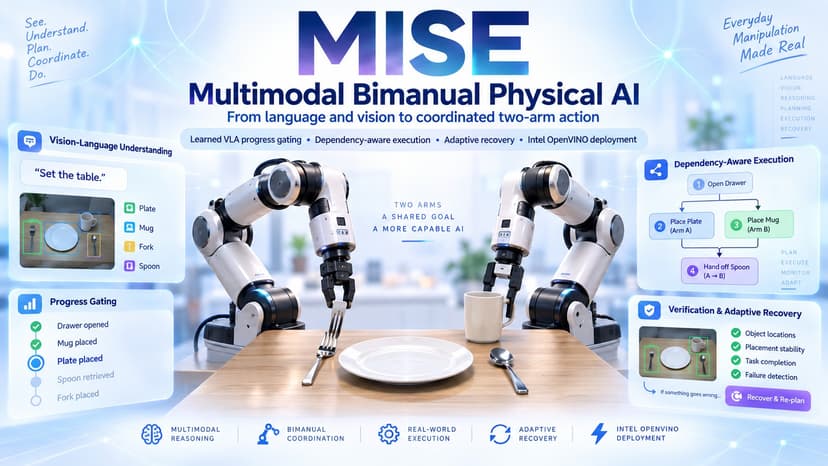
MISE: Multimodal Bimanual Physical AI
We built MISE to explore a simple question: how can a robot take a natural-language instruction, understand what is happening in the scene, coordinate two arms, and still recover when something does not go exactly as planned? MISE, or Multi-modal Instruction to Skill Execution, is a closed-loop Physical AI system for bimanual manipulation. In our demonstration, the robot receives the instruction “Set the table” and completes a multi-stage task that includes opening a drawer, placing a mug and plate, retrieving a spoon, physically handing the spoon from one arm to the other, and placing the remaining utensils. Instead of asking a learned model to directly control every robot joint, MISE separates reasoning from physical execution. A task-specific vision-language model uses the camera observation and language instruction to determine task progress and the appropriate skill. A validated dependency graph then constrains which action can legally happen next, while camera-guided motor skills perform the physical manipulation. The system continuously verifies task outcomes. If an action does not complete correctly, MISE can detect the failure and select an appropriate validated recovery strategy rather than simply continuing with a bad state. Across our final fixed-seed evaluation, the VLA-guided system completed 10 out of 10 runs, with recovery being activated in 8 of those 10 successful runs. We also exported the learned vision-language component to Intel OpenVINO and ran it on an Intel Core Ultra 7 155H system across the CPU, Intel Arc integrated GPU, and Intel AI Boost NPU. Our goal with MISE is not just to show two robot arms moving. We wanted to demonstrate the complete loop from human instruction and visual understanding to constrained execution, physical verification, recovery, and efficient edge AI deployment.
16 Sep 2026


