
🤓 Latest Submissions
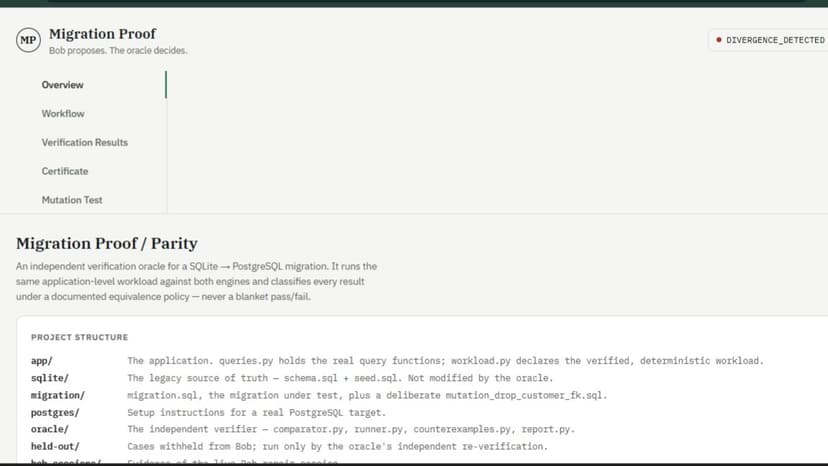
Migration Proof
### Problem Database migrations are a critical part of software engineering, but a migration can succeed technically while silently changing the behavior that an application depends on. Traditional migration checks often focus on whether a migration executes successfully, whether the resulting schema is valid, or whether basic tests pass. These checks may miss subtle behavioral regressions involving NULL semantics, data types, foreign-key behavior, ordering, numeric precision, constraints, and existing data. This creates a dangerous gap: a migration can appear safe while changing application behavior in production. ### Solution **Migration-Proof** is a verification framework designed to provide stronger evidence that a database migration preserves expected application behavior. Instead of treating a successful migration as proof of correctness, Migration-Proof verifies behavioral invariants against the migrated database. It combines an automated oracle, held-out behavioral tests, and mutation testing to evaluate whether a migration actually preserves the behavior expected from the database. The system can expose regressions that may not be visible from schema validation alone. For example, the benchmark database contains realistic edge cases involving NULL values, unique constraints, zero quantities, timestamp ordering, foreign-key relationships, type affinity, and customers without related orders. The workflow is: **Migration → Behavioral Verification → Regression Detection → Fix → Re-verification** A developer can therefore receive concrete evidence that a migration preserves the behavior encoded by the project's invariants rather than relying only on successful execution. ### Target Users Migration-Proof is intended primarily for software engineers, backend developers, database engineers, and teams maintaining applications with evolving relational databases. It is particularly useful for legacy systems where database behavior has accumulated over time and is difficult to capture through conventional tests alone. ### User Interaction A developer provides the database and migration under evaluation and runs the Migration-Proof verification workflow. The oracle executes behavioral checks, including held-out tests designed to validate important invariants. Mutation testing evaluates whether the verification suite is capable of detecting meaningful behavioral changes. The developer receives an actionable verification result and can rerun the process after correcting the migration. ### What Makes It Unique Migration-Proof shifts the question from: **“Did the migration run successfully?”** to: **“Did the migration preserve the behavior we actually depend on?”** Its combination of behavioral invariants, held-out testing, and mutation testing provides a practical verification layer between migration execution and deployment. Rather than relying solely on structural correctness, Migration-Proof treats database behavior as something that must be explicitly verified.
27 Sep 2026

