🤓 Latest Submissions
ProofFix — BUG COURT
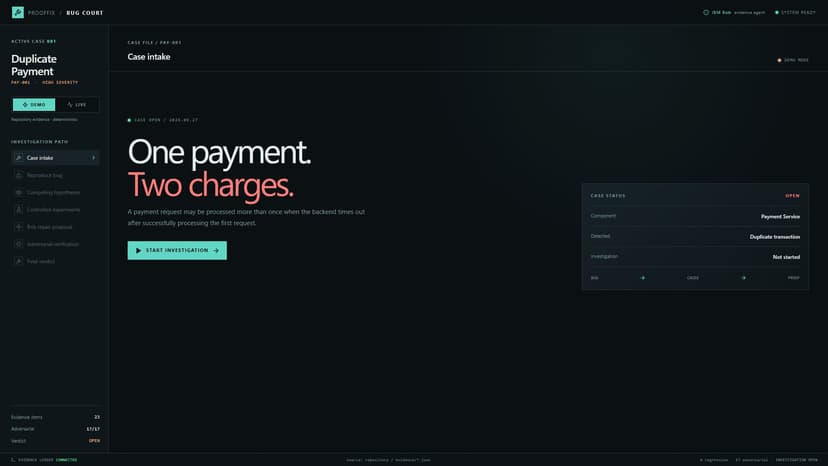
Software debugging is often treated as trial and error: developers observe a failure, guess the cause, change the code, and run a few tests. This can produce patches that appear to work while leaving the real bug unresolved or introducing new failures. ProofFix turns debugging into an evidence-driven process inspired by scientific experimentation and courtroom-style reasoning. It guides developers through a complete workflow: reproduce the bug, formulate competing hypotheses, design controlled experiments, collect evidence, apply a patch, and verify the repair against adversarial tests before reaching a final verdict. The system presents two competing hypotheses for the failure and uses controlled experiments to distinguish between them rather than assuming the first plausible explanation is correct. After identifying the supported cause, ProofFix shows the actual code change used to repair the problem. The repaired implementation is then evaluated against a deterministic adversarial test suite containing 17 tests, providing evidence about whether the patch generalizes beyond the original failing case. ProofFix is designed for software developers, AI-assisted coding workflows, students learning debugging, and engineering teams that need greater confidence in automated code repairs. The interface is designed as a focused debugging laboratory rather than a generic dashboard. A deterministic Demo Mode uses the project's evidence artifacts so the complete story can be reproduced consistently during a demonstration, while Live Mode connects to the FastAPI backend for real API interactions. What makes ProofFix different is its emphasis on proving a repair instead of merely producing one. The final result is an auditable chain from failure → hypothesis → experiment → evidence → patch → adversarial verification → verdict.
27 Sep 2026

