
🤓 Latest Submissions
DataSentinel
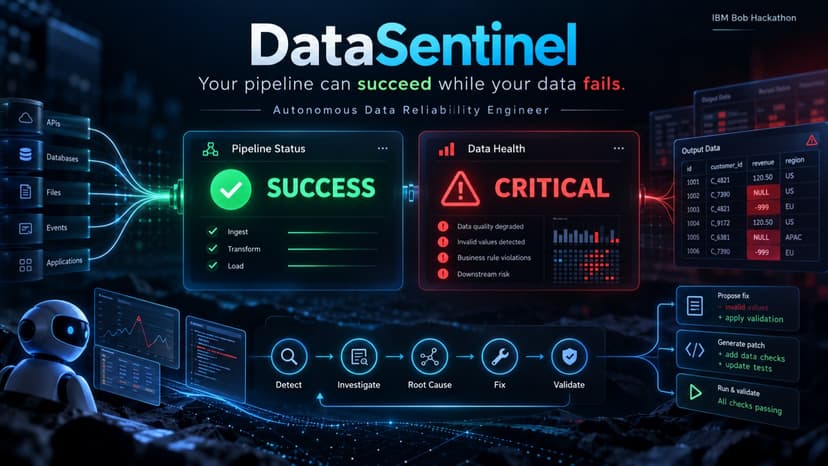
A green pipeline can still deliver wrong data. A small filter change can remove entire markets without raising an execution error. Engineers then have to connect tables, profiles, run history and code changes by hand. DataSentinel is an Autonomous Data Reliability Engineer that connects those signals in one workflow. Deterministic checks compare output against a healthy baseline. Investigation packages data and run evidence alongside real Git history, then heuristic RCA identifies a likely file, line and commit. Optional model explanations are grounded to that evidence; models never calculate anomaly metrics. In the live synthetic-data demo, a filter regression reduces 110,000 customer rows to 43,760 while the pipeline reports SUCCESS. Germany and Italy disappear. DataSentinel detects CRITICAL data health, identifies pipelines/customer_transform.py:46 and shows the actual offending Git diff. Remediation remains under operator control. A proposed reverse patch is previewed, explicitly approved, hash-checked and committed. DataSentinel reruns the pipeline, compares profiles and executes repository tests before marking RESOLVED. If a committed fix fails validation, the operator can roll back, preserve the failure evidence and retry. IBM Bob independently assessed the existing repository, found the missing committed-fix recovery path, implemented rollback, strengthened RCA trust boundaries and expanded tests. Its independent critic reported no HIGH/CRITICAL blockers and a release-ready assessment. Claude Code built the initial MVP; Codex handled QA, hardening, deployment preparation and release work. The MVP demonstrates a workflow for data and platform teams investigating silent failures. Planned integrations connect the same approach to production orchestrators and data platforms. Live demo: https://datasentinel-seven.vercel.app Problem Execution success cannot establish data correctness. Narrowed filters, schema drift, null explosions, duplicate batches and distribution shifts may satisfy an orchestrator while breaking analytics or downstream models. Investigation requires correlating evidence across systems. Solution Compare output with a known healthy baseline, investigate data/run/code evidence, propose an approved repair, and validate recovery. Keep failed fixes open and provide an explicit rollback path. How It Works DETECT → INVESTIGATE → ROOT CAUSE → PROPOSE → APPROVE/APPLY → VALIDATE → REPORT Profile the data and calculate anomalies deterministically. Combine profiles, run history and real monitored Git changes into an evidence package. Identify a likely root cause, separating observed facts from inference. Preview the patch and wait for human approval; constrain paths and verify hashes before committing. Rerun, re-profile and test. Resolve only on success; allow operator rollback and retry on failed committed remediation.
27 Sep 2026

