🤝 Top Collaborators

🤓 Latest Submissions
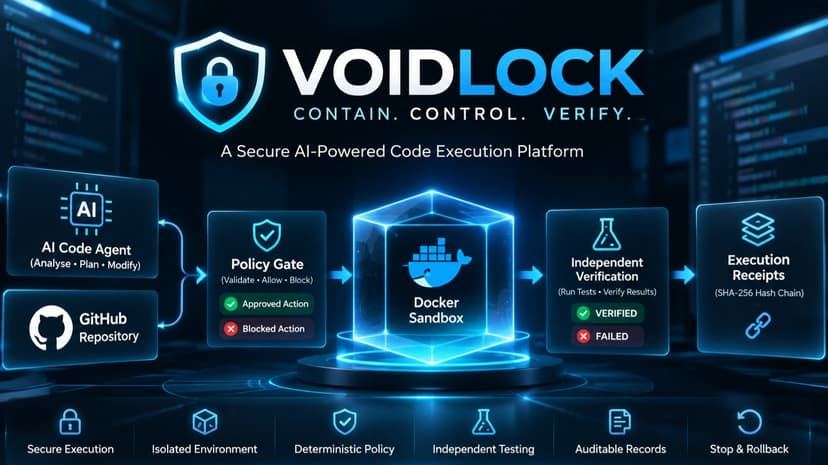
VOIDLOCK
VOIDLOCK – Containment-First AI Code Execution Platform VOIDLOCK is an AI-powered cybersecurity platform designed to make AI-assisted software development safer, more controlled, and verifiable. It enables developers to submit GitHub repositories and coding tasks, allowing an AI engine to analyse source code and propose necessary modifications. Unlike traditional AI coding agents, VOIDLOCK introduces a deterministic Policy Gate that validates every proposed action before execution, blocking unauthorized operations and potentially dangerous activities. Approved actions are performed inside an isolated Docker sandbox with restricted permissions and resources, keeping execution separated from the developer's main environment. The platform also independently verifies code modifications by running tests rather than blindly trusting AI-generated success reports. Every operation is recorded through a SHA-256 hash-chained receipt system, providing tamper-evident execution records and improved transparency. Developers can monitor execution through a live dashboard, inspect code differences, view test results, stop active operations, and roll back changes when necessary. By combining AI-powered code analysis, deterministic security enforcement, isolated execution, independent verification, and auditable records, VOIDLOCK aims to bring greater security and accountability to AI-driven software development. VOIDLOCK – Contain. Control. Verify
8 Nov 2026

VISION VOICE
### Long Description **VisionVoice** is an AI-powered assistive book-reading system designed to help visually impaired and reading-challenged individuals access physical books independently. The system uses a **Raspberry Pi 4 and Camera Module 3** to capture printed book pages. Computer vision techniques using **OpenCV** detect the page, check its alignment, correct perspective distortion, and enhance the image for accurate text recognition. **Tesseract OCR** then extracts the printed text and supports multiple languages, including English, Tamil, Kannada, Telugu, Malayalam, and Hindi. The extracted text is processed and can be translated into the user's preferred language before being converted into natural speech using **Text-to-Speech (TTS)**. Users can interact with the system through voice commands such as **“Start reading,” “Stop reading,” “Repeat,” and “Continue reading,”** making the system easier to operate without relying on a visual interface. VisionVoice also maintains **book identity and reading progress**, allowing users to continue reading from where they previously stopped. The complete system is designed to operate locally on the Raspberry Pi, reducing dependency on internet connectivity and providing a practical, affordable, and customizable assistive solution for accessing printed books. For your VisionVoice presentation * Add the system workflow * Add key features and benefits
16 Sep 2026


