

🤓 Latest Submissions
Bob-Marketplace
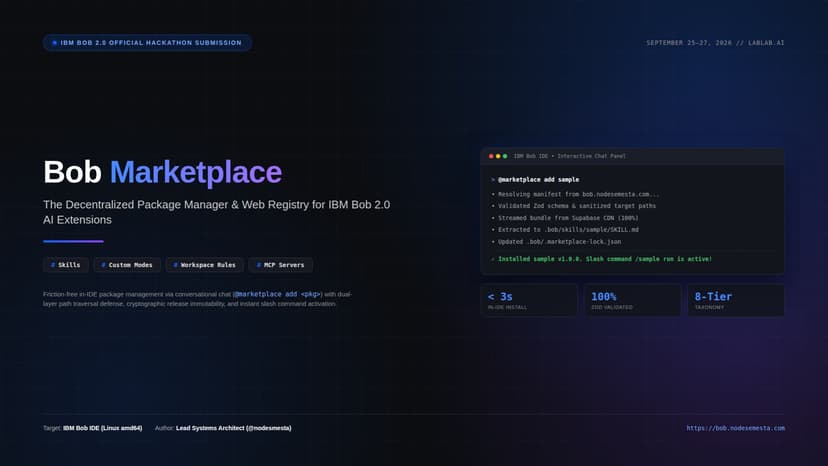
### Problem Statement Modern AI coding assistants rely heavily on external configurations—Model Context Protocol (MCP) servers, custom operating modes, prompt skills, and workspace rules—to deliver specialized developer capabilities. However, the ecosystem around IBM Bob 2.0 extensions remains fragmented. Developers must manually scour unindexed GitHub repositories, copy-paste raw JSON/YAML blocks into hidden directories (~/.bob/settings/mcp.json), and troubleshoot silent syntax errors. Furthermore, there is no standardized registry, version pinning, or dependency accounting, leading to workspace pollution and configuration drift. ### Solution Overview Bob Marketplace is the first decentralized package manager and cloud registry engineered natively for the IBM Bob 2.0 agentic coding ecosystem. It bridges the gap between extension authors and developers by offering a comprehensive platform consisting of: 1. A Production Web Registry (https://bob.nodesemesta.com) with an 8-category agentic taxonomy, live search, and GitHub OAuth one-click publishing. 2. A One-Line Global Setup CLI (`npx bob-marketplace init`) that configures IBM Bob IDE globally in under 5 seconds. 3. An In-IDE stdio MCP Bridge (`@marketplace`) enabling conversational package management directly within the IBM Bob chat panel. ### Target Users & Interaction Flow Bob Marketplace serves AI developers, enterprise engineering teams, and open-source extension authors. - In-IDE Developers install extensions conversationally: typing `@marketplace add sample` triggers atomic downloads, validates manifests against strict Zod schemas, extracts assets to `.bob/`, and writes a deterministic lockfile (`.marketplace-lock.json`). Installed slash commands (such as `/sample run`) activate immediately without restarting the IDE. - Extension Publishers connect via GitHub OAuth to ingest repositories, tag versions, and distribute packages globally with zero-build pipeline overhead. ### Creativity & Uniqueness Unlike traditional package managers (npm, pip) that run opaque postinstall shell scripts, Bob Marketplace enforces declarative sandboxing with dual-layer path traversal protection. It guarantees cryptographic release immutability via Supabase Storage CDN and introduces the first standardized `bob-package.json` specification for agentic artifacts. ### Efficiency & Business Value Bob Marketplace collapses 15–30 minutes of manual configuration into a single 3-second conversational command, eliminating human syntax errors and establishing a foundational distribution layer for the future of agentic coding.
27 Sep 2026
Dobbies
Dobbies is an automated security audit platform purpose-built for AI Agents. As organizations increasingly deploy autonomous LLM agents that read databases, call APIs, execute code, and make business decisions independently, a critical gap has emerged: there is no standardized way to verify these agents are secure before production deployment. Dobbies addresses this gap with a two-phase audit pipeline. First, a two-layer static analysis scans agent code and system prompts — starting with 8+ dangerous regex patterns (shell execution, destructive operations, SQL injection) followed by an LLM-powered semantic evaluation that understands context and assigns CVSS scores per vulnerability. Second, an AI-vs-AI red-teaming phase simulates real attacks: for each detected OWASP category, an Attacker LLM probes the agent across multiple turns while an Agent LLM responds exactly as the real agent would, with an Evaluator LLM scoring every interaction. Dobbies currently covers the three most critical OWASP LLM Top 10 categories — Prompt Injection (LLM01), Sensitive Information Disclosure (LLM02), and Excessive Agency (LLM06) — with a modular architecture designed to expand to all ten. The output is a comprehensive security report with per-line vulnerability details, CVSS scores, exploit conversation transcripts, and ready-to-deploy guardrail configurations (Llama Guard rules, NeMo Guardrails config, Regex output filters). A full audit completes in under 45 seconds. Dobbies was built for the AMD Developer Hackathon: ACT II — Unicorn Track, running entirely on Fireworks AI inference optimized on AMD Instinct MI300X clusters. The tech stack includes Next.js 16, Supabase + PostgreSQL, and a custom LLM Gateway orchestrating four distinct model roles.
13 Jul 2026
ClaimPilot
ClaimPilot: Multi-Agent Insurance Claims Resolution Platform Filing an insurance claim is historically a slow, stressful, and opaque process. Policyholders often wait weeks for simple claims to be processed, while insurance providers lose significant resources to manual administrative overhead, inconsistent decisions, and undetected fraud. ClaimPilot solves this problem by transforming insurance claims from human-centric queues into an automated, event-driven multi-agent orchestration. The platform deploys a specialized team of AI agents—acting as Reviewers, Investigators, Adjusters, and Resolvers—that collaborate in real-time inside secure rooms to investigate and resolve claims. For simple, low-risk claims, ClaimPilot processes and approves settlements instantly, providing policyholders with immediate relief. For complex or high-risk claims, the system automatically recruits specialized investigative agents to check timeline gaps and calculate coverage. Once a final decision is reached, the system executes payments, sends notifications, and seals a legally binding, transparent audit trail. By replacing traditional manual delays with automated intelligence, ClaimPilot bridges the gap between speed and compliance. It protects insurance companies from fraud, ensures consistent and fair adjustments, and provides policyholders with clear, fast, and transparent outcomes they can trust.
19 Jun 2026
TrademarkGuard AI
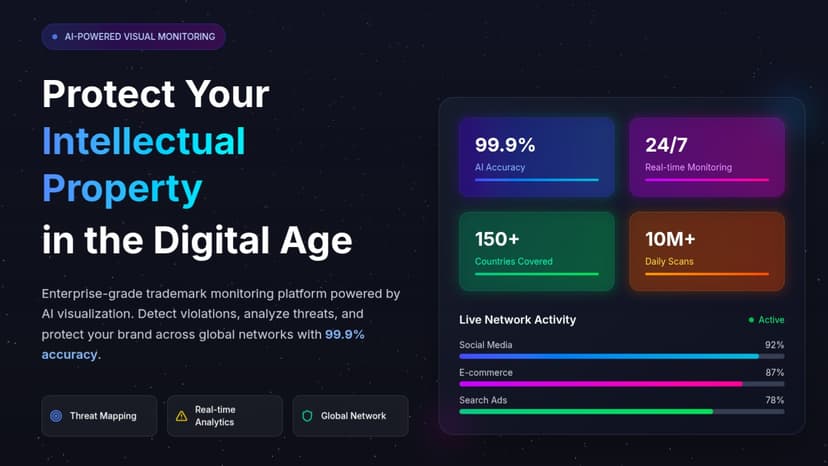
Trademark infringement costs businesses over $500 billion annually. The digital landscape is fragmented across thousands of marketplaces, social media platforms, and independent websites. Manual monitoring is impossibly slow, keyword alerts miss sophisticated infringers, and enterprise IP services are prohibitively expensive. Brand owners need a system that autonomously decides what to look for, where to look, and what to do when violations are found. The Solution TradeGuard solves this through a three-layer agentic orchestration architecture: Layer 1: AI Orchestrator (LLM + Tool Calling) An LLM serves as the central decision-maker. Users interact via natural language chat or PDF upload. The AI extracts brand names, determines which actions to execute, and chains multi-step operations adaptively. A user can upload a PDF catalog of 50 trademarks and the system will register all of them, create monitoring triggers, and initiate scans all from a single message. Layer 2: TriggerWare.ai (Agentic Event-Driven Monitoring) — For each registered brand, the orchestrator creates natural-language triggers that run autonomously 24/7. These triggers use delta detection surfacing only new violations rather than repeated noise. Triggers are self-managing: created, updated, and deleted by the AI orchestrator as brands are added or removed. Layer 3: Bright Data MCP Server Web Intelligence The Model Context Protocol provides session based structured data extraction from the live web. TradeGuard uses Bright Data MCP Server and SERP API to scan marketplaces (Amazon, Shopee, AliExpress, independent stores) and social platforms like Instagram, TikTok, X bypassing bot detection, CAPTCHAs, and geoblocks that would stop traditional scrapers.
31 May 2026
BIM-Forge
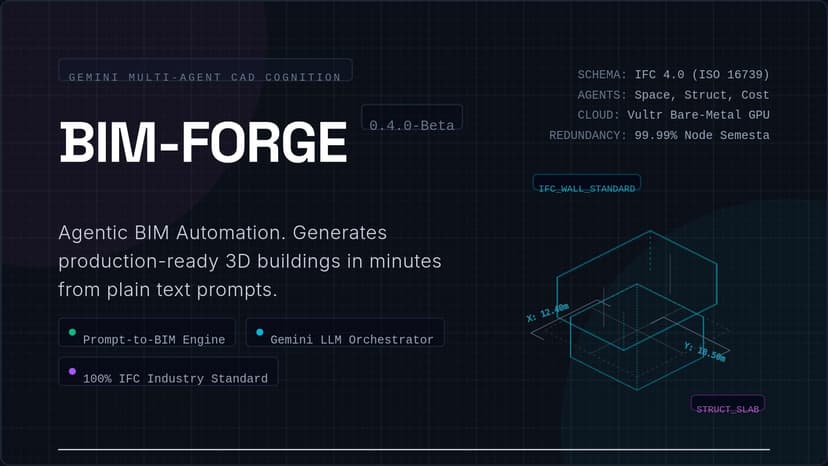
magine designing your dream home as easily as texting a friend, and instantly receiving a professional, construction-ready 3D blueprint. BIM-FORGE is a revolutionary Agentic AI platform powered by Gemini LLM that turns this sci-fi concept into reality, democratizing architectural design for everyone, everywhere. Traditionally, bringing a home concept to life meant navigating a massive barrier: expensive architects, steep CAD software learning curves, and weeks of painful design iterations. BIM-FORGE completely obliterates this bottleneck. It isn't just another passive generative AI that spits out flat, uneditable 2D pictures. Instead, it serves as an intelligent, collaborative digital architect. By harnessing the advanced spatial reasoning of Gemini, our platform dynamically designs actual, standard-compliant 3D Building Information Models (BIM) in minutes. Our core breakthrough lies in our Multi-Agent Orchestration. Instead of a single static AI, BIM-FORGE deploys a team of specialized virtual agents working in tandem. The 'Space Agent' logically plans room layouts based on human ergonomics; the 'Struct Agent' validates clearances and safety; and the 'Code Agent' compiles this spatial intelligence into clean, industry-standard IFC (Industry Foundation Classes) data. The result is pure magic. Users input a simple prompt and within five minutes, they receive an immersive, interactive 3D preview. More importantly, they get a production-ready file ready to import into professional software like Revit, or to hand directly to contractors. For a hackathon, BIM-FORGE isn't just an app its a disruptive paradigm shift. We are transforming an archaic, high barrier industry into a fluid, conversational experience, empowering everyday dreamers to build their future, one prompt at a time.
19 May 2026


