
🤝 Top Collaborators

🤓 Latest Submissions
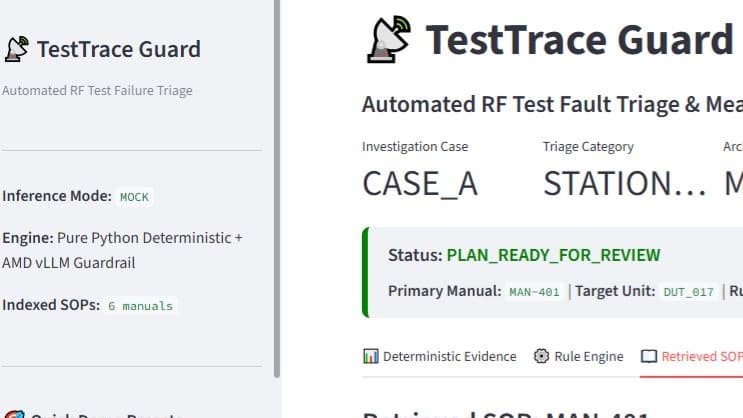
TestTrace Guard: Automated RF Test Fault Triage
In high-volume semiconductor automated test environments (ATE), intermittent RF test failures present a costly operational dilemma: Is the Device Under Test (DUT) defective, or has the measurement system drifted? Traditional triage relies on subjective troubleshooting, causing false rejections (scrapping high-value units) or false passes (shipping defective silicon). TestTrace Guard solves this with an automated, multi-tiered triage pipeline that processes raw RF parametric measurements, station logs, and golden reference standards in under 35 milliseconds to deliver hallucination-free Standard Operating Procedure (SOP) action plans. The architecture operates on a deterministic-first, LLM-augmented principle across five modular stages: 1. Deterministic Analytics Engine: Calculates Welch's t-test statistics, S21 golden standard deviations, and fixture contact repeatability without external network or ML dependencies (<1 ms). 2. Heuristic Expert Rule Engine: Classifies fault signatures into core families (Station Config, DUT Defect, Fixture Contact, Calibration Drift, Limit Revision Mismatch, and Ambiguous Data Gaps) and promotes target SOP anchors (<10 ms). 3. Hybrid BM25 Retrieval: Indexes curated engineering manuals (MAN-401 through MAN-901) to extract exact corrective action protocols. 4. LLM Reasoner & Guardrail Validator: Synthesizes diagnostic root causes via AMD ROCm/vLLM (with offline deterministic mock fallback), enforcing 100% fact grounding and overriding model drift when rule confidence is high. 5. Dual-Layer Audit & MES Dispatch: Persists full JSON telemetry traces with high-speed SQLite indexing, exposed via FastAPI and integrated with Evolus MES for automated work order dispatch. Evaluated across 43 synthetic RF investigation packages, TestTrace Guard achieved 95.3% accuracy across category, domain, status, and SOP retrieval, with 97.2% action keyword recall at an average latency of 30.5 ms.
18 Oct 2026

