
Oki Kurnia Wicaksono@okywoww718
2
Events attended
2
Submissions made
Indonesia
1 year of experience
About me
Software developer with a strong focus on systems engineering, mobile solutions, and applied AI. Experienced in building robust backend services, kernel/network modules, and resilient client applications using Kotlin, C++, Rust, and Python. Passionate about participating in hackathons, exploring generative AI workflows, and architecting fault-tolerant software. Always eager to collaborate and turn innovative ideas into reliable products.
🤓 Latest Submissions
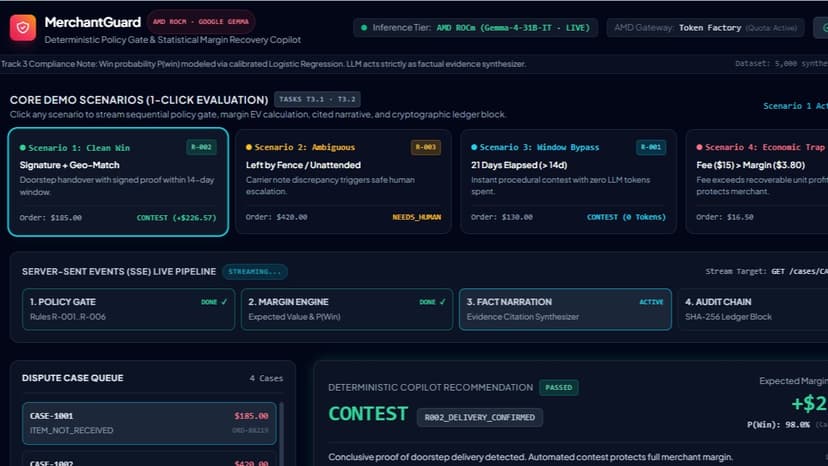
MerchantGuard
MerchantGuard is an Autonomous Dispute and Margin Recovery Copilot built for Track 3: Reinvent Commerce. It addresses the multi-billion-dollar problem of e-commerce chargebacks and friendly fraud, where raw LLMs fail due to hallucinated claims, prompt injection, and ignorance of unit dispute economics. Our architecture enforces strict Rule-First Governance ("Zero LLM Decisions"): 1. Deterministic Policy Gate (Rules R-001 to R-006): Hard-coded business logic verifies return windows, objective delivery proof (GPS geo-match & signature), and case completeness. Procedural disputes (e.g., late filing) are resolved deterministically with 0 LLM tokens spent. 2. Calibrated Margin Engine: A Logistic Regression model predicts Win Probability P(Win) and evaluates Expected Value: EV = P(Win)*(Order+Margin) - (1-P(Win))*Dispute_Fee. This prevents Economic Fee Traps where dispute fees exceed recoverable margin. 3. Isolated Evidence Synthesis: Google DeepMind's open-weights Gemma-4-31B-IT (self-dploy/Gemma-4-31B-IT) running on AMD Cloud Infrastructure via the AMD Radeon Cloud Token Factory synthesizes arbitration rebuttal briefs strictly grounded in verified evidence IDs ([F1], [F2]). 4. Cryptographic SHA-256 Ledger: Every decision is chained into a tamper-evident audit ledger verifiable live from the UI. 4 Core Scenarios: - Clean Win (CASE-1001): GPS + signature verified -> positive EV (+$226.57) -> CONTEST with cited brief. - Ambiguous (CASE-1002): Unattended delivery -> safe human escalation (NEEDS_HUMAN). - Window Bypass (CASE-1003): Filed after 21 days (>14d window) -> instant 0-token contest. - Economic Trap (CASE-1004): $15 fee on $3.80 margin -> auto-recommends ACCEPT_REFUND. Empirical Proof & Security: Passes 32/32 unit tests, zero leaked credentials, live telemetry with 3.1s-15.6s latency on AMD Token Factory, and runs in a hardened non-root container deployed live on Railway.
18 Oct 2026
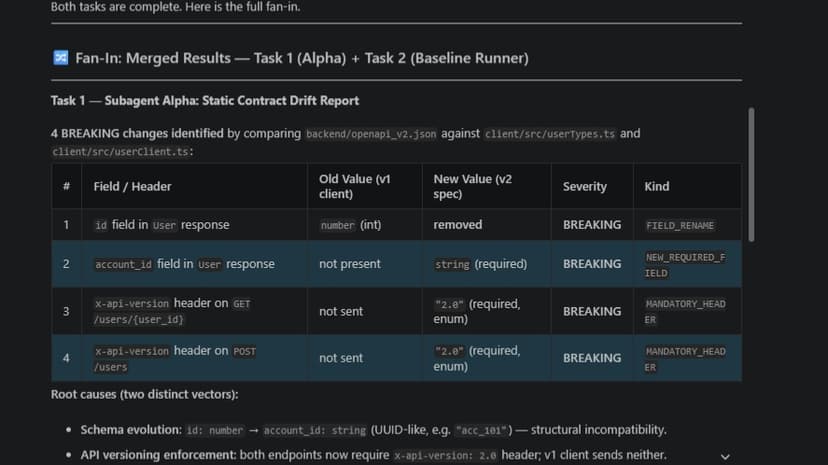
AegisContractGuard: Autonomous API Drift Guard
Problem: In modern enterprise architectures, microservice APIs evolve continuously. Upstream breaking changes, such as altered response structures, removed fields, or new mandatory headers frequently break downstream clients silently in production. Resolving contract drift manually demands tedious triage across frontend and integration teams, slowing deployment cycles and risking production outages. Solution: AegisContractGuard is an autonomous integration agent orchestrated with IBM Bob that establishes a reliable, closed-loop API contract drift detection and self-healing lifecycle. When an upstream schema drifts, the agent automatically detects breaking modifications, establishes baseline truth, creates verifiable integration tests, and synthesizes an isolated client-side patch to restore full contract compatibility without human intervention. Target Users & Workflow: AegisContractGuard is designed for enterprise platform engineers, backend/API teams, and frontend integration developers. Rather than wrestling with manual troubleshooting, developers trigger AegisContractGuard in their CI/CD pipeline or orchestration workspace. The agent orchestrates three specialized subagents: 1. Subagent Alpha (Static Contract Diff): Analyzes OpenAPI specifications against existing client schemas alongside an independent runtime baseline runner. 2. Subagent Beta (Failure Formalization): Codifies the identified breakages into executable failing integration tests (failing.test.ts). 3. Subagent Gamma (Self-Healing Synthesis): Synthesizes precise client-side updates (updating TypeScript types, headers, and request models) until all regression tests pass. What Makes It Unique & Creative: - Strict Architectural Guardrails: AegisContractGuard strictly treats backend source code as read-only. Fixes are confined entirely to client boundaries, preventing unintended backend side-effects. - Evaluation Integrity: Unlike naive AI code generators that modify test assertions to force a false "pass", AegisContractGuard preserves baseline tests (client.test.ts) as immutable, failing before-evidence. It produces separate verification suites to maintain absolute audit transparency. - Full Audit Artifacts: Every decision, diff, and schema inspection is captured in structured Markdown session summaries for human-in-the-loop review. Efficiency & Results: AegisContractGuard demonstrates extreme determinism and cost efficiency. Operating inside IBM Bob, the entire closed-loop diagnostic, test creation, and self-healing patch workflow completed in a single iteration consuming only 2.73 Bobcoins with zero retries. AegisContractGuard transforms fragile enterprise API integrations into self-recovering, robust systems.
27 Sep 2026


