
🤓 Latest Submissions
FlowCast
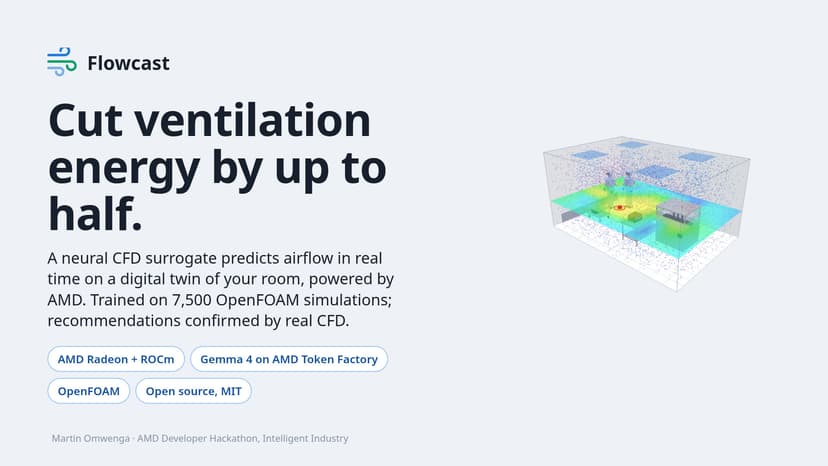
Cleanrooms, labs and fan-cooled control cabinets run their fans at a fixed, worst-case setting all day. Fan power rises with the cube of airflow, so 20% less air saves about half the fan's power. The fans stay up because predicting what a lower setting does to the room takes a specialist and a CFD study, done once at design time and never again. Flowcast is a neural CFD surrogate: we simulated each room design thousands of times in OpenFOAM (7,500 rooms in all) and trained 3D neural networks on the airflow and on each source's particles or heat. Anyone can then drag equipment and people around a 3D digital twin of the room and see the airflow, the worst point and the verdict against EU GMP or ISO limits in about a tenth of a second on an AMD Radeon GPU. Flowcast finds the lowest safe fan setting and the best place for a machine, then confirms the answer with a real simulation, stepping the fan up until one passes. Gemma 4 on AMD's Token Factory takes requests in plain words, such as "set this up as a filling suite and find the lowest safe setting", and turns a production plan into a fan schedule; every number comes from Flowcast's own tools. Two demos: a cleanroom in three ventilation designs, and a control cabinet where heat replaces particles. On rooms it never saw, the model agrees with the simulation's verdict in 92 to 98% of cases. The simulation set-up matches the published IEA Annex 20 experiment to within 4.3%. Open source, MIT.
18 Oct 2026
