
🤓 Latest Submissions
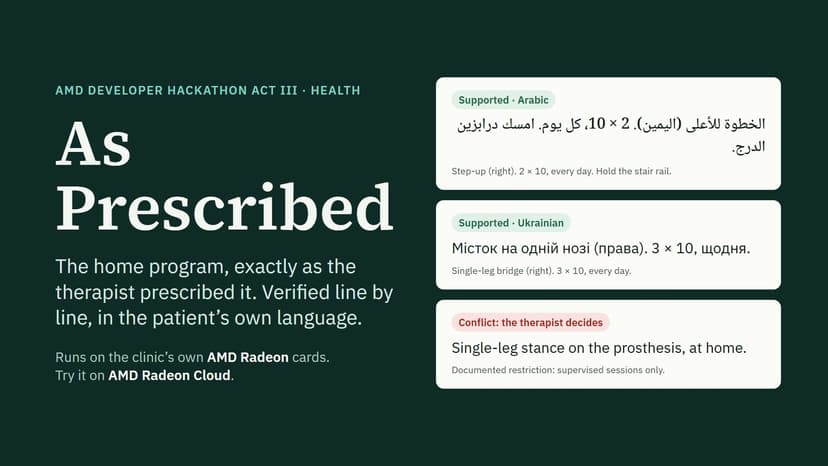
As Prescribed: home programs verified line by line
The problem: a patient who does not speak the clinic's language leaves a physiotherapy visit with a home program they cannot read, or with a translation nobody in the room can check. A wrong side, a wrong dose or a dropped caution can hurt them, and a free-writing AI adds exercises nobody prescribed. What it does: As Prescribed reads the visit transcript as it arrives, extracts what the therapist prescribed and drafts the program in the patient's language (Arabic and Ukrainian in the demo). Every line is supported (linked to where it was said), a conflict (a documented restriction blocks it and the program halts), a proposal (only the therapist can complete it) or an uncertain translation. Nothing reaches the patient until the therapist approves it. It verifies the prescription; it never diagnoses or advises. How: safety does not rest on a model. Documented restrictions are deterministic rules, a fired restriction stays a conflict, and a line the rules cannot check is never supported. A generator drafts and translates; a falsifier from another model family checks every line against the transcript and back-translates it. On AMD: real patient data cannot leave the clinic, so the product runs on the clinic's own AMD Radeon GPUs: Qwen3.5-35B-A3B on a Radeon AI PRO R9700 drafts, Gemma 3 12B on a Radeon RX 7900 XT checks, on llama.cpp with ROCm. A program is ready about 40 s after the visit, and our whole evaluation used 304 Wh. Judges can try the same pipeline live on AMD Radeon Cloud (Token Factory); each cloud run is compared with the same case on the clinic hardware. Measured, and reported as it fell: a sealed evaluation of 32 injected errors and 9 clean runs. The rules caught every documented restriction; the falsifier caught 28% of the model-only errors in the pre-registered run and 50% after fixes; false alarms fell from 16% to 7%. The recall gate failed, and we say so. All data is synthetic.
18 Oct 2026
