
🤝 Top Collaborators




🤓 Latest Submissions
Quantum AI Development
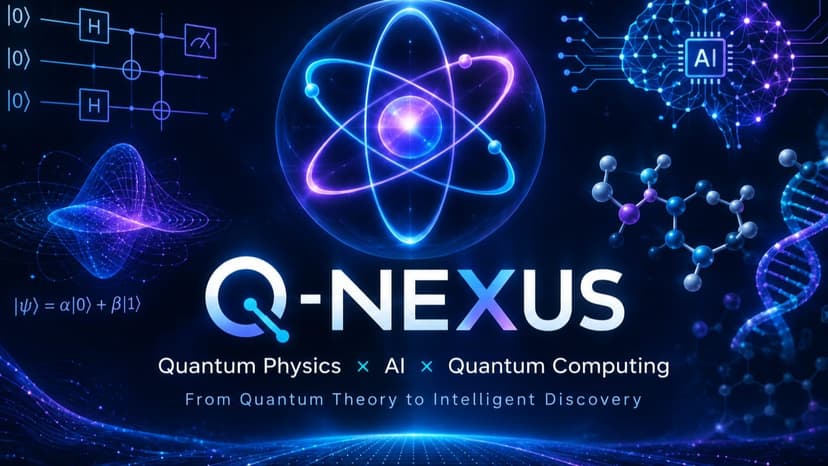
Q-NEXUS is an AI-powered quantum development and research platform designed to reduce the time and effort required to develop, debug, optimize, and understand quantum software. Quantum software is difficult to develop because quantum circuits are sensitive to noise, gate operations, circuit depth, and implementation choices. Developers and researchers often need to manually inspect circuits, identify inefficient operations, test multiple approaches, and interpret experimental results. This creates a workflow involving repeated debugging, optimization, testing, and documentation. Q-NEXUS addresses this problem by combining an AI-assisted software-development workflow with quantum computing and machine learning. A user can provide a quantum project or circuit, after which Q-NEXUS analyzes the repository and identifies relevant quantum components. Specialized AI agents assist with code understanding, quantum circuit analysis, error identification, optimization, testing, and review. The quantum layer uses Qiskit to simulate quantum circuits and experiments. Machine-learning models are used for tasks such as predicting circuit error from circuit characteristics and analyzing molecular properties. For the molecular research component, Q-NEXUS uses molecular representations and ML-based property prediction to demonstrate how the platform can support early-stage computational research. These predictions are presented as research outputs rather than claims of clinical drug discovery. The platform provides a visual dashboard where users can compare original and optimized circuits, inspect circuit depth and gate counts, view predicted error levels, explore quantum experiments, and examine molecular predictions. The system also generates an understandable summary of the analysis and recommended actions. The primary target users are quantum developers, students, researchers, and teams working with quantum software who need a faster way to understand and improve their projects. What makes Q-NEXUS different is its workflow-oriented approach. Instead of functioning only as a quantum circuit simulator or an AI chatbot, it connects repository understanding, quantum analysis, machine learning, optimization, testing, review, and reporting into one development workflow. IBM Bob forms the development-intelligence layer that helps coordinate and accelerate these software-development tasks. The prototype demonstrates how AI-assisted development can make quantum software workflows more accessible, systematic, and efficient while providing a foundation for future quantum research applications.
27 Sep 2026
